



The Exhibition Services & Contractors Association (ESCA) Summer Educational Conference closed Wednesday, July 1, at Fairmont Banff Springs in Banff, Canada, with sessions focused on brand loyalty, labor uncertainty, industry collaboration, Washington policy, artificial intelligence (AI), workforce development, and leadership.
Gabor opens with brand loyalty strategy
Deb Gabor, co-founder of Sol Marketing, opened Wednesday’s education program with “Winning the ‘Unreasonable’ Bid: How Exhibition Brands Create Irrational Loyalty and Stop Competing on Price,” a session on brand loyalty, pricing pressure, and how exhibition companies can stand out before the request for proposals (RFP) process reaches the bid stage.
Gabor focused on irrational loyalty, which she described as the point at which customers feel strongly connected to a brand and would feel uneasy choosing a competitor. For exhibit and event companies, she said that loyalty matters because many buyers compare similar services, capabilities, and pricing during the RFP process.
Her message centered on emotional differentiation. Gabor said strong execution has become the baseline, not the differentiator. Instead, she pushed attendees to define what makes their company meaningful to its best customers and how that value helps those customers succeed.
Gabor also challenged attendees to think about brand as more than a logo, tagline, or marketing statement. She described a brand promise as a strategic tool that should guide hiring, operations, customer service, sales, and client relationships.
The session asked attendees to identify their ideal customer, understand what choosing their company says about that customer, and define the one thing customers get from them that they cannot get elsewhere. She also urged companies to make the customer the hero of the story.
For ESCA attendees, the session tied branding directly to business development. In a market where competitors may offer similar services, Gabor said loyalty, trust, emotional connection, and a clear customer-centered story can help companies move beyond price-driven decisions.

Goldstein examines labor relations uncertainty
Hope Goldstein, shareholder at Vedder, followed with “Labor Relations in an Era of Federal Uncertainty,” a session on the shifting federal landscape affecting employers, unions, and labor-management processes.
Goldstein, a management-side labor lawyer, focused on changes tied to federal agencies, pending legislation, National Labor Relations Board (NLRB) operations, and legal challenges that could affect how labor disputes move forward.
She said one major change involves the Federal Mediation and Conciliation Service (FMCS), which has faced staffing cuts and reduced services. Goldstein said the agency has historically helped collect bargaining notices, provide arbitration lists, and support mediation between employers and unions. However, she said its mediation and conciliation services have been sharply limited, leaving parties with fewer federal resources when bargaining or labor disputes stall.
Goldstein also discussed proposed and pending labor law changes that could affect first-contract negotiations. She said one proposal would set tight timelines for bargaining after a union is certified and could bring in a mediator or arbitrator if the parties do not reach an agreement within the required period.
The session also covered the NLRB’s recent operational challenges. Goldstein said board vacancies, leadership changes, reduced staffing, and a large case backlog have affected the agency’s ability to issue decisions and move cases forward. She said the board and its general counsel have taken steps to reduce pending cases, including changes to intake procedures, settlement practices, and requests for injunctive relief.
For ESCA members, the practical takeaway centered on uncertainty. Goldstein said employers, unions, contractors, and service providers may face a more complicated labor environment as federal rules, board precedent, joint-employer standards, and state-level labor proposals continue to shift.
She also noted that legal challenges to the NLRB’s structure could have broader consequences if courts limit the agency’s authority. While those issues remain unresolved, Goldstein urged attendees to keep watching developments because changes could affect collective bargaining, unfair labor practice cases, and labor relations across the events and exhibitions industry.

Industry roundtable brings hallway conversations to the stage
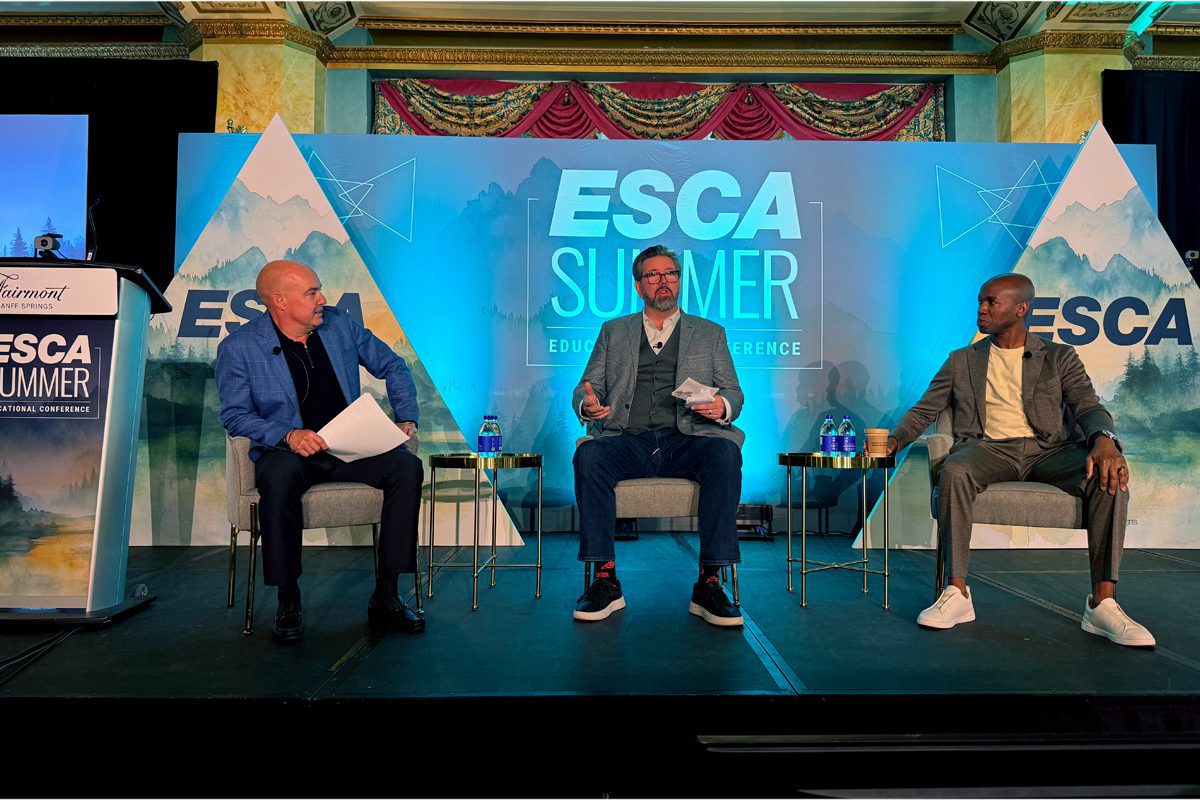
Randy Pekowski, president and chief executive officer of The Expo Group; Larry Grossenbacher, president of CSI Worldwide; and Glenn Charles Jr., president and chief executive officer of Show Strategy, Inc., led “At the Table: The Conversation Shaping Our Industry’s Future,” a room wide discussion on the pressures shaping exhibitions and events.
Rather than a traditional panel, the session brought attendee questions and hallway conversations into the room. Topics included costs, customer expectations, labor, AI, workforce development, outdoor event spaces, and collaboration across the industry.
The discussion returned often to cost and value. Participants noted that exhibitors are concerned not only about pricing, but also about unpredictability, surprise charges, unclear information, and tight planning timelines. Several attendees said the industry needs to focus more on outcomes, value, and clearer communication instead of allowing the conversation to center only on line-item costs.
The group also discussed how general service contractors and labor partners are often viewed by exhibitors as the source of rising costs, even when pricing pressure comes from several parts of the event model. Speakers and attendees said the industry needs to tell its story more clearly and work together on shared problems instead of allowing each segment to defend itself separately.
Workforce development also drew attention. Participants said the post-COVID labor environment continues to affect supervision, training, and the next generation of skilled workers. The conversation touched on apprenticeships, vocational schools, training centers, and the need to make tradeshow work more visible to younger workers.
AI came up as both an opportunity and a caution point. Attendees discussed how AI could help with operations, demand planning, delivery estimates, analytics, and customer communication. However, the room also recognized that AI will not solve every cost issue and still requires experienced people to interpret and apply its output.
The session closed with discussion of how convention centers and event organizers are using more outdoor and flexible spaces. That shift, attendees said, creates opportunities for general service contractors, labor partners, and suppliers, but it also requires earlier planning and clearer roles.
Goodwin connects Washington policy to show-floor impact
Tommy Goodwin, president and chief executive officer of the Exhibitions & Conferences Alliance (ECA), gave ESCA attendees a Washington, D.C., update focused on policy trends affecting business events, tradeshows, exhibitors, and suppliers.
Goodwin framed the session around the growing connection between federal policy and the show floor. He said politics now shapes more parts of business life, including issues that may not seem political at first, such as event funding, security, trade, travel, workforce development, sustainability, and AI.
One area of concern involved proposed federal grant rules. Goodwin said changes under review could affect whether grant recipients can use funds for conferences and whether events can recover certain security-related costs. He urged the industry to stay engaged because broad federal rules can create consequences for events even when the industry is not the intended target.
Goodwin also pointed to tariffs, trade policy, and inflation as longer-term cost pressures. He said uncertainty around imported materials, trade agreements, and future tariff policy can affect pricing, contracts, and planning timelines across the exhibitions supply chain.
International travel was another major focus. Goodwin said U.S. travel policy, visa costs, travel restrictions, and perception issues are contributing to weaker international attendance at some U.S. events. At the same time, he noted that many shows continue to see strong domestic attendance, which has helped offset some international declines.
The session also covered investment, tax policy, workforce development, sustainability, and AI regulation. Goodwin said skilled trades are receiving unusual bipartisan attention in Washington, with new and proposed policies aimed at non-degree training, apprenticeships, certifications, and workforce grants.
He closed by noting that face-to-face events still benefit as digital environments change because trust, connection, and real-world business experiences become more valuable.

Goldberg closes with leadership lessons
Danny Goldberg, entrepreneur with Danny Goldberg Speaks, closed the day with “Leadership Rewired: The Operating System for High-Performing Leaders,” a session focused on how leaders create the conditions that allow teams to perform at a higher level.
Goldberg said strong teams grow when leaders create the right environment for people to do their best work. His framework centered on three conditions: safety, deep understanding, and constant connection.
He described safety as the foundation of workplace culture. Employees need to feel safe speaking up, making mistakes, raising concerns, and challenging the status quo. Without that foundation, teams may stop sharing ideas, avoid risk, or disengage.
Goldberg also urged leaders to understand employees beyond surface-level interactions. That includes knowing what motivates them, what skills they want to build, what projects interest them, and what goals they have inside and outside the workplace.
His final condition, constant connection, focused on checking in as people and circumstances change. Goldberg said employees move through different seasons of life, and major personal events can change how they relate to work.
For ESCA attendees, Goldberg’s closing message tied leadership back to culture. High-performing teams, he said, are built through consistent moments that help people feel safe, understood, connected, and valued.