

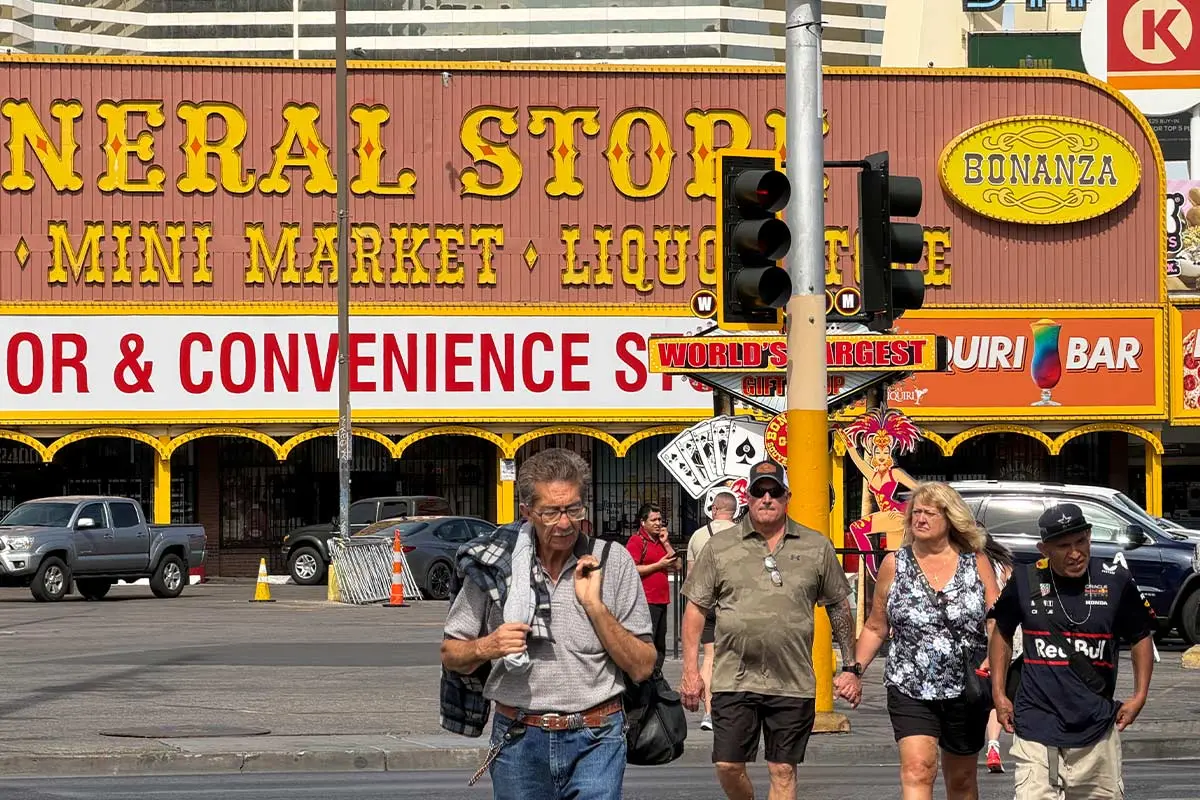


There’s no denying the downturn in visitors to Las Vegas. Blackjack tables are a little less crowded, Strip traffic is lighter, and you might not need a reservation to get into Gordon Ramsay Hell’s Kitchen. Better call to make sure.
While visitor numbers dropped 7.5 percent last year, all but a few of the 38.5 million people who came to town said they were satisfied or somewhat satisfied with their experience, according to the 2025 Visitor Profile presented to the Las Vegas Convention and Visitors Authority board of directors at its March 10 regular meeting.
Visitor declines are being seen largely among mid- and lower-income travelers, particularly young visitors early in their income earning years and retirees on a fixed income, Kevin Bagger, vice president of research, points out in his presentation to the board.
“The visitor profile reflects the broader economy,” Bagger says. “The environment around Vegas is noisy.”
People are worried about inflation and terrorism; they’re hearing about $20 bottles of water in hotel gift shops, surprise parking and resort fees, and $500 tickets to see the Eagles at The Sphere. Consumer sentiment ended the year at a historical low, yet the Standard & Poor 500 reached a record high. Bagger describes it as a “bifurcation” of discretionary income between the rich and poor.
About one-fourth of visitors in 2015 made more than $100,000 a year in income. Now, taking inflation into account, 57 percent of visitors are included in that income bracket.
Casinos and hotels are more reliant on repeat customers. Only 10 percent of visitors made their first trip to Las Vegas, continuing a steady decline from 24 percent in 2022 and a high of 27 percent in 2015.
Visitor spending patterns are “mixed,” with plateaus or declines in some categories, the research shows.
Food and beverage spending fell to $583 in 2025, compared with $615 in the previous year. Shopping budgets were pared from $281 to $222. However, gambling habits remain steady, with 81 percent of visitors taking a chance on Lady Luck, and 2.6 hours dedicated to daily gambling. Local transportation costs increased by just $2 to $162, and parking went up $1 to $24.
Generally, changes in the visitor profile were small, like average visitor length of stay dropping to 3.2 days from 3.4 days, and the same with convention stays, Bagger says.
Board member Jan Jones Blackhurst of Caesars Entertainment questioned the “positive” numbers from the profile, when she reads in the newspapers and online that things are worse.
“Social media is always the loudest voice in the room, but not always the most representative voice,” Bagger responds. “Individual properties have addressed their own value. They’ve adjusted prices. Those who do come, from our visitor profile, they’re having a good time.”
TOURISM AGREEMENT
With international tourism accounting for some of the visitor decline, including a significant number of Canadians, the board wasted no time in approving a three-year, $3.5 million agreement with Reach Global Marketing in Vancouver, Montreal and Toronto.
Fletch Brunelle, VP of marketing, says Canada has always been one of the top countries for international visitors to Las Vegas; there were 1.2 million Canadian visitors last year, and their economic impact was $1.9 billion.
The agreement calls for tourism promotion, support of nonstop air service to Las Vegas, familiarization trips, and support in leisure sales and trade missions.
EXHIBIT BOOTH
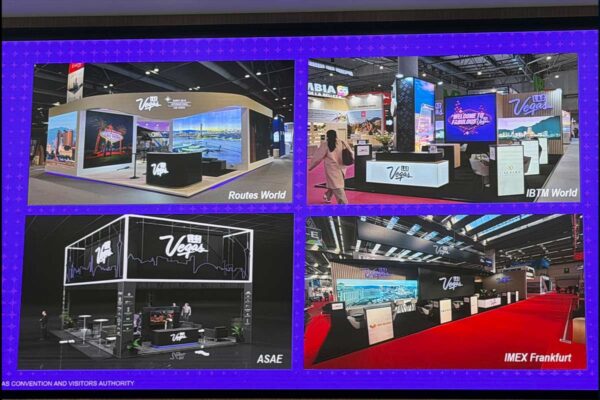
Once again, the convention authority contracted with Miami-based Conex Exhibition Services in the amount of $340,000 to design and build an exhibit booth for Las Vegas at the U.S. Travel Association’s IPW show, May 18-22, in Fort Lauderdale, Fla.
To date, LVCVA has paid nearly $2 million to Conex for a booth that was touted for its sustainability and reusability. The company previously received contracts for Las Vegas displays at WTM London; World Routes 2024 in the Kingdom of Bahrain; IMEX America in Las Vegas; and IPW in Los Angeles.
Brian Gullbrants, vice chair of the LVCVA and chief operating officer at Wynn North America, said he’s continually seeing requests for display booths at IPW, and questioned if it’s the best use of funds.
Brunelle answered that Conex uses components of the same booth from IMEX, and that Las Vegas has shrunk its footprint to reduce costs.
He emphasized that IPW promotes inbound travel to the United States, driving $5.7 billion in future travel by connecting top U.S. destinations with travel companies. It’s a cost-effective platform to conduct business, foster relationships, and strengthen connections worldwide. LVCVA and its resort partners have participated in IPW for 35 years and has hosted the event five times, most recently in 2021.
LVCC IMPROVEMENTS
The board approved $750,000 for design and engineering services related to Las Vegas Convention Center improvement projects, delegating CEO Steve Hill to select vendors and draw up agreements.
Miller & Ham collaborated with LVCVA staff and executives to identify work needed to “enhance the customer experience and increase operational efficiency.” The work falls outside of the scope of the $600 million renovation completed in January and West Hall expansion.
AUSTRALIA FLIGHTS
In staff presentations, COO Daniel Hayes highlighted the launch of Qantas Airlines’ first nonstop flights from Sydney, Australia, to Las Vegas, three times a week starting in December. LVCVA representatives met with Australian travel agents and media to promote the service.