



The Lifeblood of the Tradeshow Industry
Turns out, this guy Darwin was on to something with his theory of evolution. If you’re going to survive in the ultracompetitive tradeshow Installation & Dismantle (I&D) world, you’ll learn to adapt to a constantly changing environment.
Building codes, safety regulations, labor standards, material costs, shipping rates are all subject to revisions and adjustments. Complicating matters, rules differ from show to show, city to city, venue to venue. It takes the DNA of a chameleon to make it through the day.
Jason Jenne, floor manager for Momentum Management in Las Vegas, sees change at almost every show.
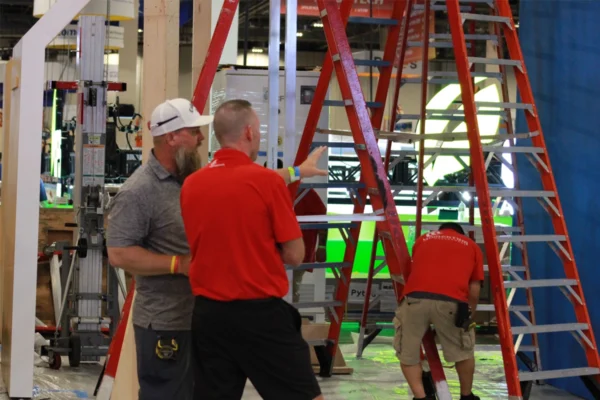
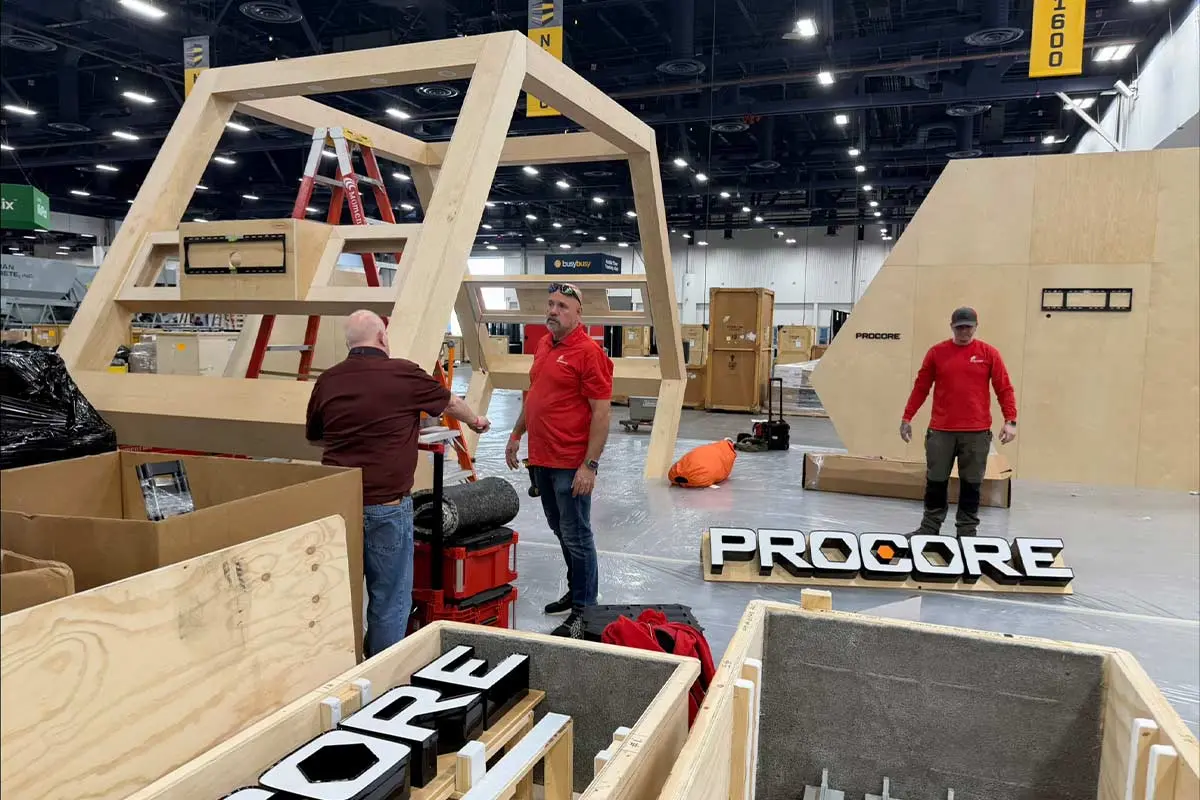
“These guys are working for this company today,” Jenne says, pointing to his crew setting up an exhibit for World of Concrete at Las Vegas Convention Center. “They may be working for someone else next week. If the price is right, they’ll be gone.”
The dog fight for skilled labor is one of a crate full of challenges Jenne faces on a show-by-show basis. It’s like any industry, he relates. “If you don’t adapt, you’re done, you’re left behind, so you have to keep up with what’s going on.”
Colleen Johnson, president of Sho-Link I&D labor services in Lake Forest, Ill., with more than 25 years in the industry, says she’s always in awe of how quickly it’s evolving.
“Above all else, we must be agile. Our ability to adapt is how we stay competitive, and we experience this every day. We are adopting new technologies. We monitor and respond to shifts in clients’ expectations,” Johnson summarizes.
Specialized Workforce
What started with World Fair exhibits and advanced in the 1930s to fancy department store window displays has evolved into elaborate, multilevel convention and tradeshow booths featuring an assemblage of audio-visual bells and whistles designed to lure customers into a space where products are sold and deals are done.
As America entered an era of post-World War II economic prosperity, large showrooms were dedicated to industries of special interest, such as automobiles, home entertainment, and fashion. Witness the growth of SEMA, CES and MAGIC, drawing as many as 150,000 attendees.
To facilitate this growth, a specialized workforce was required to install and dismantle exhibit booths. Thus, the birth of the I&D industry, a niche that emerged for cabinet makers, carpenters, electricians, and exhibit houses that design and build booths.
Organizations such as the Exhibitor Appointed Contractors Association (EACA) shaped training and certification programs for these workers who are crucial collaborators in live event logistics and scheduling. They haul freight, roll out carpet, hook up power, rig overhead signage, and set up structures that meet strict building specifications and safety standards.
There are so many elements requisite for a company to provide I&D labor services and training is one key aspect, says Jim Wurm, executive director of EACA.
Training isn’t limited to various trades that provide workers for I&D contractors. While the Teamsters and Carpenters unions have excellent training centers in Las Vegas, as well as the Decorators (IUPAT) in Southern California, programs provided by I&D contractors are “significantly more sophisticated,” Wurm notes.
Labor trades primarily provide tool and booth training. They teach workers how to read blueprints and use the tools necessary to build displays. I&D contractors teach their unique service culture, operations and logistics, and the level of customer service required from crews.
“Erecting a display on a tradeshow floor doesn’t happen in a vacuum,” Wurm lets you know. “Workers must collaborate with other service providers that aren’t part of the I&D contractor organization. They need to familiarize themselves and build relations with the general contractor’s material handling service so they can effectively and accurately plan the start time for their project based on when the freight is scheduled to arrive.”
He continues, “They must also initiate contact with rigging crew services and electrical services, as they’re generally a part of the install process and scheduling of these services must be well handled for efficiency.”
Their responsibility extends to solving problems that inevitably arise on the show floor, everything from missing freight to damaged graphics and displays. The list of possible mishaps is endless, so it’s best to keep a bottle of Tylenol on hand.
Southern Nevada Teamsters Local 631 developed a two-year program that certifies workers in all facets of tradeshow labor. The class begins with a three-day “boot camp” to determine if applicants can handle the physical requirements of tradeshow work, which might involve pushing carts, lifting tanks, climbing ladders and moving crates with a J-bar.
In the first year, they learn about exhibit booth I&D, design and repair, OSHA regulations, and beginner skills like operating a pallet jack. The second year teaches advanced forklift driving, advanced I&D, scissor lift, CPR and first aid, and elective classes in budgeting, graphics and heavy rigging. The 70,000-square-foot training center produces roughly 200 apprentices a year.
Incredible Growth
Jenne was a professional soccer player for the Las Vegas Quicksilvers in the 1990s when a Chilean teammate working for Freeman called to gauge his interest in an offseason job offer.
“Like everyone, it was someone I knew,” he says about getting his start in the industry. “I believe it was one of the best decisions I’ve made in my life, especially with the friendships I’ve made along the way. That’s the No. 1 thing for me. Relationships.”
Over Jenne’s 30-year career, Las Vegas skyrocketed from a few million square feet of exhibit space to an estimated 15 million to 20 million square feet. That’s exciting, but it presents challenges, like retaining the most productive workers.
Before Las Vegas added Mandalay Bay Convention Center, expanded Las Vegas Convention Center and MGM Grand, and Caesars Palace built 500,000-square-foot conference centers, companies like Momentum could hire a handful of people to cover all the shows. Now, with hotels from the Strip to the suburbs offering meetings and events space, it’s a struggle to keep up with labor demand.
“If I worked 30 years ago, I would be working almost every show that came through the city,” Jenne says. “Now, I’m only seeing 50 (percent) to 60 percent of the shows, as most shows are overlapping due to the extra space and venues offered. This affects multiple shows at a time due to not having enough quality labor.”
Jenne watched the rising tide of the tradeshow industry lift not only its labor force, but other sectors of the economy. Whereas maybe one food truck would stop by Las Vegas Convention Center during lunch time, he now sees half a dozen or more showing up, right on schedule.
Several rental furniture companies work with show general contractors, giving exhibitors a wide selection to furnish their booth. Graphics companies have doubled or tripled in size.
Death Of Ma Bell
Of all the changes in the industry, telecommunications may be the most significant, Jenne believes. Certainly forever. Yellow Pages are history. Google is your new best friend. Exhibitors are going online to find vendors for their booth space, where they might take clients for an evening of fine dining, what are the best shows in town.
And the cell phone? In the old days, Jenne carried a two-way beeper and equipped his crew leaders with beepers so they could communicate from booth to booth. With cell phone cameras, he can instantly send a picture of an exhibitor’s completed booth for approval.
“Years ago, after a booth was built, we had to use Polaroid cameras and we would have to mail the pictures to the clients so they could see what their booths looked like,” the I&D supervisor recalls.
The shift in technology has been nothing short of remarkable. Sho-Link’s Johnson feels like it was just yesterday that she relied on faxes, pagers, and hunting down a payphone to stay in touch.
“Now, everything happens in real time—messages flying back and forth at all hours,” the industry executive says. “Instant communication has been incredibly helpful, and it has also introduced new pressures. Staying ahead means evolving and making sure our entire team is on the same page.”
Resilient Industry
If ever there was a moment in history that showed the resilience of the tradeshow industry, it was the Great Shutdown. Conventions, tradeshows, meetings, and conferences were flourishing before the COVID-19 virus struck in early 2020. Then they closed the spicket.
It was a costly pause. With 1.7 million exhibitors, the tradeshow industry brought $396 billion in direct spending to host cities in 2019, including $55 billion for hotels, $30 billion for restaurants and retail, and $29 billion for ground transportation, according to the National Trade Show Alliance (NTSA). It was time to clear out the losses and restart the engine.
Even as virus infections declined and pandemic restrictions were lifted, the industry was challenged to replace its workforce and reconnect with meeting planners, material suppliers, and trade unions.
“You have an industry that has to work on sustainability through workforce development,” Laura Palker, founder and president of NTSA, says in a 2022 interview with Exhibit City News promoting the organization’s Invisible Industry nationwide bus tour. “At the end of the day, we had a pandemic that was a blessing. It gave us a wake-up call to the importance of our workforce. If we don’t act now, in five to 10 years, the majority of the workforce will (be retired).”
Once again, the industry adapted. A state of normalcy returned, even if it was the “new norm.”
“Flexibility, problem solving at any time, having a sense of purpose, and having to adapt to any situation is a must in this industry,” Jenne reiterates. “Key factors to having a successful company are to provide strong customer service to our clients and maintain a talented team of individuals who will and can provide that customer service.”
Capital Investment
Vicissitudes of the tradeshow industry have led to a spate of mergers and acquisitions in recent years, strategic moves by companies looking to expand their footprint, consolidate operations, fatten their bottom line and move forward with growth.
Among major transactions: Nth Degree joining Fern Exposition Services; Riverside Companies acquiring Impact XM; Riverside investing in Vomela, which then acquired Moss; Corp Events New England acquiring Dame Associates; Truelink Capital acquiring GES.
The tradeshow and live events industry bounced back from COVID faster than expected, its value proven and even strengthened by the pandemic, according to JEGI Clarity. Opportunistic investors and private equity firms are jumping to access deals across the spectrum.
The global exhibition market has traditionally grown ahead of GDP, increasing 5 percent annually until it peaked with a value of $29 billion in 2019, the investment bank reported. Growth was halted dramatically by COVID, with the market shrinking 69 percent to $10 billion in 2021.
“We see supply and demand with this industry on a daily basis,” Jenne comments, “and many times, smaller companies are acquired by larger companies as they may be getting too big themselves and cannot adapt to the increasing labor force, or any other reason for that matter, in which they’re having trouble adapting.”
Dennis Taylor and his son, Gabriel, owners of Black Ops show services in Las Vegas, are resisting the M&A movement. They don’t plan on selling their business or merging any time soon, or ever.
“Companies that value their own vision and true independence will never sell or merge because they have more flexibility from top to bottom,” Gabriel Taylor tells ECN. “Direct line of sight to the customer. Leverage. Bargaining power. The list goes on. We’ve shown that we have staying power, building our own table. We don’t need co-signs or permission.”
Dennis and Gabriel hear workers complain about being mistreated by large companies, along with a decline in customer service, especially in the last few years. “When they’re dealing with smaller companies like us, it feels more close-knit,” Gabriel confides. “Better treatment overall, and the quality of execution is drastically higher.”
Consolidation makes it imperative to be more focused on customer service and support, Johnson postulates. Regardless of ownership structure, the goal for everyone is to elevate the experience created by the I&D company, to make sure exhibitors and attendees come away with real value, and support designers in realizing their concepts.
“The real challenge is when you are growing the business and absolutely refuse to sacrifice the quality and personal attention that got you here in the first place,” Sho-Link’s president says. “That has taught me how essential it is to build a company culture that doesn’t just accept change but actually thrives on it. When your team is on board, you can take on new opportunities without compromising what makes your business special.”
Rules And Regs
Another area of constant change, rules and regulations definitely serve a purpose for the tradeshow industry, but what matters most is keeping the exhibitor at the center of everything, according to Johnson.
“Whenever there’s talk of new fees or changing requirements, the question really should be: How will this affect the exhibitor’s experience and their ability to succeed?” she posits.
EACA does an excellent job communicating on this subject, one of the great advantages for contractors to join the association, Johnson notes.
Also, Exhibitor Advocate is “really moving the needle here,” making sure exhibitors have a voice and their needs are heard when decisions are made.
“Their work is all about helping exhibitors navigate the process, raising awareness, and ensuring that the industry continues to support the people we’re all here for. At the end of the day, our job is to make sure exhibitors feel supported and valued, no matter what changes come our way,” Johnson says.
Hard Times
Business prospects can get a little scary without deep-pocket financing that a larger corporation provides.
A few years ago, Black Ops was owed a significant chunk for an installation job, and the client was slow to pay. Dennis and Gabriel waited nearly a year and a half for full payment. That’s the sort of hiccup that can doom a small business.
Father and son were building booths mostly by themselves, with the help of a few friends, depending on the size of the job, and not drawing pay, which is expected when starting any new business.
“At that time, we really couldn’t afford to take a hit like that,” Gabriel explains. “We were dealing with so much professionally and personally in our lives at that time. We couldn’t afford lawyers.”
They endured the dodging of phone calls and condescending attitude from the client’s account executive. They kept treading, laboriously, heads down, focusing on what they could control, trusting that things would eventually work out. And they did.
“We kept everything on a shoestring budget,” Gabriel says. “We got a lot of no’s in the beginning, a lot of laughs from the peanut gallery. We just said, ‘Watch this.’ Now they know this isn’t a game, and it never was to begin with. We’re playing for keeps.”
Then came the pandemic and everyone was fearing for their lives, never mind the future of the tradeshow industry. Who would risk attending a live event with the virus circulating in the air? Let’s Zoom, instead.
“I think everyone learned something from that situation that was vastly different from the 2008 financial crisis,” Gabriel relates. “One important lesson was that, to a fault, we all have a natural human inclination, this insatiable sense of curiosity to feed our five senses. That’s never going to change. Attendees want an experience and tradeshows fulfill that need. Kind of like a concert, it’s a once-in-a-lifetime thing where you just had to be there to see it for yourself.”
Even at tradeshows such as CES and World of Concrete, held every year, each show is different from year to year. New ideas emerge, new products are developed, and people are intrigued by what’s hot in the market.
“They want to interact with others in a bubble, so to speak, who share the same level of interest.” Gabriel says. “Human connection is what it all boils down to. We underestimate that sometimes.”
Longterm Survival
It’s true. The tradeshow industry has changed, transformed, consolidated, morphed, and survived over the years, linked by one common, positive thread.
“This is a people business and people will never go out of business,” Jenne proclaims. “One thing I’ve enjoyed over the years is being able to work with several different companies and experiencing the differentiations and ideologies of each company, as they are unique in their own way.”
For Johnson, a key factor to keeping the industry alive is increasing awareness about opportunity in the trades. I&D work is the backbone of the industry, but a lot of young people don’t even know these careers exist, she asserts.
She credits the Experiential Design and Producers Association (EDPA) for its recruiting efforts, showing how the industry offers stability and growth for skilled tradespeople.
“It doesn’t stop at simply growing our talent pool,” Johnson adds. “We need to make sure we’re supporting them, not just with the work itself, but with helping them balance everything they have going on. There’s a lot on their plates. They’re often planning the next job while still in the middle of the current one and fielding questions about a previous project.
“So, making sure our teams have the right tools and resources is extremely important in preventing burnout and keeping everyone engaged for the long haul.”