



Before Disneyland and Epcot Center, before travelling carnivals, local amusement parks, and modern-day convention centers, there was the great grandaddy of all entertainment destinations—the Midway Plaisance at the 1893 Chicago World’s Fair. The place was a mile long, 73 acres in size, and “midway” between Jackson Park (home to the Fair) and Washington Park.
Imagine entering this strange and wonder-filled world of foreign lands, a jam-packed area teeming with exotic sights, sounds, and people. Walking the Midway, one would see:
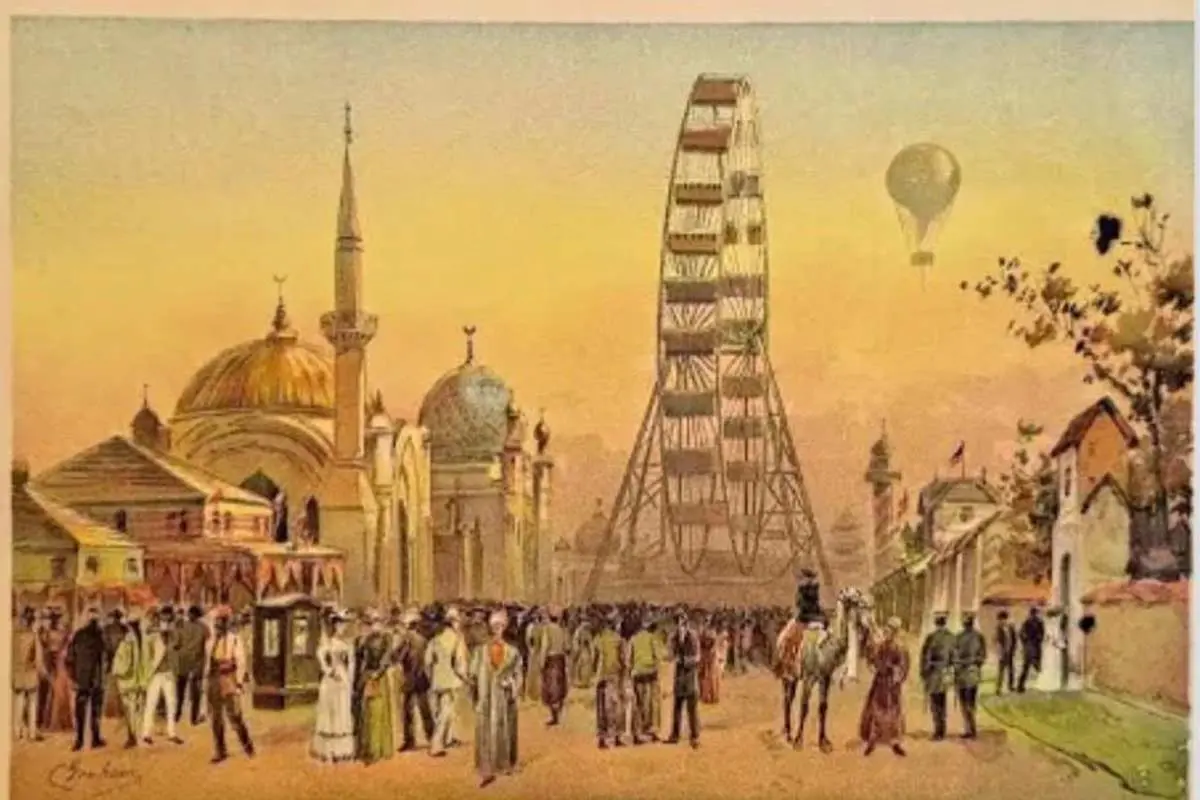
Mosques, castles, and pagodas. Egyptian belly dancers. Foreign villages. Camels, ostriches, and reindeer. Bedouin warriors. Lions riding on horseback. Sword fighting. Human curiosities. Weddings. Street brawling. Roller-skating bears. “Hindoo jugglers.” A volcano. The Wild Man of Borneo. A movie theater. Harry Houdini. Scott Joplin. An ice-railway roller-coaster. An indoor swimming pool. An ice-skating rink (during the summer of 1893). A captive hot-air balloon ride. A giant rotating wheel.
The attractions were mind-blowing, but perhaps even more impressive was its sheer size. The Midway was larger than the total exhibit space of any current convention center in North America. Picture the largest one with its 2.6 million square feet of exhibit space. Combine the multiple buildings there into one and move all the exhibit floors onto a single level. Add 20 percent more space. Now remove the ceilings and walls and visualize it as an open-air festival. That was the Midway. It was huge.
And the individual exhibits were just as impressive: The German Village was approximately 225 feet wide by 775 feet long with structures rising 20 to 30 feet in the air. This was one of 41 commercial areas that had to be constructed and installed. And just like any convention or carnival, these exhibits were temporary: after the show they were dismantled, and either destroyed or shipped to another location.
The Top
Midway Attractions
The Midway proved to be the money-maker of the Fair, far outgrossing the revenue generated at the entrance to the Exposition itself. While walking the Midway was free, admission to most of the attractions was not. Some of the villages were original and authentic; others were contrived and purely commercial. Most sold food, drink, products, souvenirs, and entertainment. Many of the villages had exhibited at the 1889 Paris World’s Fair and were seen there by an advance team from Chicago. Show organizers charged participating companies 50 percent of their gross for the privilege of being present. Crowd numbers were not recorded, but the money was. Here are the top attractions, in order, in terms of revenue.
“The Street in Cairo” was a sensation in Chicago with 87,139 square feet of engaging exhibit space. It showcased a theater, a mosque, the Temple of Luxor (with imitation mummies) and over 60 cafes and shops. Egyptian men, women, and children worked the street, sharing the area with dogs, donkeys, and snakes. Camels were available to ride, for a price, and it cost extra for photographs. There were sword fights, weddings, brawls, and inside the theater, belly dancers. Cairo grossed $787,826.95 in 1893, equal to $28.37 million in 2026.
The Great Wheel stood 265 feet high in the center of the Midway. Show organizers wanted a landmark that would “out-Eiffel the Eiffel Tower” and George Ferris delivered an engineering marvel with 36 passenger cars. Fully loaded, the Wheel rotated 2,160 people 25 stories up into the air. Tickets cost 50 cents (about $18.00 today), the same as admission to the Fair itself. The Wheel grossed $733,086, not bad considering it didn’t open until June 21 (and had almost two months fewer sales than the other attractions).
The German Village at 173,940 square feet was the largest space and the third highest in terms of revenue. It had representative architecture from different provinces featuring houses and shops, and a fortress exhibiting medieval weapons. Its most popular attraction broadcast live music in the boisterous beer garden.
Hagenbeck’s Animal Show announced its presence in advance with the wafting, sickly-sweet smell of manure. Lions, tigers, and bears performed tricks inside the 4,500-seat auditorium. Panthers, parrots, leopards, monkeys, and dogs also amazed audiences.
Libbey Glass showcased a twin-towered palace with a hundred-foot glass dome. The majestic building featured a fully functioning factory with forty glass blowers providing live demonstrations. People paid 10 cents for the privilege to watch, and the admission fee could then be applied to souvenir purchases. The company grossed the equivalent of $17,659,000 in today’s money.
Old Vienna, occupying a space of 510 feet by 195 feet, replicated a 1740’s town square with cafes, taverns, a church, a city hall, and more than 40 different shops.
The Turkish Village had the highest population of any village and was one of the few attractions that did not charge an admission fee. It made money through sales from the 300 different vendors, many with men wearing red fezzes. The Sultan of Turkey donated an authentic Muslim mosque for this event.
The Moorish Palace housed a bazaar selling jewelry, Persian rugs, coffee, candy, curios and more.
The Vienna Bakery and Natatorium was separate from the Old Vienna village, but like the village, it attracted customers from Chicago’s German and Austrian immigrant population. The Natatorium was an ornate Moorish-style indoor swimming pool that was used for social gatherings.
The Algerian & Tunisian Village displayed a semicircle set of buildings, including a bazaar, a coffee house, café, and stalls. Street performers, jugglers, and snake charmers engaged tourists walking by. The village won a gold medal in Paris and rounded out the top ten money makers in Chicago, grossing the equivalent of $9.3 million.
There were dozens of other attractions, including two separate Irish Villages (the Catholic village replicated the Blarney Castle, and the Protectant Village built a Donegal Castle), a Persian Village plus a Persian Palace, the World Congress of Beauty, the Bedouin Camp, the Dahomey Village, the Siemen’s Electric Scenic theater, the Diamond Match Company, the first commercial movie theater, and a 22-foot tall Eiffel Tower.
A few of the foreign villages housed primitive populations. Diverse ethnic food was available in many different locations, but the most unusual restaurants were in an underground coal mine, and inside the base of a giant redwood. Buffalo Bill Cody presented his popular Wild West Show on land outside the Fairgrounds, because he did not want to pay the exorbitant 50 percent surcharge for the privilege of exhibiting inside the Fair. He generated over a million in profit (in 1893 dollars). Cody’s bottom line greater than the gross revenue of any single concession on the Midway.
Was the Midway the first amusement park? Depends on one’s definition. Early amusement centers in this country often originated as picnic areas or lakeside resorts. Lake Compounce in Connecticut opened in 1846, built a casino in 1895, then added a carousel in 1911. Coney Island opened its carousel in 1876, added a roller coaster in 1884; their Steeplechase Park added a Ferris Wheel and miniature railroad in 1897. Dorney Park in PA, opened in 1884 as a picnic area with trout ponds; they began adding rides in the early 1900’s and their first coaster in 1924. None of these places, however, could match the Midway in terms of size, excitement, or in the number of rides and attractions.
Setting the Future
For many visitors to Chicago in 1893, the Midway was their most memorable experience. But it did more than simply create fond recollections. It demonstrated that Americans were willing to spend millions of dollars on entertainment.
Over the next two decades, nearly 100 small amusement parks popped up in the state of Illinois. The Midway lent its name to the 20th century carnival craze. It laid the foundation for entertainment centers at future fairs in the US. “The Amusement Zone” at the 1939 New York Fair was larger than the entire World’s Fair in Paris two years earlier. It was a precursor to Disneyland in California, and Epcot Center in Orlando.
Engaging audiences is a critical function for any type of business endeavor, whether it be a convention, a carnival, or a magazine. The Midway Plaisance performed this function amazingly well.