




by Debbie Hall
“AI works best behind the scenes. It’s great for early planning, brainstorming, data entry, organizing notes and handling simple exhibitor FAQs. It saves time, cuts costs and removes a lot of repetitive work.” — Aram Pajian, Director of Business Development & Sales, LUXX Exposition Services.
Artificial intelligence (AI) is being used to shape how general contractors design floorplans, manage logistics, forecast budgets and execute strategy, highlighting its strategic role in the tradeshow and expo industry. From design tools to scheduling software, AI is demonstrating its current and future influence.
However, studies highlighted in ScienceDirect and the Harvard Gazette are emerging that suggest a heavy reliance on AI among students may correlate with diminished critical thinking, reduced problem-solving stamina and cognitive atrophy. The implication can be uncomfortable for an industry that prides itself on ingenuity, adaptability and human-centered problem-solving.
“It’s something the industry should take seriously. Tradeshows rely on instincts, fast decisions and clear communication. When something goes wrong on-site, there’s no time to ‘ask AI.’ Someone has to step up and solve it and quickly,” explained Aram Pajian, Director of Business Development & Sales, LUXX Exposition Services.
Events still require improvisational problem solving (reading the room) and these are skills that only developed through practice. The cost to setup the infrastructure, and getting the buy-in of attendees and users at the physical event have been the biggest hurdles in achieving greater connection. Relationship development will be aided by AI (connecting people in a more rapid manner with those that share their interests). However, the judgment that comes from experience are hard earned from reading the event energy on a human level.
How AI Is Already Being Used
In today’s exhibit ecosystem, AI is utilized as a tool of efficiency and optimization. General contractors are using it to:
- Generate early-stage booth layouts based on space constraints, traffic flow data, and exhibitor goals
- Optimize material usage, reducing waste and controlling costs
- Predict labor needs, shipping timelines, and potential points of failure
- Analyze attendee behavior patterns to inform booth placement and experiential design
- Automate project management tasks such as scheduling, procurement tracking, and change-order forecasting
AI doesn’t replace problem-solving; it reallocates it.
How AI Could Be Used Looking Forward
AI has the potential to support deeper strategic thinking and future-facing applications may include:
- Scenario modeling for exhibiting ROI, allowing exhibitors to test strategies before committing capital
- Adaptive booth environments that respond to real-time attendee behavior without preprogrammed scripts
- Sustainability modeling that evaluates environmental impact alongside cost and logistics
- Knowledge preservation systems that capture expertise as veteran builders and designers retire
AI is meant to be a collaborator.
Reclaiming the “People First” Narrative
People want to engage with other people. They want to connect in ways that digital interfaces cannot replicate. As AI becomes more prevalent behind the scenes, the industry’s responsibility is to oversee what happens in front of the curtain.
That means:
- Designing booths that prioritize conversation over spectacle
- Training staff to listen, not just pitch
- Valuing craftsmanship, storytelling, and hospitality as strategic assets
- Measuring success not only in leads captured, but in relationships formed
“Client relationships, real-time problem-solving and high-touch customer service still require people. That human layer is what makes events successful and events don’t happen without people,” added Pajian.
People-Centric Marketing in an AI Future
In an AI-enabled future, people-centric marketing is not anti-technology—it is intentional technology.
“We do need to prioritize human-led storytelling. You do this by making sure we have live testimonials, unscripted fireside chats in the programming and show the behind-the-scenes. In a world of perfect content, imperfection is trusted because it’s human,” said event producer and CEO Valerie Bihet, VIBE Agency. “AI can simulate a smile, but only a human can make someone feel seen. It can help us design, but it’s still up to us to put the people at the forefront and use this as a tool.”
In this AI future (or not-so-distant future), AI handles segmentation and delivery, while people handle the story and the authentic connection. Industry professionals should use AI to identify who needs to hear from them, and keep the relationship building component to people.
The tradeshow industry has arrived at the intersection of creativity, logistics and human connection. If AI helps do those things better—without dulling the skills and empathy of the people in the industry—then, according to the general contractors, it has a place on the show floor.
The future is not AI-first. It is people-first, with better tools.
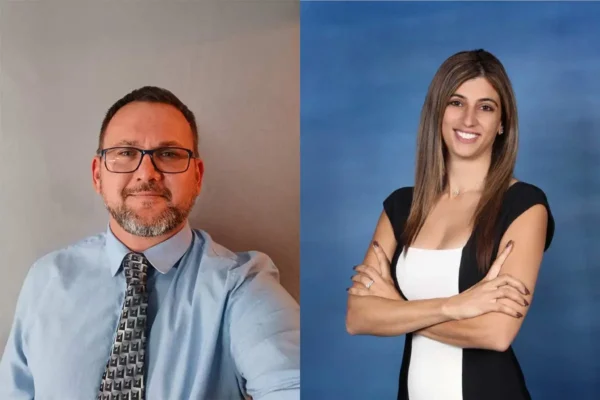
Image Caption (Left to right): Aram Pajian and Valerie Bihet