



Gimmick, Threat, or Your Next Creative Partner?
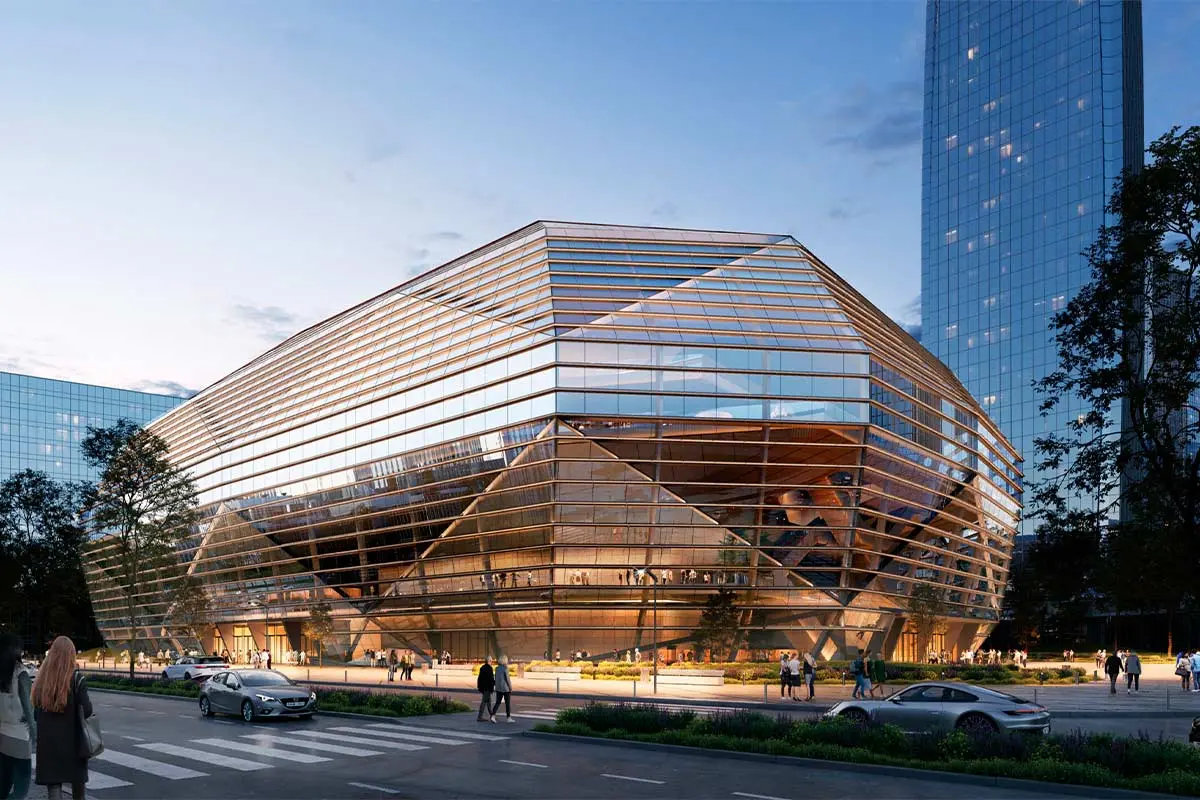
Artificial intelligence is no longer a fringe experiment reserved for Silicon Valley labs or sci-fi think pieces. It is actively reshaping industries that once seemed immune to automation—creative fields included. Architecture firms are using generative design tools to explore thousands of structural options in minutes. Fashion brands are testing AI-generated collections. Filmmakers are de-aging actors, resurrecting dead voices, and storyboarding scenes with synthetic talent. And headlines rippled through the global design community when a massive new convention center sprang up in China, reportedly designed using AI-driven architectural modeling.
To be clear, China’s West Bund Convention Center wasn’t designed by AI, despite what the headlines might imply. Rather, a team from Skidmore, Owings & Merrill (SOM) used AI to optimize circulation, energy efficiency, and spatial planning at a pace and scale few human teams could match. In the words of SOM Communication Manager Francisco Lopez de Arenosa, “Our team used an AI-assisted workflow to explore a wider range of design options more efficiently, allowing designers to resolve multiple challenges in parallel.”
AI didn’t have a vision. It didn’t sketch the first idea on a napkin. It didn’t walk the site, talk to stakeholders, or debate the emotional impact of the atrium. It simply did what machines do best: crunch options, identify patterns, and accelerate decision-making. Still, if AI can help design a convention center, the question facing our industry is unavoidable: What role, if any, should it play in designing the exhibits that fill those halls?
Three years ago, at EuroShop 2023 in Düsseldorf, German exhibit house Pixlip presented what it billed as “The first tradeshow stand designed by AI.” And while the exhibit itself received mixed reviews, it stood as proof of concept. And, much like SOM’s convention center, it wasn’t exactly designed by AI.
“We used generative systems to explore visual directions, moods, and thematic elements, which helped accelerate brainstorming and inspire new creative ideas,” said Pixlip COO Daniel Liba. “Ultimately, the concept emerged from an internal meeting, and AI served as an additional tool to expand the range of possibilities during the design process.”
So, it’s not surprising the exhibit-design community finds itself at a crossroads—equal parts curious, cautious, and conflicted. According to The Experiential Design Authority’s recent report, The Role of AI in Exhibit Design, 59 percent of respondents say they currently use AI during the exhibit-design process, while 41 percent do not. That split reveals an industry still feeling its way forward, unsure whether AI is a creative accelerator, a potential liability, or something in between. Or, to put it more bluntly: Is AI a tool or a Trojan horse?
Tool or Tradecraft?
In architecture and product design, AI has gained traction largely because of its ability to process complex variables quickly. Generative design tools can optimize structures for airflow, daylighting, materials usage, and sustainability metrics. In urban planning, AI is being used to simulate pedestrian flow and predict congestion patterns. These are data-heavy challenges—fertile ground for algorithms.
Tradeshow exhibits, however, live in a more nuanced space. They are temporary, brand-driven environments that must balance storytelling, functionality, budget, logistics, emotion, and the unique parameters created by show organizers, convention centers, and union regulations—all within a relatively small footprint and a few precious seconds of attendee attention. That complexity may explain why AI adoption in exhibit design has been slower and more selective.
While TEDA’s survey found a majority of respondents already use AI in the exhibit-design process, the depth of usage varies widely. Roughly one-third describe moderate usage, turning to AI regularly, but not habitually. Another 25 percent use AI more sparingly, only for specific tasks, and only after human alternatives have been exhausted.
“AI enables us to generate initial concepts, layouts, and visualizations faster, allowing us to explore more design options in less time and support better-informed client decisions,” said one anonymous respondent. “It also helps automate repetitive tasks and supports technical checks. By using AI to review brand and construction guidelines, we can interpret and apply requirements more consistently, ensuring designs meet both brand standards and technical feasibility before production.”
Interestingly, 69 percent say their organizations already use AI for non-design purposes, such as marketing (46 percent), client communications (48 percent), or project management (31 percent). In other words, resistance to AI isn’t ideological—it’s contextual. Many firms are comfortable with AI in the background, just not yet at the creative core.
When asked about the benefits of AI integration, over half of respondents cited heightened creativity and improved ideation as the top advantages, followed by increased efficiency (31 percent) and shortened project timelines (23 percent). Only 9 percent reported seeing no benefits at all, suggesting skepticism often stems from philosophical or practical concerns rather than a lack of measurable upside. Translation: Most people who try it don’t hate it. They just don’t trust it. Yet.
Catalyst or Copycat?
Among firms that are using AI, most are treating it as a support tool rather than a lead designer. Casey Baron, Senior Director of Creative at Storylink Creative, sees AI as a way to widen the creative funnel—not replace it.
“We occasionally use AI during the concept phase to get more ideas or help visualize ideas,” says Baron. “But I fear designers are beginning to rely too heavily on AI as the final creative execution. While AI can be a powerful tool for ideation, it should never replace human intuition or our ability to think differently about how an audience truly experiences a design.” That sentiment is echoed by many respondents: AI is valuable early, dangerous late.
Others are deploying AI for highly tactical needs. Steve Deckel, CEO of Deckel & Moneypenny, uses tools like Topaz Gigapixel AI to enhance client-supplied imagery and Gemini to turn still images into motion graphics.
“AI can help once you know the creative direction, but it seldom recommends a solution we would recommend,” Deckel explains. “Our job is to communicate in an unexpectedly charming way, not the obvious, predictable way. And just as great jokes don’t work once they’ve been diagrammed, design is difficult to quantify and explain.”
Deckel’s analogy is telling. Creativity, like humor, doesn’t survive dissection. You can analyze it, optimize it, reverse-engineer it—but the magic lives in the messy, human part. That may be why, for four-tenths of the industry, AI remains at arm’s length. And the reasons are rarely technophobic.
Some designers feel AI threatens the very craft they’ve spent decades refining. Kristof Van Leughenhagen, owner and designer at Standideas, puts it bluntly: “I became a designer to design, not to type prompts. Every brief is different, so every design is unique.”
Others worry about feasibility. Jeff Kisko of Octanorm points out that AI-generated concepts can create unrealistic expectations. “It will sometimes produce ideas that are not feasible. If a customer sees this, it may lead to confusion or frustration.”
That concern is already playing out in real time. Several respondents noted clients bringing AI-generated booth concepts into RFPs—designs that look compelling on screen but collapse under the weight of budgets, timelines, rigging points, freight realities, union labor rules, or even the basic laws of physics. In short: AI doesn’t know what it doesn’t know.
Wendi Jacobs of Acer Exhibits raises a deeper concern: perception. “The creativity of our designs is one of the foundations of our business. I’d hate to see that lose value to clients who think they can create a design with AI and expect us to build it.”
One anonymous respondent voiced a more existential anxiety: “I worry about the amount of spec design we create and put out into the universe, as well as the fact that all our old work is being used by AI to create derivative solutions. We’re feeding a monster that’s trying to take our jobs.” And that’s not paranoia. It’s math.
AI models are trained on vast libraries of existing content—much of it created by the very designers now worried about being replaced. Which raises an uncomfortable question: Are we teaching the machine how to imitate us or how to eliminate us?
Another issue is that AI doesn’t do a great job of distinguishing between temporary tradeshow exhibits and, say, permanent museum installations or retail architecture. As such, the primordial ooze from which these automated renderings are emerging is already tainted by impractical ideas and irrelevant inspiration.
That’s one reason Jacobs considers AI more of a device than a designer. If a client asks for a traditional, techy, bright, open booth, Acer might use those words in a prompt and see what AI generates. In theory, this can help ensure clients and designers are speaking the same language when discussing design styles. But as Jacobs puts it: “Just like a chatbot can’t fully replace a human conversation—at least not from the consumer end—I don’t think AI design can replace human design. Assist it, yes. Do the whole job? No.”
Similarly, Liba reports that Pixlip again used AI to help design the stand it’s debuting at EuroShop 2026. The company has even launched an AI-based configurator where customers can input their website and receive initial stand design suggestions aligned with their corporate identity — concepts then refined by Pixlip’s design teams.
But Liba stops short of seeing AI as an alternative to human design. “For us, AI is not a replacement for creativity. It’s a new creative instrument. When used thoughtfully, it can help designers move faster, explore more options, and bring fresh ideas into physical spaces.” Bottom line: AI may be a powerful intern. But it’s not the creative director.
Linchpin or Liability?
Perhaps the most revealing data point from the TEDA survey is this: 39 percent of respondents are unsure how their clients feel about the use of AI in exhibit design. Only 15 percent report that clients actively encourage or support it, while another 8 percent say clients discourage or prohibit it outright. The rest fall somewhere between indifference and uncertainty.
That ambiguity may explain why disclosure practices are inconsistent as well. Just 11 percent say they always disclose AI usage to clients, while 34 percent do so only if asked, and 10 percent say they never disclose it at all. That reluctance seems to say, “we’re already using AI—we’re just not sure we want anybody to know it.” That tension reflects where the industry is today: experimenting without surrendering control.
So, is AI the future of exhibit design? When asked to look ahead, 48 percent believe AI is a trend—powerful for some, unnecessary for others. Another 44 percent say it’s the future and everyone will use it. Only 8 percent dismiss it as a fad.
The more telling question may be this: Is it a liability not to use AI? Only 15 percent answered yes outright, while 39 percent said maybe. On the other hand, 8 percent believe the opposite—that using AI is itself a liability.
One of the main concerns is privacy and intellectual property. As one respondent put it: “When using AI tools to generate visuals or concepts, there is often uncertainty about what happens to the data you upload. When entering client names, brand assets, logos, or confidential project details, it is not always clear whether this information is stored, reused for training, or exposed outside the project environment.” That concern suggests the near future of AI in exhibit design won’t be about replacement. It will be about restraint.
AI’s most realistic role in exhibit design may be as a creative amplifier—expanding ideation, accelerating workflows, and improving communication—without supplanting human judgment. It can help designers pressure-test ideas. Visualize aesthetics faster. Translate vague brand language into tangible mood boards. Streamline production tasks. Catch errors. Generate variations. Provide a second (or third, or fourth) opinion.
What it cannot yet do—at least not well—is understand context, emotion, or the lived experience of a show floor. It doesn’t know why a conversation matters. It doesn’t feel the energy of a crowd. It doesn’t notice the subtle hesitation before a prospect steps into a booth. As one respondent noted, AI can reinterpret the past, but it struggles to invent the unexpected. In an industry built on surprise, storytelling, and human connection, that distinction matters.
The firms that will thrive, it seems, won’t be the ones that reject AI outright—or blindly embrace it—but those that define clear boundaries for its use. AI may soon be ubiquitous behind the scenes. The magic, however, will still happen where it always has: at the intersection of insight, intuition, and imagination. And for now, at least, that intersection remains distinctly human.