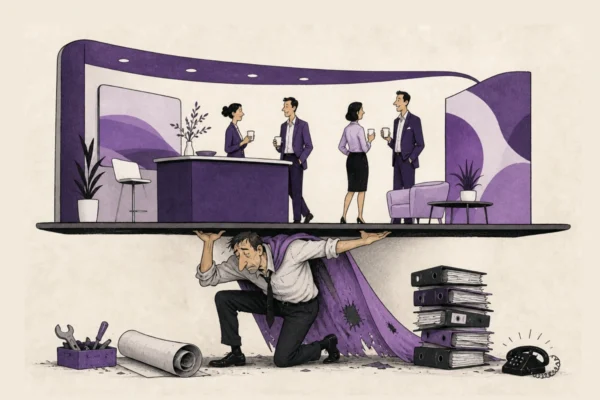




Most leaders think they are stuck because of strategy, people, or execution.
What actually slows them down is harder to see. It shows up in where they step in, what they hold onto, and what they avoid.
This piece looks at the three things leaders quietly protect, and how those protections end up capping how they lead as their business grows.
Watch this video.
A short conversation on what leaders are often protecting and how it quietly caps how they lead.
Now let’s go deeper into where this starts to show up.
You Know What Needs to Happen. So Why Isn’t It Moving?
You know what needs to happen.
You have known for a while. The decision. The shift. The conversation. None of it is new, and it is still not moving forward.
You step in. You stay in the work longer than you should. Sit in meetings you do not need to be in. Review things your team already handled. You ask for one more pass, even when you already know what you are going to say.
Or you wait.
You hold a decision a little longer. You tell yourself you just need one more piece of information, one more conversation, one more look at it.
This is not about capability. You have already proven you can do the work. That is not the issue. It is not about effort either. If anything, you are more involved than ever, more present, more engaged, more in it.
Something is not shifting, even though you know it should. There is a gap between what you know needs to happen and what you are actually doing.
Most leaders try to solve that gap with better planning, clearer communication, or more focus. That is not where it starts. Something else is getting in the way, and it is not what most people think.
The Hidden Factor: What You’re Protecting?
There are things you are protecting. You are not calling them out. Most of the time, you are not even calling them out to yourself.
They show up every day in where you step in, in what you hold onto, and in what you avoid. Over time, they begin to shape your decisions. They shape what you push forward, what you delay, and what you leave alone even when you know it needs to change.
You do not think of it this way because it does not feel like fear or self-protection. It feels like being responsible. It feels like making sure things do not break. It feels like keeping people aligned. Underneath all of that, there is something you are protecting.
Those protections are quietly capping how far you can go.
Identity: When Your Value Is Tied to Doing
One place this shows up is in how you see yourself.
When you built your confidence, it came from doing the work. Being the one who could step in, figure it out, and get it done. That is how you learned. How you proved yourself. That is how you became valuable. When something matters, you still go there. You jump in. You stay involved.
Deep down, you still trust your hands more than the machine you are trying to build.
That is where this starts to break.
The role has changed. What the business needs from you has changed. Your sense of value does not always change with it. You are not just supposed to do the work anymore. You need to build the people, the thinking, and the consistency that let the work happen without you. When you keep stepping in, you pull it back to you, even if you do not mean to.
Over time, your team adjusts. They wait longer. They check with you sooner. Work is brought to you half-finished because they assume you will want your fingerprints on it anyway. They stop making full decisions and start bringing partial recommendations. They do not own things all the way through because they know you may take it back anyway.
That is the cost. It is not just that you stay too involved. You quietly train the business to keep depending on you.
The harder question underneath all of it is this: If you are not the one delivering it, where does your value come from?
You stay involved. You stay in it longer than you should. Stepping back does not just change the work. It changes how you see yourself, and that is what you are protecting.
Control: When Everything Still Runs Through You
Another place this shows up is in control.
Control does not always look like control. A lot of the time, it looks like being responsible, keeping an eye on things, and making sure nothing gets missed. When the business is smaller, that can work. In some cases, it is exactly why things worked. You caught problems early. You kept things from slipping. You protected the outcome.
As the business grows, that same instinct starts to work against you.
There are more people, more handoffs, more moving parts, and more decisions being made without you standing right there. That is where control gets tested. It is not because you want power. It is because you do not want things going wrong on your watch.
You stay in the loop on everything. You want visibility into every important decision. You ask to be copied. You want one more check-in before something moves. You become the place things run through before they are allowed to keep going.
Again, it does not feel controlling. It feels careful. It feels smart. It feels like leadership.
Over time, the cost starts to show. Decisions slow down. People wait. They stop using their judgment all the way through because they know it still has to come back to you.
That is the cost.
The business is not moving on the strength of its people. It is moving on the speed of your attention.
That is the trap.
What once looked like protecting the business turns into the very thing that keeps the business dependent on you. Underneath all of it is the same tension. If you loosen your grip, what happens that you cannot control?
That is what you are protecting.
Validation: When You Don’t Say It All the Way
Then there is validation.
Not everything you hold back is about the work. Some of it is about how it lands.
You know the conversation that needs to happen.
You know what needs to be said and what needs to change.
You soften it. You leave room. You say it halfway.
You tell yourself you are being thoughtful. You do not want to come down too hard. You do not want to damage the relationship. You do not want to become the person they now see differently.
You ease into it and circle it. You let things sit longer than they should. What you call patience is often protection.
What you are protecting is how you are seen.
Once you say it clearly, once you draw the line, and once you make the call without softening it, you do not control how it lands. You do not control who thinks you were too hard, too blunt, or too much. You adjust. You hold back just enough. You leave space for interpretation. You give people room to hear what they want to hear.
Over time, the cost shows up.
Teams start operating off tone, guesses, and partial clarity. Different people walk away with different understandings of what was actually decided. Priorities are not clear. Standards move. People are not sure where they stand.
Cleanup shows up later in missed expectations, in rework, in follow-up conversations that should not have been necessary, and in things that should have been handled but were not.
It is not because people do not care. It is because you did not say it all the way.
That is the trade. You protect how you are seen, and the business absorbs the cost.
That is what you are protecting.
Why This Gets Missed as You Grow
This is why leaders miss it for so long.
When you are the one doing the work, these patterns do not hurt the same way. In fact, some of them help. Being tied closely to the work helps you move fast. Staying on top of everything helps you catch problems early. Reading people well helps you manage relationships and keep things from blowing up.
That is why this gets hard to see.
The same patterns that helped you build the business start creating drag once the business gets bigger.
They show up in the work coming back to you too often, in decisions stacking up around you, in people waiting for your read before they fully move, and in conversations that feel clear to you but land differently across the team.
From the outside, it can look like a people problem. Or a communication problem. Or a sign that the company just needs better managers. Sometimes those things are true.
There are also times when the deeper issue is that the business has grown and the leader has not fully let go of the way they had to lead when everything depended on them directly.
That is the shift that usually goes unnamed.
The business has grown. The role has changed. What leadership now requires from you has changed. Some part of you is still trying to lead from the place that made you successful before.
You see it when a founder keeps solving things at the point of impact instead of building the conditions that keep the same problem from coming back.
You see it when the leader says they want ownership of outcomes, and the team has learned that real ownership never fully leaves the leader’s desk.
You see it when people get better at reading the founder than at reading the business.
It is not that you do not know what to do next. You are still holding onto what made you effective at the last level. If you do not see that, you keep trying to solve the next-level problem with the last-level version of yourself.
That is where leaders get stuck. It isn’t that they cannot grow. Something in them has not let go.
The Real Fear Isn’t the Decision
This is also why fear gets misunderstood.
Most people think fear shows up around the decision. The hard call. The change. The conversation. That is usually not the real fear. The real fear is what that decision takes from you.
WHAT THIS REALLY COSTS YOU
If you stop stepping in,
you lose the version of you who could always fix it.
If you loosen control,
you risk something going wrong without you catching it.
If you say it all the way,
you lose control over how you’re seen.
That’s the real trade.
That is the fear. Not the decision itself. What the decision forces you to give up.
It forces you to give up the version of value you have trusted, the version of control that made you feel safe, and the version of approval that let you stay connected. That is why this is harder than it looks.
From the outside, it can look like a leadership issue, a discipline issue, or a communication issue. Underneath it, it is a letting-go issue.
Most leaders do not struggle because they cannot see the next move. They struggle because the next move costs them something internally.
The transition is hard. It is not because the business outgrew their skill. It is because the role now asks them to release something they have leaned on for a long time. That is what fear is doing here. It is not stopping the decision. It is protecting what the decision threatens.
The Question You Can’t Avoid
The question is not whether you know what needs to happen. You do.
The question is what you are still protecting.
Where are you staying in the work longer than you need to? Where are things still running through you that should not be? Where are you softening something that needs to be said all the way?
It isn’t that you do not know. Letting go of it costs you something.
It costs you how you see yourself. How much control you feel. How you are seen by others.
If those protections stay in place, they quietly set the ceiling on how you lead. You do not lack the ability to grow.
Something in you still has not let go.
Pat Alacqua and Jane Gentry work with founders, CEOs, and leadership teams to help them get the right work done by the right people at the right time as their businesses grow.
If you saw yourself in this story, you probably already know where it is showing up inside your business. The question is whether you are going to address it now or keep managing around it.
If you want a sounding board or thought partner to explore it further, reach out. There is no formal pitch here… just a direct conversation about what might be in the way.
Pat Alacqua – Pat@PatAlacqua.com
Jane Gentry – Jane@JaneGentry.com