



Every year, our industry produces what seem like the most legitimate predictions about the future of exhibits, events, and experiential marketing. Most focus on technology, attendee trends, or the next big innovation. All those topics matter, yet after more than two decades working with marketing leaders, sales teams, and executive leadership, I’ve learned that the biggest shifts rarely begin with technology. They begin with the client.
The questions clients are asking today are different than they were just a few years ago. Budgets remain under scrutiny, timelines continue to compress, and expectations keep rising. Can we do more with less? It’s become a common theme. At the same time, AI is changing how organizations work, creating more information than ever before, and the learning curve is steep. That’s making authentic human interaction increasingly valuable.
As we look toward 2027, the industry is being shaped by new technology, and even more by changing client expectations. Here are four signals I believe will influence exhibit companies, event professionals, and marketing agencies over the next year.
Human Connection Is Becoming More Valuable, Not Less
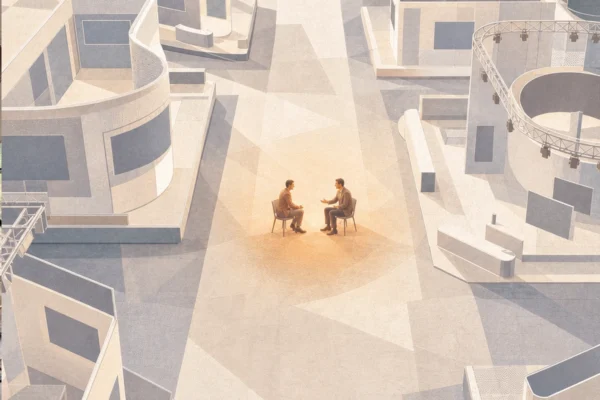
One prediction I continue to hear is that artificial intelligence will eventually replace much of face-to-face interaction. I believe the opposite is happening. As AI becomes increasingly capable of generating content, answering questions, and automating routine tasks, the value of genuine human interaction rises. “In Real Life” (IRL) is back in a big way, and brands are seeking fresh ways to integrate it. In a world shaped by AI, companies are realizing that crafting human experiences with intention outweighs flashy, tech-driven moments.
Audiences have seen the tech tricks before; what stands out now are the moments they can see, touch, and know are real. Events like Comic Con or the Consumer Electronic Showcase (CES) offer something no social platform can: thousands of people gathering in one place around ideas they already care about. It’s also a reminder that the footprint that matters most is the one that follows the audience, not the one bounded by a show floor. Extended events are spilling into hotels, restaurants, and city blocks, turning much of a convention city into an extension of the experience itself. Brands are creating their own extensions of presence, too, through executive client meetings and user conferences—event editions that keep on giving.
People don’t travel across the country simply to gather information. They travel to meet people, build trust, and solve problems together. The opportunity for our industry isn’t to compete with AI. It’s to create environments where relationships develop, ideas are exchanged, and business moves forward. That has always been the value of live experiences, and it will only matter more in the years ahead.
The data backs this up. Industry research found that 84 percent of tradeshow attendees say connecting with subject matter experts is “extremely or very important” to their event experience, yet only 26 percent of exhibitors identify that access as a top priority for improving exhibit engagement. Badge scans still matter for building a database, but hands-on time with a product matters just as much: 42 percent of attendees who left an exhibit without it said they’d be more likely to prioritize another vendor. Meanwhile, 95 percent of those who got hands-on time said it made evaluating the product significantly easier.
Clients Will Demand Proof, Not Promises
Artificial intelligence, sustainability, lead generation, and audience engagement are all areas that nearly every organization today claims to excel in. Clients are asking a simple question: Can you prove it? Marketing leaders are under growing pressure to demonstrate measurable value.
While ROI remains important, success is no longer one universal metric. A startup introducing a new product may define success by awareness and qualified introductions. An established manufacturer may prioritize strengthening relationships with existing customers. A healthcare company may focus on education and compliance. A technology company may measure sales acceleration. The definition depends on where an organization is in its business journey.
One-size-fits-all reporting doesn’t cut it in 2027. The partners who stand out will be those who understand each client’s objectives from the beginning, establish meaningful measures of success, and demonstrate how the experience contributed to those goals. The conversation is shifting from “here’s what we built” to “here’s what changed because we built it.”
The accountability gap starts well before the show opens: 80 percent of exhibitors do little to no targeted pre-show marketing, and 64 percent of tradeshow leads never receive any follow-up, according to data shared at a recent industry convention. This execution gap is one of the more fixable problems we face heading into 2027.
Proof will vary by objective. One brand marketer at a recent industry panel described tracking event impressions through beacon technology during a show, while measuring an entirely different set of KPIs—social shares, earned media, influencer reach—for an off-site activation happening blocks away. The same program produced two different kinds of proof for two different internal audiences. A single metric misses most of what it accomplished.
Relevance Will Matter More Than Spectacle
The industry has always celebrated the “wow factor”: bigger exhibits, high-touch events, larger LED walls, more immersive technology.
While those elements still have a real place, clients are asking a different question: Does this experience support our brand and our business objectives, and how do we know it really worked? An experience perfectly aligned with a company’s audience and goals will almost always outperform one that’s visually impressive but disconnected from its purpose. Not every company needs an immersive activation or a keynote presentation. Not every event requires the largest possible footprint. Clients want strategies and well-defined experiences that feel authentic to their brand and meaningful to the people they’re trying to reach. Success is now measured by the quality of conversations, relationships, and outcomes rather than by how many people stopped by an exhibit.
The most successful partners begin with strategy, asking why before deciding what. That instinct came through clearly in a recent industry panel of brand marketers and agency leadership. One experiential strategist shared a common scenario: a client asks for a large- scale visual centerpiece because a competitor had one last year, and when asked what message it should carry, the room goes quiet. Once a brand can articulate what it wants an attendee to think, feel, and do, the graphics, staffing, and technology decisions become clear and straightforward.
Clients Need Alignment as Much as Execution
“Do more with less” has become one of the most common phrases in business, but I don’t think it tells the whole story. Clients aren’t asking for less creativity or cookie-cutter solutions. They’re asking for partners who reduce complexity, build consensus, and help move projects forward with fewer surprises. One marketing exec recently shared an observation that has stayed with me: “The hardest part isn’t creating the strategy. It’s socializing the plan.”
An exhibit or event is no longer owned solely by marketing. Sales, communications, product, customer success, procurement, and executive leadership all have a stake in the outcome, each bringing a different perspective and often a different vision of success. Too often, teams leave a planning meeting believing they’re aligned, only to discover weeks later that everyone interpreted the strategy differently. That’s when the last-minute revisions begin: messaging changes, creative changes, budgets grow, and timelines compress. Frustration builds, not because the work wasn’t good, but because alignment never happened.
By 2027, I believe clients will increasingly value partners who help build organizational alignment before creative development begins. The right partner will ask the difficult questions early, facilitate productive conversations across departments, and help create shared ownership before a single exhibit is designed or an event is produced.
That isn’t about doing more work. It’s about helping clients accomplish more with less friction, fewer revisions, and greater confidence that everyone is moving toward the same goal. The same industry panel offered a vivid illustration of what happens when alignment breaks down mid-project: a product manager driving every creative decision, only for a CMO to step in late and redirect the entire plan. It’s a familiar story precisely because it’s common.
Looking Ahead
Tradeshows, conferences, and live events are becoming more intentional. More than 60 percent of marketing budgets are now going toward IRL, live events, and three- dimensional experiences like tradeshows and meetings. Clients still value creativity. They still appreciate innovation. They still want memorable experiences. Yet increasingly, they expect experiences to be purposeful, aligned with their brand, easier to execute, and connected to measurable outcomes.
For exhibit companies, agencies, and event professionals, that’s an opportunity. The organizations that succeed in 2027 won’t necessarily be those with the biggest exhibits or the newest technology. They’ll be the ones that listen more carefully, simplify more effectively, and create experiences uniquely relevant to the organizations they serve. The future of our industry isn’t simply about designing better events, though we need to do that too, and stay ahead of sustainability and cost-control measures.
We’re not really designing “booths” anymore. We’re designing business outcomes, and the honest test of any program is what happens the weeks and months after the show ends, not how it looked on the floor. That’s a fitting way to think about 2027: not toward bigger booths, but toward better outcomes.
P.S. One small request: Let’s stop calling them booths. They’re so much more than that. Today, they’re immersive brand environments, three-dimensional expressions of a brand, and thoughtfully designed human experiences.
This story originally appeared in the Q4 2025 issue of Exhibit City News, p. 16. For original layout, see Print Version