



When we talk about safety in the trade show industry, we usually think about the obvious things: rigging, forklifts, working at height, and electrical.
Those things matter. A lot. But there is another safety issue that is less dramatic and happens every day in warehouses and on show floors: people lifting and carrying heavy things all day.
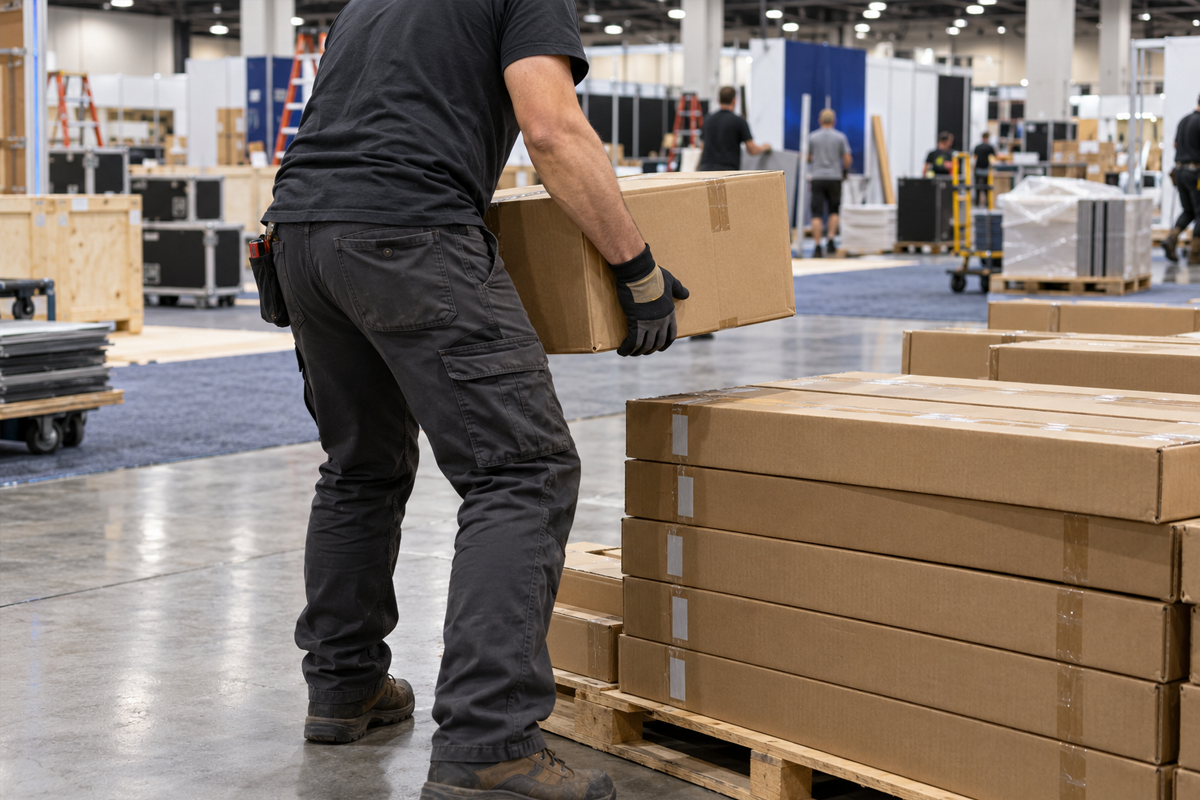
Our teams move everything — hardware, wood, glass, structural components, mountains, and literally everything else that goes into an exhibit. Every time they lift it, carry it, load it or unload it, there is some wear and tear on their bodies.
So I think there is a pretty simple question we should be asking:
How much of that physical strain is necessary, and how much are we choosing to create?
That is why weight belongs in the safety conversation.
A few pounds may not pop off the pages of a spec sheet. But when those extra pounds are being lifted hundreds or thousands of times, they start to matter.
A Few Pounds Adds Up
A five- or six-pound difference in a component may not sound important. If you pick it up once, it’s probably not.
But nobody in our industry picks these things up once.
We routinely stack 25 or more of the same component on a pallet. When we move them by hand, we often move as many pieces at a time as one person can safely carry. Sometimes more than that. A warehouse employee may handle the same component hundreds of times. An install crew may handle dozens or hundreds during one build. Then the booth comes down and we do it again.
Then it goes to the next show.
Over the life of an exhibit system, those extra pounds can be lifted thousands of times.
In its Ergonomic Guidelines for Manual Material Handling, NIOSH uses scientific evidence to support the conclusion that reducing the physical demands of manual material-handling work can reduce both the incidence and severity of musculoskeletal injuries.
Additionally, in the Back Disorders and Injuries section of the OSHA Technical Manual, OSHA states that manual material handling is a principal source of compensable workplace injuries. It goes on to state that material handling tasks should be designed to minimize the weight. It also cites an aging workforce as a contributing factor.
That is pretty straightforward.
If we can safely reduce the amount of weight people have to lift, carry and move all day, we can reduce some of the strain we are putting on their bodies.
I’m not saying that lighter is automatically better. If taking weight out of a product makes it weaker, less stable or less safe, then we have not improved anything.
But if two products can do the same job, have similar durability and meet the same performance requirements, and one weighs materially less, I think that should be part of the decision.
Check the Spec Sheet
In my last Exhibit City News article, I talked about checking the spec sheet before making a major inventory purchase.
Ask the manufacturer what the product weighs. Then compare it.
Take a typical booth and look at the total structural weight. Think about how many times that material is going to be handled over its life.
We already look at price, compatibility, installation speed and lifespan. Weight/safety should be part of that discussion too.
Not because lighter always wins, but because somebody on your team may be picking up that product for the next 10, 15 or 20 years.
An Injury Is Personal
When somebody gets hurt at work, it is easy for a company to look at missed time or lost productivity.
But that is only part of it.
A lot of operations employees in our industry are paid hourly. Some have great insurance. Some may not. Some count on overtime. Many have children, spouses, parents or other family members depending on their paycheck.
A strained back or injured shoulder can create problems pretty quickly.
It may mean missing a few days of work. It may mean a smaller paycheck. It may mean putting off a bill, cutting back on groceries or trying to figure out childcare.
That is the part of workplace safety that can get lost when we only talk about the business impact.
The person carrying that product has people depending on them.
Making a more thoughtful purchasing decision is a way to show them you see them, a way to show them you care about their livelihoods and their families.
Think About Who Has to Carry It
The leader making the purchasing decision is not usually the same person who will be handling that product every day.
We look at price, durability, compatibility, appearance and ease of installation. All of those are important.
But there is another question worth asking:
What is this going to be like for the person who has to move it all day?
If you are buying hundreds of pieces of reusable exhibit inventory, those pieces could be in your operation for years. Somebody may end up lifting them for a significant part of their career.
Weight is not just another number on a specification sheet. It affects the job we are asking people to do.
And I think that is where leadership comes into it.
True leaders make decisions that intentionally benefit their teams. Not every decision can make the work easier, but when we have a real opportunity to reduce unnecessary strain and improve safety, we should take it.
According to Michael Kaack, Sr. Director of Safety, North American Safety GES
“True safety leadership means looking beyond today’s job and asking how our decisions impact the people who will perform that work for years to come. Every pound that we can safely eliminate from a task is more than an operational improvement. It’s an investment in the health, wellbeing, and future of our people”
The Industry Runs on People
This industry still depends heavily on people.
People unload trucks, people pull orders, people build exhibits, people make last-minute changes and people stay late when something does not go according to plan.
That is the reality of the work.
We spend a lot of time talking about taking care of customers. We should put the same thought into taking care of the people doing the work.
Our warehouse teams, installers and operations employees have people depending on them at work, and they have people depending on them when they go home.
They should be able to depend on us too.
We are never going to remove every physical demand from this industry. It is hands-on work, and it probably always will be.
But we can make better decisions about the things we can control.
Sometimes improving safety requires new equipment, a major investment or a completely different process.
Sometimes it is as simple as looking at the spec sheet and checking the weight.
Five pounds may not seem like much.
But ask the person who has to lift it a thousand times.