



EuroShop, 2020. After years of designing and building booths across Europe, I arrived on site quietly confident. I should not have been. I had misread my own floor plan, got my compass points backwards, and set the whole stand out as though north were south. I felt less like a seasoned exhibition professional and more like a mildly drunk Jack Sparrow.
The power was in completely the wrong corner. The entire booth orientation was flipped. What followed was a good deal of careful negotiation, in worse German than I would like to admit, to get the electrics moved and the stand turned around. The day was saved. The invoice from the electrical team was not something I would call saved.
Which is the whole point. The lesson from that morning was not really about compasses. It was that the things that catch you out at a European show are almost never the costs on the quote. They are the assumptions you walk in with. Fifteen years of building stands across Europe and North America, and they still get me. These are the ones I see catch out American exhibitors most often.
Pipe and drape do not exist here
Start with the big one, because everything else follows from it.
In the United States, a smaller booth typically arrives as pipe and drape: poles, fabric, and the rest is yours to fill.
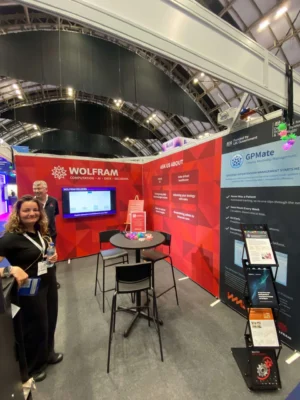
In Europe that is almost unheard of. Anything that is not an island booth will usually come as a shell scheme: rigid, pre-built walls, most often an aluminium system such as Octanorm or Sodem, at a fixed height, with a fascia board across the front carrying your company name.
Ask for space only instead and you get exactly that: a taped-off rectangle on the concrete with your booth number in the corner. Nothing else.
Neither is a problem, once you know. But you are not building into empty space. You are building inside a box that already exists, and the box has rules.
Nobody can tell you where the brace will be
Here is a subtler one, and it catches out people who have done this for years. Ask the organiser for the height limit and they will tell you: two and a half metres, say. What they very often cannot tell you, because it has not yet been decided, is whether your particular booth will end up with a diagonal corner brace or a fascia sitting well below that line.
Those braces and fascias are frequently added on site by the contractor building the shell scheme, for stability, depending on how that run of walls behaves. Not every booth gets one. Which is exactly why you are never quite sure what you are working with until you are standing in it.
So do not design to the maximum. Design under it and leave yourself somewhere to go. Build tolerance into your header and your graphics and you will absorb a surprise, rather than standing in a hall at seven in the morning with a saw, negotiating over whether a diagonal can come out.
Some can. Many cannot. It is not a bet worth taking.
The back of your stand is not yours to ignore
This is the rule that catches Americans out hardest, and almost nobody warns you about it.
If any part of your stand rises above the stand behind you, which in most European halls means anything above roughly 2.4 metres, then the back of it is visible to every visitor walking the aisle beyond.
Two things follow.
You may not advertise on it. That rear face is not yours to sell from. Branding it is, in effect, advertising into your neighbour’s space, and an organiser will make you take it down.
And you may not leave it raw. Exposed framework, bare panel edges, a nest of untidy cabling: none of it is acceptable. If it can be seen, it must be clad and clad properly. That is your responsibility and your cost, and it is astonishingly easy to forget while designing something that looks magnificent from the front.
It cuts both ways, which is the fair part of the bargain. If your neighbour builds higher than you, you are owed exactly the same courtesy: a clean, covered, unbranded rear elevation, and not the back of a wardrobe.
Attach to the shell. Do not build inside it.
Here is the trick Americans coming to Europe almost never know.
Because shell scheme walls are rigid and structural, you do not have to build a freestanding structure inside them. Attachment kits clamp a modular framework straight onto the shell walls.
The reason it matters is floor space. Build a freestanding wall inside a shell scheme and you have paid for square metres, then covered them with your own structure. Hang off the shell instead and that space stays yours. On a small booth, that is the difference between a stand you can work in and one you cannot.
The floor, and the ramp you forgot
In the U.S., flooring generally means carpet, bought through the general service contractor, at prices that routinely astonish visiting Europeans.
In Europe it is far more common to build a raised floor: a platform, carpeted and trimmed. The quality can be excellent, and it hides your cables.
But raise your floor at all, even slightly, and you take on an accessibility obligation. At most venues that means a ramp, built to a set gradient, and organisers will hold you to it. You can sometimes satisfy it another way, but the ramp is the expectation — so design it in at the start rather than discovering it on site.
Work out your power before you land
This one has cost me money, so I will be blunt about it.
Calculate what you actually need and order it in advance. Every screen, every light, every laptop, every coffee machine somebody smuggled into a flight case.
I have been caught out in Germany, where increasing the supply on site meant bringing in the venue’s own electricians at a cost I would call ‘memorable’. The order form, submitted in good time, is cheap. The man with the cable on the morning of the build is not.
None of this is a reason to be nervous about exhibiting in Europe. It is a reason to budget honestly for it, and to ask the right questions early. If it helps, I keep a plain-English guide to what an exhibition stand actually costs that breaks the numbers down line by line.
One small thing that buys you an hour
Leave a ladder and a flight case inside your booth.
If your tools and cases have gone into storage, you cannot touch anything until the empties come back, and the whole hall is waiting on the same forklift. Keep a ladder and a case in the booth and you can start breaking down the moment the show closes, on the road while everyone else is still queuing.
What it comes down to
In fairness, Europe hands you some pleasant surprises too. Drayage, as Americans understand it, barely exists, and in most halls your own crew can build your own stand with your own tools.
But the expensive thing you carry to another continent is never the freight. It is the assumptions.
Read the manual, every time. Ask what is not included. And ask what is already inside your booth before you design anything to put in it.
Philippe van Ameyde is managing director of T3 Systems, a British-French maker of modular, reusable exhibition stands. He has spent 15 years designing, building, and contracting stands across Europe and North America. For more info, visit t3systems.com.