



By Michael Costantino, iLLUMITUBES
A corporate event’s visual identity should not disappear when guests leave the stage area and sit down for dinner. For exhibition and event teams planning an associated reception, awards program or company celebration, the tabletop is another place to carry the event’s artwork. It also has practical constraints: guests need room to eat, see one another and read what is in front of them.
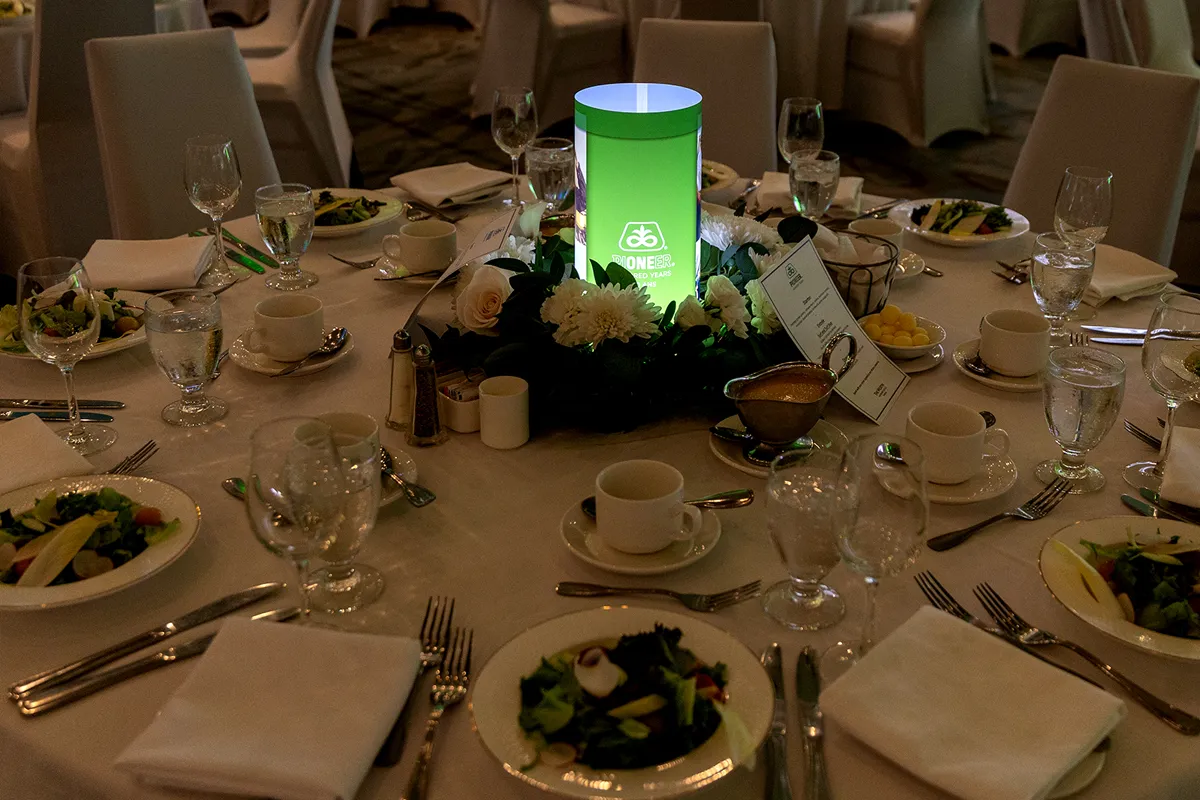
Pioneer’s 100th-anniversary celebration in Toronto offers a concrete example. The final order for the August 24, 2026 event was 80 illuminated, 13-inch iLLUMITUBES centerpieces, divided evenly among four artwork designs. The green artwork included the Pioneer logo, anniversary wording in English and French, and photographic panels.
The banquet photographs show the illuminated pieces surrounded by white flowers and place settings. The floral arrangements are part of the event setting, not a component of the iLLUMITUBES product. In the room view, the anniversary identity also appears on the screens. The tabletop treatment carries that identity into the dining area without requiring every surface to use the same format.
This was a corporate banquet, not a measured trade-show activation. The project does not establish a return on investment or a change in attendee behavior. What it does provide is a useful production example for teams trying to coordinate branded elements across a room.
Plan the artwork as a set
Four designs can still read as one event. The useful starting point is a shared visual system: a consistent logo treatment, a limited color palette and a clear hierarchy. Individual versions can carry different images or messages while retaining those common features.
A cylindrical surface deserves its own artwork review. A layout that reads well on a flat screen may place an important word near the seam or turn a photograph away from the main viewing position. Review the complete wrap, then inspect an assembled sample or dimensional preview. Check the primary message from several directions rather than approving only the flat artwork.
Translate the table plan into quantities
“Eighty centerpieces” is a purchasing total. “Twenty of each of four approved designs” is a production instruction. Both belong in the final handoff.
For a mixed-design order, list the approved artwork filename, version, size and quantity together. If the table layout changes, reconcile that list before production. Decide separately whether spare pieces are needed rather than treating the entire shipment as the exact table count. Labeling cartons by artwork version can also help the installation team distribute the pieces as intended.
Review the complete table
A centerpiece should be checked with the surrounding setting, not in isolation. Table numbers, menus, flowers, glassware and shared serving pieces compete for the same space. The review should include a seated view from opposite sides of the table and a check under lighting similar to the event.
Illumination adds another variable. Artwork contrast, ambient light and the light source can affect how a graphic reads. A practical test should confirm the appearance of the assembled piece, access to its light and the setup steps the crew will perform. These are project-specific checks, not guarantees that one size or lighting arrangement will suit every room.
Make the handoff usable
The production package should leave as little interpretation as possible: approved artwork, quantities by version, receiving instructions and setup guidance. The event team should know which supplier is responsible for each element, including any surrounding flowers or décor.
The broader lesson from the Pioneer project is straightforward. A tabletop object can carry a corporate identity, but the result depends on the work around it: coordinated artwork, accurate quantities and a realistic view of the finished table. For teams extending a conference or exhibition identity into hospitality spaces, those decisions are worth making before the final print files are approved.
About the author
Michael Costantino is the owner of iLLUMITUBES, which produces custom illuminated centerpieces for events. He supplied the centerpieces discussed in this article. More information: https://illumitubes.com/