

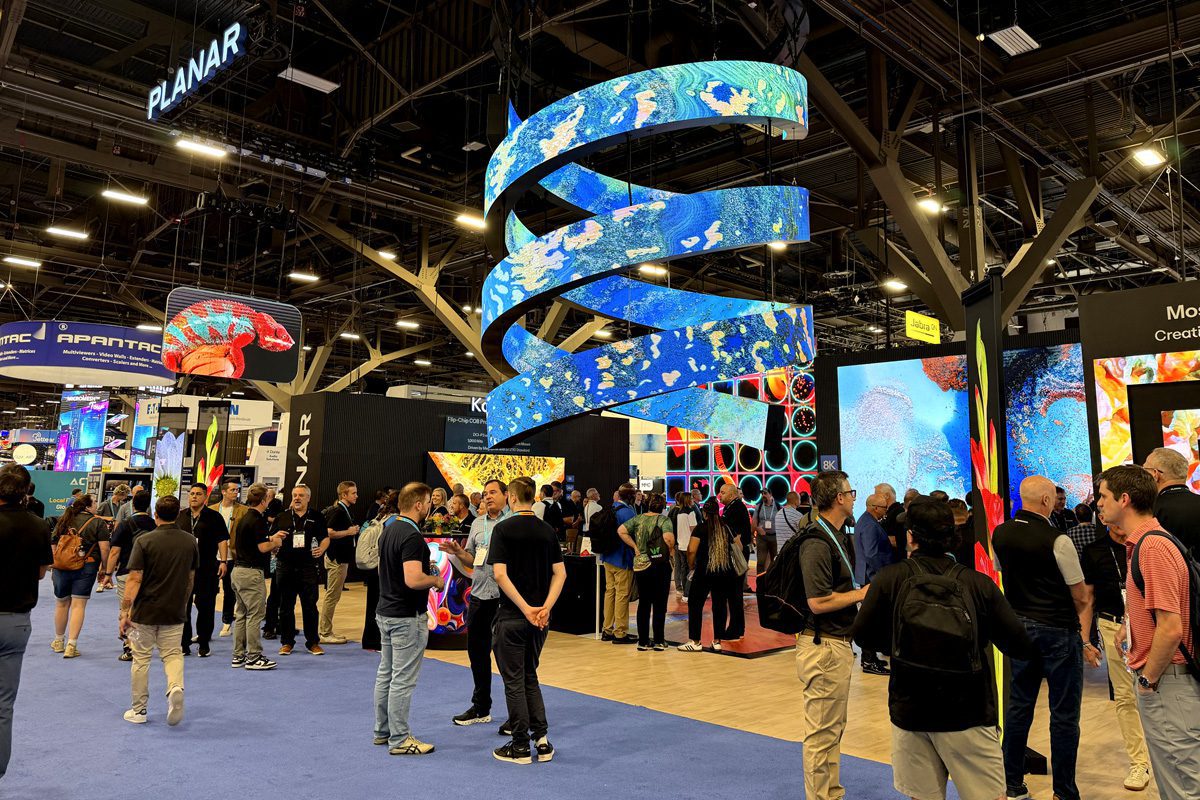


Every year, InfoComm offers a glimpse into the future of professional audiovisual (AV) technology. In 2026, the industry’s largest North American tradeshow revealed something bigger than the latest LED display, collaboration platform, or audio solution.
The story emerging from the Las Vegas Convention Center was one of convergence. InfoComm 2026 hosted 807 exhibitors across 395,500 net square feet of show floor. It drew 28,132 verified attendees from 94 countries, with international attendance representing 20 percent of the audience. End users made up 37 percent, according to figures released by AVIXA, the show’s producer. Total registrants reached 35,707. In addition, education programming included more than 300 sessions on artificial intelligence (AI), workplace technology, broadcast AV, digital signage, enterprise IT, and experience design.
Across those exhibits and sessions, a common theme connected nearly every category: office communication, commercial development, digital experiences, AI, and live events are merging into one connected ecosystem. For exhibit builders, event producers, AV integrators, designers, and experiential marketers, the implications are significant. The technologies transforming corporate workplaces today are also shaping tomorrow’s tradeshows, conferences, brand activations, and public spaces.

The Future of Work Dominated the Conversation
AVIXA placed workplace transformation at the center of this year’s show. “Today’s workplace is no longer defined by a single space or platform – it’s an ecosystem,” said Jenn Heinold, senior vice president of expositions, Americas, for AVIXA. “InfoComm 2026 is designed to show how AV, IT and AI come together in real environments to create workplaces that are more connected, more intelligent and ultimately more effective for the people who use them.”
One of the show’s four immersive floor activations, Smart Workplace, demonstrated how integrated technologies can create more intelligent work environments. FORTÉ powered the activation, which featured AI-enabled collaboration, workplace analytics, and enterprise communications systems.
Meanwhile, a companion activation, The Pitch, showed how sports, broadcast, live events, and fan engagement technologies are starting to overlap. Diversified powered the activation, which included production workflows, collaboration spaces, and interactive audience experiences. Together, the two activations showed how blurred the line between “workplace” and “event” technology has become.

Artificial Intelligence Moves From Buzzword to Business Tool
InfoComm organizers called 2026 a defining year for AI. The topic appeared across keynote presentations, education sessions, show floor experiences, and exhibitor demonstrations. Attendees explored how AI applies to workplace collaboration, content creation, customer engagement, enterprise communications, and operations.
The keynote stage reinforced the point. Microsoft highlighted how AI-powered platforms, including Teams Phone, Teams Rooms, Teams Events, and Teams Premium, are shaping communication across physical and digital workspaces. Cisco also explored its vision of “Connected Intelligence,” showing how integrated AV, IT, and AI-driven infrastructure can unify workplace environments. Those systems can also offer deeper insight into how people use spaces.
AVIXA’s own research backed up the floor-level energy. “The biggest trends shaping our industry today are being driven by end users’ expectations for richer, more intelligent experiences powered by AI and broadcast-grade quality,” said Mike Sullivan-Trainor, senior industry analyst at AVIXA. Heinold offered a useful filter for buyers wading through the noise: “The best AI is an enhancement to AV, and not the other way around. The best AI is what’s making AV more proficient, efficient and personalized.”
For event professionals, that distinction matters. Rather than standing apart as a separate product category, AI is becoming an integrated layer across communication platforms. As a result, it can help personalize experiences, automate workflows, and turn attendee data into useful insight.
Smart Buildings and Communication Infrastructure Continue to Evolve
One of the strongest undercurrents at InfoComm 2026 was the growing relationship between communication technology and the built environment. Developers, architects, and facility managers increasingly treat communication systems as core to modern building design. Digital signage, wayfinding, occupancy analytics, and visitor management are becoming standard features of commercial developments, not optional add-ons.
The goal is no longer simply to connect devices. The goal is to connect people. As buildings get smarter, communication technology is becoming as fundamental as traditional infrastructure.
The Event Industry Is Adopting Enterprise Technology
Perhaps the most interesting takeaway is how quickly enterprise communication technology is moving into live events. AI-powered cameras that support boardroom meetings now track keynote speakers. Digital signage platforms from office environments now manage attendee communications across convention centers. In addition, analytics systems used to study workplace behavior are helping event organizers optimize traffic flow and engagement.
That convergence is becoming structural, not incidental. InfoComm 2026 also served as the launchpad for RESIDE, a new event dedicated to the residential integration market. AVIXA, HTSA, and ProSource created the event, which will debut alongside Lightapalooza at InfoComm 2027 in Orlando. Organizers say the move reflects the growing overlap between commercial and residential AV technologies. However, if commercial and residential AV are merging, the line between workplace tech and event tech was never going to hold either.
This convergence creates new opportunities for exhibit houses, AV providers, production companies, and experiential agencies looking to deliver measurable value to clients.
LED, Immersive Experiences, and Visual Storytelling Remain Strong
While workplace communication dominated the conversation, the visual side of the industry stayed just as innovative. Large-format LED displays, immersive environments, projection technology, and interactive content systems continued to draw crowds throughout the week.
Costs are decreasing, and capabilities are improving. As a result, these tools are becoming accessible to more brands, organizers, and venue operators. They are no longer limited to major productions and permanent installations.

What It Means for the Industry
Attendance came in roughly 7 percent below the previous Las Vegas show in 2024, which had set post-COVID records, according to AVNetwork. Still, the substance of the show pointed forward, not back. The same technologies driving collaboration in corporate environments are now shaping commercial developments, entertainment venues, hospitality, retail, and live events.
For the exhibit and events industry, that’s an invitation to think beyond displays, staging, and AV equipment. Clients are increasingly looking for communication ecosystems that connect audiences, generate insights, personalize experiences, and create measurable outcomes. Therefore, organizations that bridge workplace technology and live experiences will be better positioned to lead the next generation of engagement.
As Heinold put it, this year’s show wasn’t just about telling attendees where AV is headed. It was about letting them experience it firsthand. Experiential communications are now taking shape everywhere people gather.
Related stories
EXHIBITRECRUITER Releases 2026 Hiring and Compensation Report