



Hard work built this industry. Hard work alone won’t scale it. The rest comes down to whether you stay the one who rescues or become the one who builds.
Watch this video.
The Week That Tells You the Truth
It’s a peak stretch. Sales just closed three new programs in two cities. Scheduling is tight. Warehouse capacity is stretched. A project manager is overloaded. A client wants scope changes before install. Labor questions are stacking up. Another show overlaps next week.
You’re approving pricing. Adjusting staffing. Calming a client. Clarifying a handoff that should have been clear weeks ago. Then you get to the show floor, and you make it work. You always make it work.
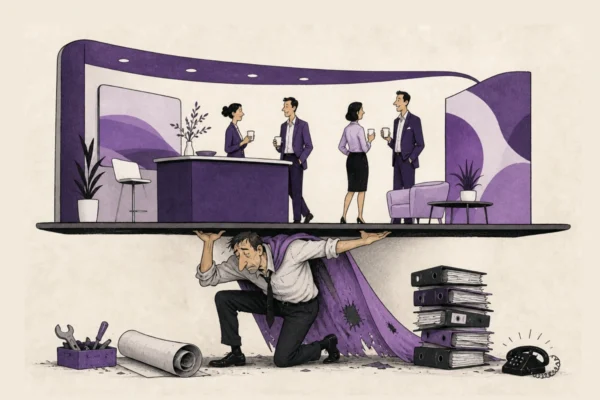
Every time you make it work, you reinforce a system that depends on you. Every time you save it, the company learns to wait for rescue. And you teach the team a quiet lesson. Don’t decide. Bring it to you.
Every peak season feels like controlled chaos. The same breakdowns repeat. Decisions drift upward. Growth adds volume, but not clarity. Peak season doesn’t create the cracks. It exposes them.
And it isn’t only what happens on the floor. It’s in the pricing that still needs your sign-off, the staffing plans that fall apart without you. The billing questions that route back to your inbox. The overlapping cities that stretch leadership thin since no one else is fully empowered to decide.
Then the show ends and the bill comes due. Write-offs, disputes, and a team too tired to fix what caused it. You don’t call it strain. You call it hustle. That’s when the voice shows up. And that voice will either save you or sabotage you.
Hustle Built It. Hustle Won’t Scale It.
This industry was built on hustle. Hard work, blue-collar pride, making the impossible happen. Saving shows at the last minute, loading trucks in the rain, and solving problems at midnight. That’s why this industry is great.
Here’s the wake-up call. You can’t scale the hustle. Hustle is how you survive a hard week. It isn’t how you build a company that can handle a hard year.
If working harder is still your growth strategy, you don’t have a scaling strategy. You can add more shows, more cities, more clients, more people. If every new show increases your personal load, you’re not building capacity. You’re building dependency.
Hustle is a cultural strength. Heroics are episodic saves. But when they become your default plan, the company runs on effort instead of on systems that hold.
If hustle is the plan, you’re renting performance instead of building it.
When Rescue Becomes the Business Model
When the systems don’t catch up to growth, something fills the gap. In a lot of trade show and event companies, that something is the founder, or CEO, or a few key leaders.
You stabilize the client relationship. You resolve the pricing gray areas. You fix the sales-to-ops disconnect. You make the final call during install. You smooth over the misalignment nobody else will touch.
It works. And that’s the trap.
If the company’s greatest strength is your personal intervention, it’s also its greatest risk. A company that runs on rescue isn’t a company. It’s a series of emergencies with invoices.
You can survive a long time this way, looking successful while the business quietly becomes unmanageable. More shows, more cities, more customers, same bottlenecks.
Survival disguised as growth still breaks the moment real pressure hits.
Why the Voice Gets Loud When You Grow
Growth forces a role shift. Doer to builder. Builder to architect.
Many leaders in this space came up through the work. You earned your credibility by knowing the details, by being the one who could save the show. That identity doesn’t fade when revenue grows.
And that’s where the voice in your head gets distorted.
Three Ways the Voice Turns on You
Three forces hijack it as you grow: identity, control, and validation.
Identity. The voice tells you you’re the only one who gets it right, so you step in again. That instinct built your reputation. Now it caps the company, since the work never fully leaves your hands and the team learns there’s no point deciding without you.
You stay the most valuable person in the building, and the building never outgrows you.
Control. The voice says this one’s too important to risk, so it routes through you. One more sign-off, one more regroup. Nothing goes wrong on your watch, and nothing moves at its own speed either.
Sales waits, design waits, ops waits, install waits, and the speed that is your real edge in this business bleeds out a day at a time.
Validation. The voice says they still need you, and being needed reads as proof you still matter. But that pull fights every system that would let you step back.
If your worth is wired to the rescue, you’ll protect the rescue, and a company built to need you can’t scale past you.
The Question You’re Avoiding
Here’s the uncomfortable one.
If you were forced to step away for 30 days during peak season, not by choice, would the business perform? Or would your inbox fill with pricing questions, staffing gaps, and scope exceptions?
Not emotionally. Operationally. Would decisions flow? Would handoffs hold? Would clients feel steady? Would margin survive?
If more cities and more shows increase your personal load instead of the company’s ability to deliver without you, you aren’t scaling the business. You’re scaling dependence.
And if you’re honest about the answer, the next move isn’t to work harder. It’s to pick the one decision or handoff that still has to run through you and fix that one first.
When to Trust the Voice, and When to Fight It
That voice isn’t always intuition. Sometimes it’s the doer in you grabbing the wheel again.
Trust it when it points to the breakdowns that repeat. When sales promises outpace delivery. When the handoff from contract to execution is inconsistent. When nobody’s sure who decides on scope and change orders. When overlapping cities stretch leadership past its limit. When margin erodes at peak as accountability blurs.
If every peak season feels like the same cycle of pressure and last-minute saves, that’s not the industry. That’s how your business is built to run.
Here’s what real operating discipline actually is, and it isn’t bureaucracy. It’s repeatable clarity under pressure. Who’s responsible for what. Who decides what. What happens when the plan changes.
If your team can’t answer those three without looking at you, you don’t have clarity. You have everything concentrated in one person.
Fight the voice when it pulls you back into the hustle. “I’ll just handle it. They’re not ready yet. We just need to push harder.”
You call it leadership. If everything still routes back to you, it isn’t leadership. It’s the default move: bring it to you. You can’t build a company on constant heroics.
If you become the operating system, growth will always cost you exhaustion.
Stop Rescuing. Start Building the Need Out.
Hard work will always matter here. It has to sit on top of systems, not stand in for them. The goal is fewer surprises, fewer rescues, fewer late-night decisions.
That means clear responsibility from the sale to the show floor. Decision rights settled before peak hits, not during it. Leadership deep enough to hold across cities. Planning that keeps the same chaos from repeating.
And it starts smaller than a full overhaul. Take the two or three decisions that always route through you and name who owns each one now. The change-order call that lights up your phone in the middle of every show, who owns that, and do the client and the crew know it’s them and not you?
Then take the handoff that breaks every season. The one from the deal sales closed to the people who have to build it. Write down what “done” looks like before it leaves one set of hands for the next.
That’s a week’s work, and it’s where real capacity comes from.
The role change is the scale change. Stay the hero, and growth just adds stress. Become the architect, and growth adds strength.
What the Voice Is Really Telling You
There comes a point where effort isn’t the constraint. Thinking is. And many leaders can’t see the difference from inside their own identity.
So the real question isn’t whether to work harder. It’s whether the voice in your head is pointing at a flaw in how the business runs, or clinging to a role you’ve outgrown.
You can’t scale the hustle, and you can’t live forever off heroics. If your growth depends on your adrenaline, it isn’t scale. If the company only works when you’re exhausted, it doesn’t work. Architects don’t rescue. They remove the need for rescue.
That voice in your head can save you. But only if you’re willing to hear what it’s really saying.
Pat Alacqua has built and sold his own companies, and led them through startup, growth, and turnaround. He’s made the move this article describes, from doer to business-builder to company architect. Today he works with owners, CEOs and leadership teams on the operating discipline that lets growth add strength instead of stress. Reach him at Pat@PatAlacqua.com.