



How Growth Attracts the Wrong Business — and What It’s Costing You
It’s two weeks before the show opens and your phone rings. The client has decided the configuration is wrong. Not the graphics — the entire layout. The booth they approved six weeks ago, the one your crew has already started prepping, needs to come apart and go back together differently.
You’ve been here before. You’ll absorb the rush. You’ll pull people off other jobs. You’ll make it work, because that’s what your company does.
What you probably haven’t calculated is what this client is actually costing you — not on this show, but across a full year of relationships built on your willingness to fix their problems on your timeline.
That calculation is where this gets uncomfortable.
The Deeper Problem Isn’t the Client. It’s What They’re Doing to Your Company.
Before we get to the math, there’s something more damaging happening that most owners don’t see until it’s baked into how their operation runs.
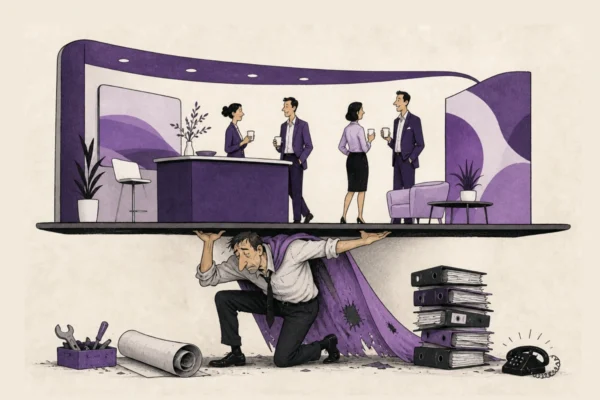
When you repeatedly build around chaotic clients, you don’t just absorb their cost — you absorb their behavior. Your best project managers become expert firefighters. Your intake process gets built around exceptions. Your team stops asking how to prevent problems and starts asking how to get through them. Chaos stops feeling like a problem. It starts feeling like the job.
Your hiring decisions, your systems, your day-to-day culture all start bending toward the hardest client you serve — not the best one. And when that happens, you lose the ability to serve well-organized clients the way they deserve. The instincts that got you through a chaotic build are the wrong instincts for a client who needs precise communication, proactive updates, and a project manager with enough bandwidth to think ahead instead of react.
You start losing good clients not because of a specific failure, but because your operation no longer fits how they want to work. Usually you don’t know it until they’re already gone.
This is the customer complexity cascade — and the reason it’s dangerous isn’t just that it attracts bad clients. It’s that it rewires your organization around them.
The Loop Most Owners Don’t See Until It’s Too Late
The cascade runs like this: growth pressure pushes you to say yes to clients you’d have qualified out in better times. Those clients create operational drag — late specs, on-site decisions that should have been made in the planning phase, scope changes at the two-week mark. Managing that drag pulls your best people into firefighting. Your core clients feel the service decline. Some leave. Revenue softens. Growth pressure increases. You say yes to more clients you shouldn’t.
The loop doesn’t pause when things get busy. It compounds. Most owners believe they’ll fix it when things calm down. The cascade is precisely why things don’t calm down.
What makes event services companies uniquely exposed is the operating model. You work on fixed deadlines. When the show opens Thursday morning, it opens. When the installation window closes, it closes. When the freight needs to be on the dock, it needs to be on the dock. Every problem a client creates lands on your operation. You absorb the rush charges. You pull your best crew off another job. You make it work, because that’s what this industry demands.
That culture — get it done, no matter what — is exactly what problem clients count on. They know you’ll figure it out, so they stop planning. They get worse every engagement because the consequences keep landing on you, not them. And because you keep solving it, they have no reason to change.
Run the Management P&L, Not Just the Revenue P&L
Every client in your portfolio has two P&Ls. The revenue P&L is what shows up in your system. The Management P&L — what that client actually costs in senior time, operational disruption, and absorbed expenses — almost never gets calculated. That gap is where your margin goes.
Here’s what it looks like at real industry numbers.
You have a client doing four events a year at $40,000 each. $160,000 in annual revenue. At industry-average gross margin of 20.7 percent, that’s $33,100 in gross profit before you account for what this client actually costs to manage.
Now run the real numbers.
Difficult clients don’t just require more labor — they require more of your most experienced people’s time. Across your project manager, account manager, and production coordinator, this client generates an average of 20 additional management hours per event beyond your standard process: extra calls, scope clarification, damage control, internal coordination triggered by their disorganization. At a fully-loaded cost of $145 per hour, that’s $2,900 per event — $11,600 annually.
Add rework. This client changes something material after final approval on three of four events. Each change runs five to seven hours of senior labor. At $145 per hour, that’s $1,015 per incident — $3,045 annually.
Add absorbed rush charges — expedited freight, overtime on the crew, production upgrades you eat rather than bill because the relationship is already tense: conservatively $2,000 annually.
They’re also on net-75 terms. On $160,000 in annual billings, you’re carrying an average of $33,000 in receivables at any given time. That money is sitting in their AP queue instead of your operating account.
Total management tax: approximately $19,300 annually.
Real gross profit after management tax: $13,800 — 8.6 percent on $160,000 in revenue, not 20.7 percent.
Now look at what’s left. At industry-average net margin of 8.7 percent, this client generates roughly $13,900 in net profit before the management tax. After $19,300 in management cost, you are $5,400 in the hole on $160,000 in annual revenue.
This client is not underperforming. They are losing you money — while appearing on your revenue line as one of your better accounts.
At 20.7 percent gross and 8.7 percent net, there is no cushion to absorb a difficult client. The math leaves almost no room for error on even one bad relationship — let alone the two or three most growing companies are carrying right now without realizing it. Run these numbers on your most demanding clients. The answer will be clarifying, and usually uncomfortable.
The Client Complexity Index
Most event services companies don’t have a formal intake process. They have judgment — which is inconsistent by nature and falls apart under growth pressure precisely when you need it most.
Score each criterion from 0 to 10. Below 42 out of 60, either price the relationship to reflect what it actually costs, or have the qualification conversation before you commit.
Decision-maker access (0–10) Are you working directly with the person who can approve changes, or are you three layers removed from someone you’ve never spoken to? If you’ve never had a real conversation with the person who can actually say yes, you don’t have decision-maker access — score it accordingly. The client who says “I’ll need to check with corporate” at the two-week mark is a fundamentally different operational risk from the one who can give you a green light in the room.
Project readiness (0–10) Does the client arrive with confirmed specs, approved plans, and decisions made — or are they still figuring out what they want when your execution window opens? Whether you’re waiting on final graphics, confirmed crate dimensions, or approved floor plans — the pattern is the same: their indecision becomes your emergency. If they haven’t arrived ready in the past, price as though they won’t next time.
Internal coordinator maturity (0–10) Are they managing their own logistics, or are you doing the job their internal team should be doing? The client whose coordinator is fielding questions from seven internal stakeholders the week of the event is importing their organizational chaos into your workflow. You’ll feel it in the calls, in the changes, and on the floor.
Scope change timing (0–10) Not whether they change scope, but when. Six weeks out is manageable. Two weeks out is expensive. One week out is margin-destroying. Score on actual history, not their intentions. What they’ve done before is what they’ll do next.
Payment terms and AP process (0–10) Net-30 with a clean AP process is a 10. Net-90 with a four-step approval chain, disputed invoices, and a finance team that takes three weeks to cut a check is a zero. Clients who finance their marketing programs on your receivables are costing you more than it looks — particularly at these margins.
Planning-to-execution runway (0–10) How much working time do they consistently give you between final approval and event open? Your best work happens with eight weeks of clean runway. Your worst happens with twelve days and a client who still has questions. Score what they actually deliver, not what they agreed to in the kickoff call.
Run this on your current portfolio. The clients below 42 are consuming the most management time and generating the least real margin. When you find a low-scoring client who still seems manageable, look harder. You’ll almost always find a senior person quietly absorbing a cost that isn’t showing up anywhere in your project tracking.
Resetting the Relationships Already in Your Portfolio
Most articles on this topic cover intake. Almost none address the harder problem: the difficult clients already on your roster. You can’t fire your way out of this — abrupt exits damage referral networks in an industry where relationships travel and everyone knows everyone. What works is a deliberate reset that corrects the economics and lets the wrong clients find their way out on their own.
Step one: price to actual cost at the next renewal. Before the next project cycle, build a service structure that reflects what different client behaviors actually cost. Late asset fees, scope change protocols with explicit pricing, rush premiums that stop getting absorbed — these aren’t punitive. They’re accurate. Present them as your updated production process, not as a reaction to this client’s behavior specifically.
The conversation sounds like this: “We’ve standardized our pricing to reflect actual production costs across all our accounts. Here’s how the new structure applies to your program.” Some clients push back. Some leave. Both outcomes work — you’ve either corrected the economics or produced a clean exit without making it personal.
Step two: stop absorbing consequences, starting now. You don’t need a contract renewal to change this. When a client delivers late, document it factually at the time it happens. Not a complaint — a statement of record.
“Your final specs arrived on the 14th rather than the 7th as specified in your production schedule. We’ll meet your show date, and I want to make sure you’re aware this has moved us from standard to rush production. I’ll have the associated costs to you by end of day.”
That last sentence is the one that changes behavior. As long as consequences stay unspoken, clients have no reason to plan better. Once they’re documented and consistent, the dynamic shifts. Over two or three cycles, clients who adjust become more profitable accounts. Clients who don’t are now paying for what they’re creating.
Step three: pull your senior people back deliberately. Look at every account that only runs smoothly because your most experienced person is managing it personally. That’s not a client relationship — that’s a situation where one person’s judgment is covering a broken dynamic, and it’s costing you their time and attention everywhere else.
Transition these accounts with intention: bring in a second PM, establish new communication protocols, reset expectations. Frame it as investment, not demotion. “We’re building dedicated team depth on your account rather than a single point of contact.” Most clients accept that if the transition is handled well. The ones who refuse to work with anyone but your top person have told you exactly what they cost and exactly how little they plan to change.
Before the Next Proposal Goes Out
Four questions. Answer them before you commit capacity, not after the contract is signed:
- Does this client’s score on the Complexity Index match the pricing in this proposal — or are you bidding as if they’ll behave like your best accounts?
- If this client behaves the way their history suggests, what does that do to the accounts already in your pipeline this season?
- Are you pursuing this because it fits how you operate, or because you need the revenue?
- What is the one thing about this prospect you’re choosing not to look at closely?
That last question is the most important one in the list and the least comfortable to answer honestly. In almost every bad client relationship, there was a signal in the sales process that got explained away. The procurement team that haggled over every line item. The marketing director who couldn’t get internal approval on the initial brief. The RFP that arrived with three weeks to respond and requirements that changed twice before submission.
The cascade doesn’t start when a difficult client becomes a problem. It starts when you decide not to look at the signal clearly.
If you’re running these numbers for the first time and recognizing the pattern — in your current portfolio, in the clients you’re already carrying, in the proposals going out this week — that’s the right moment to act. The math clarifies faster than most owners expect, and the fixes are more straightforward than they look from the outside.
If you want to a thought partner to help evaluate your own portfolio and see exactly where the margin is going, that’s a conversation worth having. Reach out at jane@janegentry.com.