



Growth isn’t the problem. The business just can’t keep up with what it’s being asked to do.
From the outside, it looks like momentum. Revenue is up. The pipeline is active. The team is bigger than it’s ever been.
Inside, it feels different.
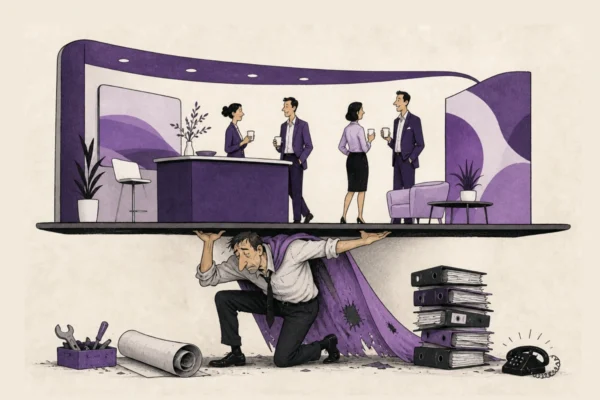
Margins are tighter. Decisions are backing up. The same problems keep coming back under different names. When something really matters, it still lands on you.
You start to feel it before you can explain it. The business is growing, but it’s getting harder to run.
If this feels familiar, here’s a quick breakdown of what’s actually happening… and where to start.
More people didn’t make this easier
At this stage, most leaders don’t think the business is broken. They think it’s under pressure, so they do what they’ve always done.
They lean in harder.
- More meetings.
- More check-ins.
- More involvement.
- More oversight.
There’s more frustration but it isn’t about effort. They have built a bigger company, but the way they run it hasn’t caught up.
More people didn’t create clarity. It created more dependence.
Now everything takes more coordination than it should. Decisions don’t land where they’re supposed to. People are stretched across too much. Instead of things getting easier with scale, they start to feel harder in a different way.
The number that changes everything
For most founders and CEOs, the breaking point doesn’t show up with a warning. It shows up in a number.
- Revenue is up.
- Profit is down.
For the first time, you can’t explain it away as timing, investment, or a one-off.
You start asking different questions.
- Why does every gain feel like it comes with more strain?
- Why does progress require this much involvement from me?
- Why do the same issues keep resurfacing, even after we’ve dealt with them?
Nothing really moves without you stepping in.
I was in a conversation with a CEO not long ago. Revenue was up, the team had grown, and on paper it looked like things were working.
When we started digging in, every meaningful decision still ran through him or just a few key leaders, and the numbers weren’t holding the way they should.
That’s when it hit him. The business had grown, but it still couldn’t operate without him in the middle of it.
That’s the moment it shifts. Not in public. Internally. You realize you’re still the system.
You did what you were supposed to do
At that point, leaders don’t sit still. They take action.
- They bring in outside help.
- Invest in new systems.
- Add leadership roles.
- Run planning sessions.
- They track more metrics.
None of this is wrong, but here’s what happens.
- The reports look better.
- There’s more activity.
But the day-to-day doesn’t feel any easier. Your load doesn’t go down. It just shifts.
You’re still the one connecting the things that don’t line up. Still the one making calls that don’t get made. Still stepping in when something important stalls out.
Why nothing you added fixed it
Most of what gets introduced at this stage sits on top of the business. It organizes information, adds process and creates more structure on paper. Underneath that, the same issues are still there.
- Decisions stall or get rerouted.
- Roles overlap or leave gaps.
- Work gets stuck between people.
- Meetings replace actual progress.
The leader compensates. They step in, connect the dots and make the call.
They were trying to improve results without changing how the business actually runs day to day.
What got you here won’t carry forward
Then another realization starts to creep in. What got you here isn’t going to carry you forward.
It isn’t that it was wrong. It’s because the demands have changed.
The way you think about your role, how decisions get made, how work moves across the business, those patterns were built for a smaller, more hands-on version of the company.
Now you’re trying to run a bigger business with yesterday’s approach. That gap is what you’re feeling every day.
At this point, it’s not about more ideas
Now is not the time for more ideas. You’ve had enough of that.
You’re looking for someone to help who can see what’s really going on quickly, say it straight, and help you think it through. Someone who can tie decisions back to how things are going to play out once they hit the team.
This is not something you want to translate. It isn’t something that sounds good in a meeting but falls apart once people try to execute it. Been there, done that.
When it finally starts to make sense
When leaders finally find the right approach for help, the first shift isn’t excitement. It’s relief.
Relief that someone sees it for what it is. That it won’t be about pushing harder. Relief that this isn’t going to turn into something else the team has to carry on top of everything else.
Then things start to come into focus.
- Who actually owns what.
- Where decisions belong.
- Where things are getting stuck.
- What needs to change first.
For the first time in a while, it doesn’t feel like another initiative. It feels like things might actually start working without you in the middle of everything.
The overcorrection that makes it worse
Once this becomes clear, there’s a natural reaction. “I need to get out of the middle.”
Leaders often try to step back at this point, but that’s where things can get worse. The answer isn’t to remove yourself. It’s to change how you show up.
If you pull out too fast, decisions don’t get made, standards drop, and the same issues show up in a different form. You haven’t fixed the problem. You’ve just moved it.
The goal isn’t to go from being in everything… to being out of everything. It’s to get to being involved where it actually matters. Where your role matches the stage of the business. You’re not the one holding everything together, but you’re still shaping what matters most.
The way I think about it is simple.
- One foot in the present.
- One foot in the future.
Often you lean more into what’s in front of you. Sometimes you lean more into where the business is going. Other times you never fully leave.
That’s the shift.
Not stepping away. Repositioning yourself so the business can move without depending on you for everything.
Where to start without making it bigger
You don’t need a full overhaul to begin. Start by looking at where work consistently comes back to you. Not the one-offs. The patterns.
- Where decisions stall until you step in.
- Where people are waiting for direction, they shouldn’t need.
- Where things only move because you pushed them.
That’s your signal. Not to do more, but to fix how that part of the business is operating.
Clarify who actually owns the outcomes. Make sure decisions land there. Stay close enough to see if it holds. Then move to the next one.
You don’t step out all at once. You step out as the business proves it can carry it.
This is where things change… or don’t
Leaders don’t get stuck here because they lack ambition. It’s that growth has outpaced how they lead and how the business runs.
Growth didn’t create the problem. It exposed it. The shift happens when the leader realizes this isn’t a phase… it’s a limit.
What got them here won’t carry forward. That means changing how they show up. And changing how the business runs so everything doesn’t keep coming back to them.
If this feels familiar, the answer isn’t to push harder or disappear.
It’s to adjust how you lead and how the business operates so it can move without depending on you for everything.
If you saw yourself in this story, you probably already know where it is showing up inside your business. The question is whether you are going to address it now or keep managing around it.
If you want a sounding board or thought partner to explore it further, reach out:
Web-site – PatAlacqua.com
Email – Pat@PatAlacqua.com