



Fashion Institute of Technology (FIT) Graduate Exhibition and Experience Design students partnered with Access TCA during the 2026 spring semester. The sponsored project focused on experiential tradeshow design.
Students developed design proposals in response to a client brief for Akebia Therapeutics. The project was tied to The American Society of Nephrology’s Kidney Week 2026.
Students work on a real-world brief
The project gave students a look at experiential marketing and exhibit design. They worked with Stephen Ross, senior vice president of brand strategy and experience design at Access TCA; Joseph DeLaunay, experiential designer at Access TCA and FIT Exhibition and Experience Design alumnus; and Trevor Steels, FIT Graduate Exhibition and Experience Design faculty member.
Students presented their concepts to Ross and DeLaunay. Their work included floor plans, elevations, renderings, and technical decks.
In addition, the design strategy asked students to consider site-specific design, visitor journey, brand experience, audience engagement, and sustainability.
Project includes research and renderings
As part of the project, students created concept decks. Those decks included research on brand identity, the competitive landscape, and the audience.
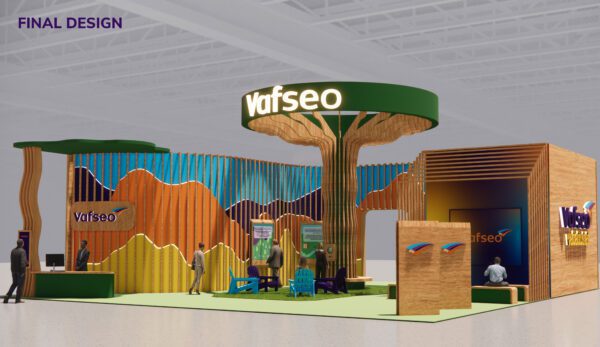
Students also developed mood boards, sketches, 3D renderings, plans, elevations, and material selections.
The final presentations included in-progress technical decks. These documents served as construction guides for the tradeshow designs. They also included 3D files, models, and design details for fabricators.
The completed projects were submitted for consideration for the EXSYS Awards. The awards recognize excellence in system-based exhibit design, adaptability, and innovation. Submissions are judged by The Experiential Design Authority (TEDA).
“This process required extensive research into the client’s medical therapy, various audience groups, and industry guidelines when communicating and developing their creative approach,” says Steels. “Not only did all students create unique and innovative solutions with their designs, but they also adhered to the same real-world parameters and guidelines that industry professionals face when creating achievable designs for their clients. Watching the thought, the detail, and the acknowledgment of feedback in their creative process was inspiring.”
Access TCA mentors student designers
Ross says the project gave students a chance to work through a complex life sciences design challenge.
“It was a pleasure working with such talented students,” says Ross. “You all learned so much in a short amount of time, and about an industry segment, life sciences, that not many designers understand. You listened to our constructive feedback and adjusted your designs to meet all expectations. Congratulations on completing this assignment. I am so proud of you all.”
FIT student Jessica Doan says the project challenged students to translate clinical information into an immersive experience for Vafseo.

“Designing an immersive experience for Vafseo was a daunting challenge,” says Doan. “As design students with no background in biomedical sciences, we had to learn a new language overnight. Stephen Ross and his team, including Joe DeLaunay, were instrumental in helping us find the human story hidden within the clinical data and regulatory constraints. Their invaluable insights empowered us to create deep, multi-sensory experiences that both inform and entertain.”
Doan adds, “This project proved that if we can navigate the complexities of a medical tradeshow booth, we can design anything.”
Students reflect on the experience
Summer Xiang, FIT student, says the project connected spatial design with scientific communication.
“This project challenged me to focus on how space, lighting, and interaction can communicate a clinical system,” says Xiang. “Working with Access TCA made the relationship between experiential design and scientific communication much more tangible to me, while also deepening my understanding of the purpose of our kidneys.”
Lydia Lee, FIT student, says client parameters helped her apply classroom learning to a real-world assignment.
“I had a great experience working with Access TCA to create a tradeshow booth for Vafseo,” says Lee. “It was a new challenge for our cohort, and having a client to build the design around gave us all a chance to use what we’ve learned in the program and apply it to a real-world project.”
Sarah Reynolds, FIT student, also says the experience strengthened her design work.
“Getting to work on this project with Access TCA was an incredible experience,” says Reynolds. “It allowed us to apply our classroom learning to a real-world brief and pushed us with novel design constraints and challenges. I appreciated getting insightful feedback from Stephen and Joseph at Access TCA, and I feel that this experience has helped me to become a better designer.”
2026 FIT Graduate Exhibition and Experience Design students
The 2026 FIT Graduate Exhibition and Experience Design students include Anna Soucy, Bhavya Ohri, Christina Walker, Jenny Estevez, Gabriel Pechia, Grace Warnick, Iris Yee, Jessica Doan, Lily Li, Lydia Lee, Marina Latto, Maya Peters, Sarah Reynolds, Shreya Patel, and Summer Xiang.
For more information on joining the Exhibition and Experience Design (EED) program or design partnership projects, contact Christina Lyons, chair of FIT Graduate Exhibition and Experience Design, at christina_lyons@fitnyc.edu.
Access TCA is an exhibit and event marketing company. It designs and builds environments for exhibits, meetings, and attendee engagements. For more info, visit www.accesstca.com.
Press release submitted by FIT Graduate Exhibition & Experience Design. Edited by Exhibit City News for clarity, length, and style.