




Las Vegas has never needed an introduction. But in boardrooms from Anaheim to Zurich, it’s earning a new one. The city once defined by its neon skyline and world-class conventions is now being recognized for something it has quietly built for years: a genuine, diversified business economy that is drawing headquarters, investment capital, and top-tier talent from across the country and around the globe.
A few years ago, the question was whether Las Vegas could survive its dependency on tourism. Today, the better question is whether other cities can keep up.
Taxes: Still the Most Compelling First Sentence
Nevada remains one of the most tax-friendly states in the nation for businesses of any size. There is no personal income tax, no corporate income tax, no franchise tax, no estate tax, and no inheritance tax. Sales tax sits at 8.375 percent in Clark County—a fraction of what companies contend with in California, which continues to hold near the bottom of the Tax Foundation’s State Business Tax Climate Index. That contrast is not theoretical: it is showing up in moving trucks. Businesses leaving California for Nevada aren’t just chasing lower costs. They’re chasing predictability, and Nevada delivers it consistently.
Growth and Access: The Numbers Have Only Gotten Bigger
Southern Nevada’s economic development ecosystem has matured significantly. The Las Vegas Global Economic Alliance has been closing deals at a notable pace, designated as one of eight Regional Development Authorities by the Nevada Governor’s Office of Economic Development (GOED) for 2025–2026. Recent wins include TensorWave Inc., an AI-specific cloud computing company establishing its headquarters in a 20,000-square-foot Clark County facility with 60 high-wage jobs. Neuro Inc., the parent company of NeuroGum, expanded its Southern Nevada operations into a 50,000-square-foot distribution facility. Carson Manufacturing relocated its entire headquarters from Texas to Las Vegas with a $10.2 million capital investment. And, in a signal that should resonate loudly with the venture capital world, Andreessen Horowitz—one of the world’s most influential venture capital firms, with $45 billion in assets under management—reincorporated its principal business from Delaware to Nevada. When smart money moves, the rest of the market pays attention.
Infrastructure: Getting Even Better Connected
Harry Reid International Airport continues to be one of the most well-connected airports in the country, with nonstop service to virtually every major U.S. city and a growing number of international routes, including a new Southwest Airlines partnership with German carrier Condor. Meanwhile, the Brightline West high-speed rail project is becoming reality: PCM RailOne AG, a global German manufacturer, committed a $20 million investment into North Las Vegas specifically to produce railway ties for the project. When completed, Brightline will connect Las Vegas to the greater Los Angeles metro in under two and a half hours—a development that fundamentally changes the city’s relationship to the California market it already serves.
Business Assistance Programs: Incentives With Real Teeth
Nevada’s GOED doesn’t just talk about being business-friendly—it backs that claim with board-approved incentives. Available incentives include sales and use tax abatements, modified business tax abatements, and personal property tax abatements for qualified companies. Whether you are seeking industrial space, commercial office, or land for development, Southern Nevada offers an abundance of options at competitive pricing relative to coastal markets. The Las Vegas Global Economic Alliance provides hands-on support through the entire relocation and expansion process.
Quality of Life: This Is a Major League City Now
Recruiting top talent requires more than a good tax rate. It requires a city people actually want to live in. Las Vegas has crossed a threshold that many in the business world are still catching up to. The city now has an NFL franchise in the Raiders, an NHL champion in the Golden Knights, a WNBA champion in the Aces, and Formula One’s Las Vegas Grand Prix anchored on the Strip each November. Henderson and Summerlin consistently rank among the best suburban communities in the West for families, quality schools, and outdoor recreation—all within 20 minutes of downtown. With 292 sunny days a year and the Spring Mountains an hour away, the lifestyle argument writes itself.
The Innovation Inflection Point: A New Chapter Entirely
Here is what wasn’t in the story a few years ago: Las Vegas is now a credible innovation hub. Data centers are expanding across the valley, driven in part by Nevada’s energy infrastructure and dry climate. Fintech is taking root in Henderson, where Paysign Inc.—a financial services and payments platform company—recently added 245 jobs at an average wage of $33.31 per hour. Advanced manufacturers from defense-sector precision parts to recycling technology are choosing Clark County for their U.S. operations. Even University of Nevada Las Vegas’s (UNLV) Boyd School of Law is attracting faculty who are relocating specifically because they believe Nevada’s business activity will generate decades of legal and institutional work. The innovation ecosystem is feeding itself.
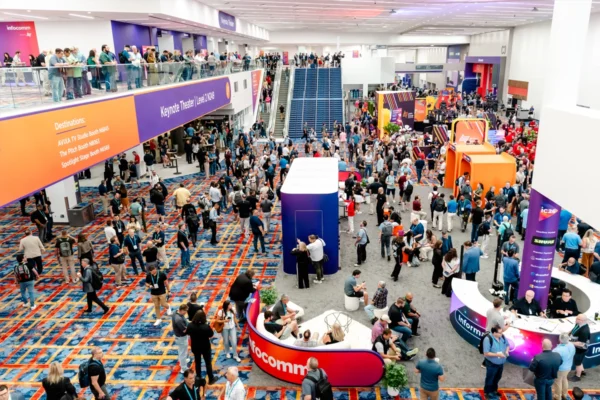
For the tradeshow and events industry, this matters in a way that is easy to miss: every company that plants its flag in Las Vegas becomes a local stakeholder in the convention economy. The momentum extends beyond corporate relocations—industry suppliers including Main Light, George P. Johnson, Aluvision, beMatrix, Felix Lighting, and Two Eighteen are among those who have opened additional warehouse and operations facilities in Las Vegas since 2019, reflecting a broader industry shift toward maintaining a permanent, full-service presence in the nation’s busiest trade show market.
Decision-makers who live here attend CES, NAB, SEMA and MAGIC not as out-of-town visitors but as neighbors. Relationships that used to require a flight now happen over lunch. The pipeline between corporate headquarters and the show floor is getting shorter—and that is good for everyone in this industry.
Las Vegas has always been a city that plays the long game better than it gets credit for. The bet on diversification is paying off. The question for businesses still on the fence isn’t whether Las Vegas is ready for them. It’s whether they’re ready for Las Vegas.
Melissa Skipworth is a licensed REALTOR with Berkshire Hathaway Nevada Properties Commercial Division, Lic. S.0191667, specializing in luxury and commercial real estate in Southern Nevada. She serves as 2026 Membership Director for NAHREP Greater Las Vegas. For questions about buying, selling, or investment in today’s market, contact her at 702.481.4103.
This story originally appeared in the Q3 2026 issue of Exhibit City News, with the original magazine layout available here.
Related stories
How Tradeshow Salaries Stack Up in Las Vegas, Chicago and Orlando