



The New Orleans Story
In 1900, the United States had one horse for every four people and one car for every 9,500 people. At the time, most people viewed horseless carriages as toys for the wealthy. Life happened; things changed. By 1940, there was roughly one car for every five people. By 1965, the ratio had fallen to one passenger car for every 2.6 people, nearly one car for each licensed driver.
Cars on Display
At noon on May 1, 1893, the lives of millions of people were about to change. They just didn’t know it yet. With the flip of a switch, Chicago’s World’s Columbian Exposition demonstrated the power of electricity to visitors from across the country.
There was another epoch-changing invention at the fair that summer. It was a self-propelled vehicle, and it was easy to miss because there were only two on the entire 686-acre fairgrounds. One was powered by electricity, and the other was powered by gasoline.
Tucked into a corner of the Transportation Building, where massive locomotives took center stage, the Daimler Quadricycle went mostly unnoticed. The few people who did notice it read like a who’s who of automotive pioneers: the Duryea brothers, Charles Brady King, Henry Ford, and James Packard. They all noticed, and they all took notes.

Later that summer, Frank and Charles Duryea built the first successful American gasoline-powered car. They drove it along a street in Springfield, Massachusetts, on September 21, bewildering people and terrifying horses. Charles Brady King later built and drove the first gasoline-powered automobile in Detroit on March 6, 1896. Henry Ford followed with his Quadricycle three months later.
By the time the Pan-American Exposition opened in Buffalo in 1901, automotive technology was advancing rapidly. Although many people still viewed motor vehicles as expensive toys for the wealthy, the automobiles on display attracted attention. The Winton Runabout, the Packard, the electric Waverley, and the Curved Dash Oldsmobile lined the fairgrounds. Considered the first mass-produced gasoline-powered automobile in the United States, the Oldsmobile cost $650 and reached a top speed of 20 mph. Oldsmobile produced more than 19,000 during the model’s production run. Henry Ford wasn’t exhibiting. But he was there, and he was watching.
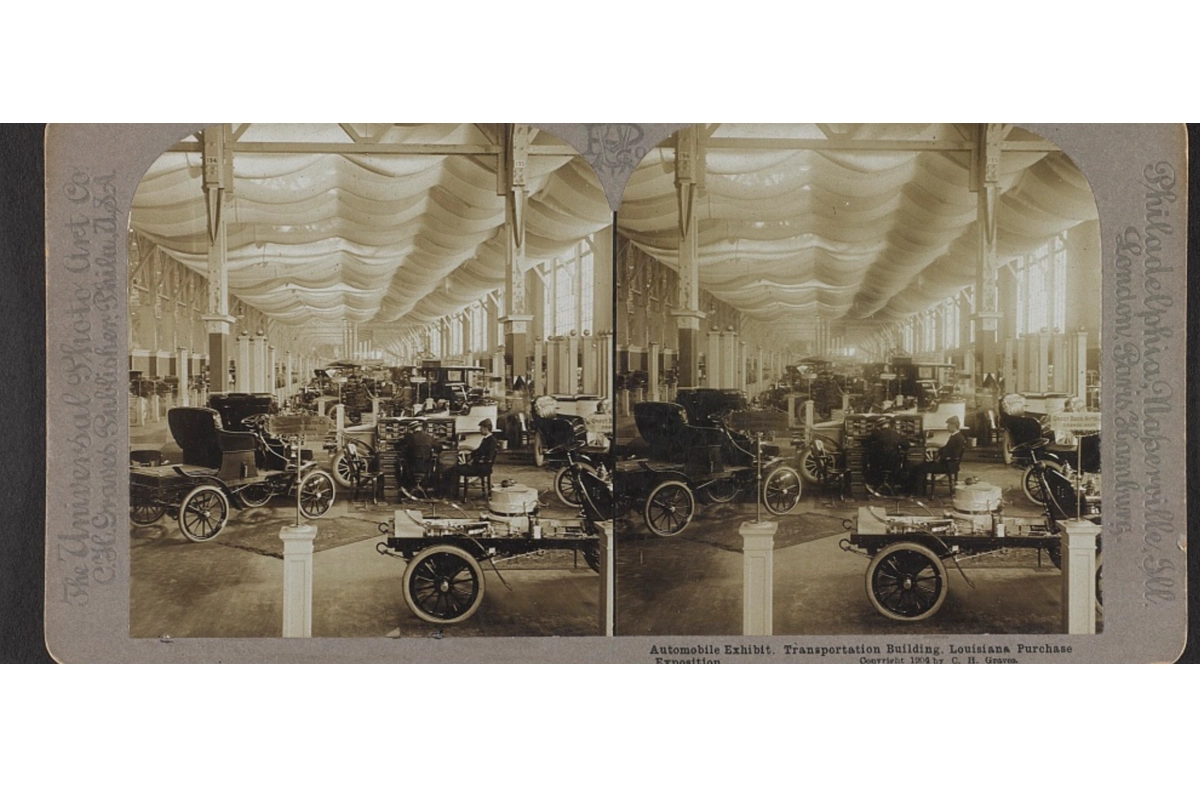
By 1904, the St. Louis World’s Fair offered a snapshot of an industry on the move. Inside the massive, 15-acre Palace of Transportation sat more than 150 American, French, and German automobiles.
Ford brought his Model B, a four-cylinder, 24-horsepower luxury touring car priced at $2,000. It wasn’t his most important car or his cheapest one. That car was still in the future.
Ransom Olds beat Ford to mass production. His Curved Dash Oldsmobile was simple, rugged, and relatively affordable. While history credits the Model T with bringing automobile ownership to the masses, the Curved Dash began that process first.
The 1903 Cadillac used precision manufacturing that helped Henry Leland advance the use of interchangeable automobile parts. In 1908, Cadillac demonstrated that precision in England by disassembling three cars, mixing their parts, and reassembling three working vehicles.
Packard targeted buyers for whom luxury was nonnegotiable. The Model L sold for $2,600 at a time when the average American earned $450 a year. It proved its value by running 1,000 continuous miles without a single mechanical failure.
George Pierce started with bicycles before designing the four-cylinder, $4,000 Great Arrow. It won the inaugural 870-mile Glidden Tour reliability run the following year and cemented the Pierce-Arrow as the gold standard of American luxury.
The rest of the Palace revealed an industry still debating its fuel source. The Baker Motor Company was the largest electric vehicle manufacturer in the world, selling 800 units a year. Studebaker displayed its first gasoline model alongside its electric lineup. In 1904, a rational observer could have bet equally on gasoline, electric, or steam.
Mass Production Takes the Stage
By 1915, more than 40 automakers exhibited at the World’s Fair in San Francisco. The biggest draw was Ford Motor Company and its live demonstration. Henry Ford built a plant with a fully functioning assembly line inside the Palace of Transportation. The line manufactured one car every 10 minutes, six cars an hour, for three hours a day. The 18 cars were then paraded around the fairgrounds. It was the most-watched exhibit at the fair.
By 1933, the Great Depression had crushed the luxury automotive market, and manufacturers gathering at Chicago’s exposition were fighting for survival.
General Motors (GM) dominated the fairgrounds with a 131,000-square-foot pavilion crowned by a 177-foot tower. Taking a page from Ford, GM’s centerpiece was a fully operational assembly line where visitors watched Chevrolets being built from scratch and driven out under their own power. For an extra fee, visitors could order a custom car, watch it being built, and drive it home that same afternoon. Nestled modestly inside the building was a prototype called the Cadillac V-16 Aerodynamic Coupe, the world’s first formal “dream car,” designed to showcase what automobiles might become.
Chrysler built a 125-foot tower and an adjacent racetrack. The company hired stuntmen to race cars and flip them onto their sides to demonstrate structural integrity. Henry Ford skipped the 1933 opening but returned in 1934, spending $2.5 million on 137,000 square feet of display space and determined not to let GM monopolize the moving assembly line.
Firestone presented manufacturing from molten rubber to finished tires. Sinclair Oil debuted its iconic green brontosaurus mascot alongside seven roaring dinosaurs.
Selling the Automotive Future
By 1939, America’s “Big Three” had commissioned massive standalone pavilions at the New York World’s Fair. Other companies exhibited in the Transportation Building.
Mercedes sent its massive Grosser limousine. Auto Union, a predecessor of today’s Audi, showcased a 250-mph racing engine. BMW displayed a 328 roadster. Italy showed Alfa Romeo and Fiat, Great Britain brought Rolls-Royce and Jaguar, and France displayed engineering from Citroën and Talbot-Lago. Five months before World War II, these nations’ cars sat a mere 20 feet apart, all shiny and peaceful.
The American pavilions focused on consumer experiences. Chrysler treated visitors to a simulated rocket ride. Ford featured the “Cycle of Production,” a 100-foot rotating turntable, and drivers offered fast rides up a spiraling outdoor ramp.
The triumph of the fair was General Motors’ Futurama, an experiential exhibit that cost $7 million, roughly $170 million today. Visitors sat in moving platform chairs equipped with synchronized sound systems. For 18 minutes, they “flew” over an acre of floor space containing 408 interconnected dioramas. Below them lay a vision of America in 1960: 500,000 miniature buildings, a million trees, and 50,000 tiny vehicles traveling on multilane superhighways with cloverleaf interchanges. Every guest walked out with a pin that read, “I have seen the future.”
The interstate highway system didn’t exist in 1939. But Futurama anticipated many features of the highway network that followed. When Congress passed the Federal-Aid Highway Act 17 years later, parts of GM’s vision seemed remarkably familiar.
By the time the World’s Fair returned to Flushing Meadows in 1964, the automotive industry was no longer speculating about superhighways. It owned them. Corporate pavilions were grander and more entertaining than ever. General Motors presented Futurama II, a spectacular ride that carried visitors past moon bases, underwater resorts, and machines designed to transform deserts.
Chrysler constructed a massive five-acre pavilion featuring a simulated 100-foot engine. Guests walked through it, viewing the mechanical ballet of an internal combustion engine.
The Mustang Makes Its Debut
It was the Ford Motor Company that stole the show. The company partnered with Walt Disney to create the Magic Skyway. Sitting inside Ford convertibles, visitors glided along a track through a prehistoric world of animatronic dinosaurs before emerging into a sparkling midcentury vision of the future. On opening day, April 17, 1964, Ford used the fair as a launching pad for a new sporty coupe designed by Lee Iacocca. It was the public debut of the Ford Mustang. Priced at $2,368, the car triggered an immediate cultural frenzy, securing more than 22,000 orders in a single day. Ford sold 418,000 Mustangs that year.
World’s fairs propelled industrial expositions into a new dimension. They didn’t just display the future; they manufactured it. Fairs of the past laid the foundation and built the structure for today’s industry-specific tradeshows.