

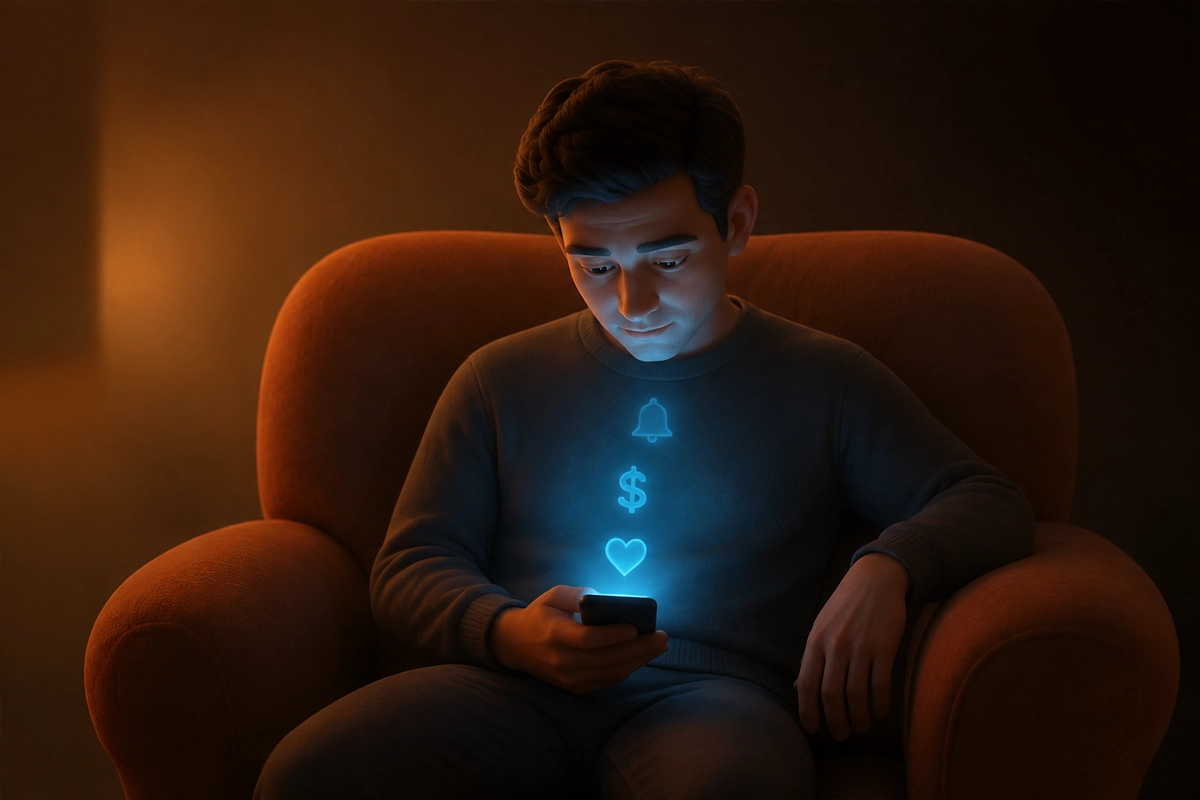


We’ve all watched Wall-E, where overweight humans end up floating around on hover chairs, eyes locked on screens and completely disconnected from the world right in front of them. The future we once thought was impossible is here; we just needed phones.
Every scroll, every notification, every red dot is a hit of dopamine, and the science behind it has replaced most addictions of the past. Your brain doesn’t release dopamine when you get the reward, it releases dopamine in anticipation of the reward. That’s why you check your phone for no reason. That’s why a notification feels like a slot machine pull. It’s literally the same mechanism that makes slot machines addictive: variable reward. You never know if the next scroll is going to be boring or amazing, and that uncertainty is exactly what keeps your thumb moving. Social media platforms didn’t stumble into this. They engineered it, it’s psychology and neuroscience all-in-one.
Here’s the part that should make every brand, every business owner, every person building something pay attention: energy and money flows, where attention goes.
Global ad spend hit $1.14 trillion in 2025, and digital now owns roughly 69 percent of it. TV, radio, print, the stuff that used to run the entire advertising world‚ is splitting what’s left. In the U.S. alone, display advertising spend beat all of TV combined. Social media ad spend hit $96.5 billion in 2025 and is on track to cross $110 billion in 2026. Facebook and Instagram alone pulled in $192 billion globally. The reason is‚ brands didn’t leave TV because TV stopped working. They left because social media gave them: trackable proof, clicks, conversions, and data down to a zip code. Whoever holds that data holds power.
Now I grew up on social media, where the worst issues were side effects on mental cognition and decline, along with body dysmorphia, and depression from comparing yourself to a perfectly curated life and image. But the future is changing, and unless you control it, it’s already controlling you.
AI content is about to flood every feed on earth. The irony is that the more AI-generated content there is, the more valuable a real human voice becomes. We’ve already crossed the line where AI-written content outpaces human content online. People can see the difference looking at a feed. ‘Brain rot’ it is on every level of what it entails; making consumers, users that are connected and move through life like non-player characters (NPC).
Not everything is dark and dreary. There’s a window of opportunity for current social media users. The brands that double down on real, human, slightly imperfect content are going to win the next five years. If you want to create a brand for yourself, you have about 1-2 years left before the next AI model or creator who’s more perfectly curated to the viewer takes over and nobody cares about who you are.
Furthermore, censorship is no longer a ban, it looks like silence and a lack of engagement. You’re not getting kicked off a platform; you just stop showing up. Algorithmic burial is already the dominant form of control, and most people don’t even know it’s happening to them.
Meanwhile, the institutions talking the loudest about protecting your digital rights are the same ones building the infrastructure to track every move you make online. Watch that space closely. “Safety” and “control” are going to keep getting used interchangeably, and the smartest move is creating the problem, only to sell you the solution.
People are already quietly migrating, to Discord, to Substack, to Bluesky, to anywhere that isn’t one algorithm’s mercy, but it’s not going to do anything. If you want to own, really own, anything, it’s not going to be online. I’d say give it a shot, use it while it’s still monetizable and move on to the next. The moment it’s no longer providing value; and make sure you have back-up plans that include reality.
Here’s the twist nobody’s talking about: radio‚ the medium everyone wrote off‚ is quietly outperforming digital in places that matter. It reaches 93 percent of U.S. adults monthly, and it just out-reached linear TV in the 25-54 demo for the first time ever. Why? Because it’s the one medium that doesn’t need your eyes. It fills the moments screens can’t: the commute, the kitchen, the morning. In a world drowning in scroll fatigue, “low-tech” might be the next unfair advantage.
Finally, is a question: with the reliance on experts and human-to-human connections, what does that mean for print media? Will it too make a comeback? Will the physical and tangible experience of media created by human hands have more importance? Is this the next low-tech medium that will have an impact on people?
The world is currently built where attention is the currency, and most people are spending it on useless things without even noticing. The question isn’t whether the algorithm is watching. It’s whether you are creating your life or are you an NPC letting life pass you by. Years wasted on platforms that could disappear in the blink of an eye. If you’re not the user, it’s using you.
This story originally appeared in the Q4 2025 issue of Exhibit City News, p. 40. For original layout, see Print Version
Related stories
Engineering Human Experiences: How Simple Technology Creates Meaningful Connections