



By Jensen Yan, FSARCAN
A photograph can help an exhibit buyer choose a flower shape or an overall palette. It is less useful for deciding how that flower will look and feel in the finished display. In my work supplying artificial flowers, I find that photographs and videos can make products of different quality look surprisingly similar. A physical sample gives the buyer a chance to examine details that are difficult to judge on a screen.
For an exhibit, that examination should connect the sample to the proposed display. The useful question is not simply whether the flower looks attractive on a desk, but what the buyer needs to understand before ordering it in quantity.
Check texture and color in the intended setting
Start close up. Look at the petal edges, the joins between components and the finish on the leaves. Turn the sample around rather than judging it from its most flattering angle. Consider which surfaces would remain visible once the stem is arranged.
Then move back to the distance from which the display is likely to be seen. A detail that stands out in your hand may matter less at that distance; a color mismatch may still be noticeable. Neither observation replaces the other. They answer different questions about the intended use.
Where possible, examine the sample under the lighting planned for the display. Compare it with the actual fabrics, printed graphics or other materials it needs to sit alongside. Color in a photograph or video may not match the physical item, so a photograph should not be the final color reference.
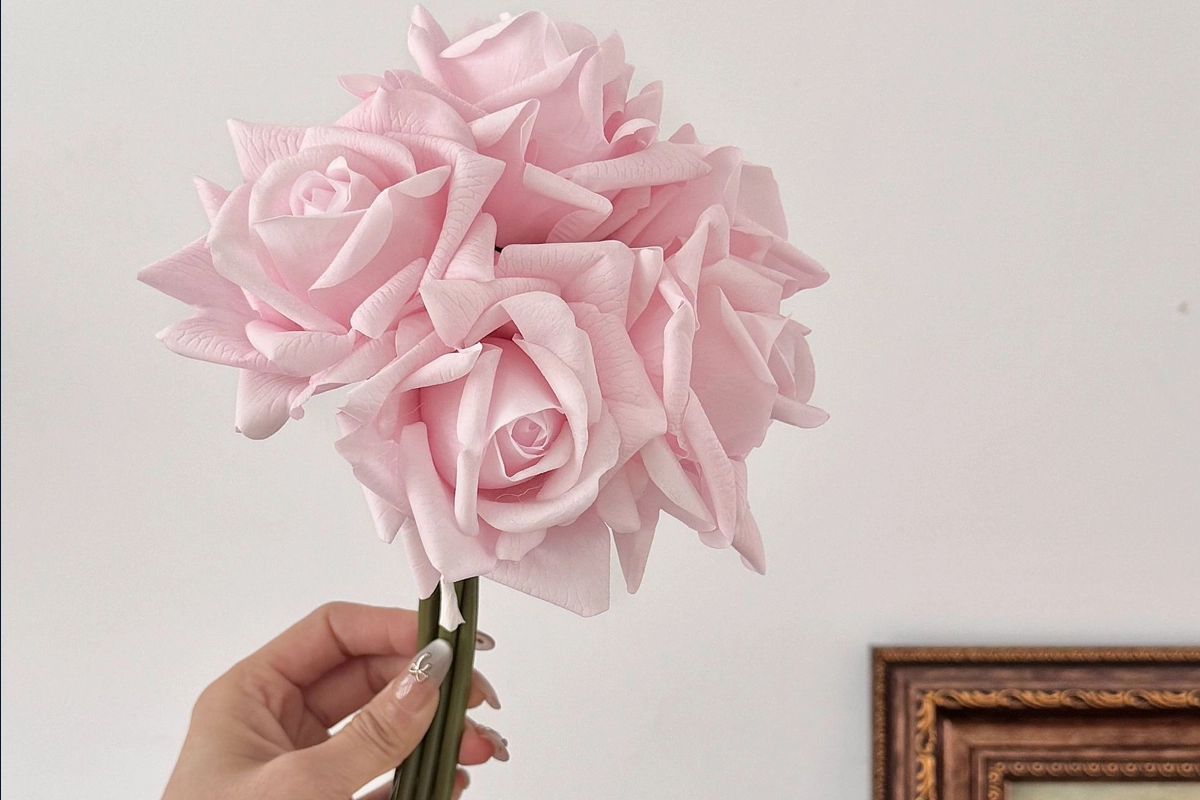
Treat “real touch” as a description to investigate. Products described this way can use different processes, and buyers may have different ideas of what the term should feel like. Ask what it means for the particular item, and handle the sample before deciding whether it meets your expectations. The label alone does not establish a uniform feel.
Understand the dimensions and the sales unit
A stated length needs a reference point. Is it the full stem, including the flower head, or another measurement? Does a flower-head dimension describe its widest point? Examine the sample and ask the supplier to explain how the listed dimensions were measured.
Also check what you are actually buying. A photograph may show several stems arranged together, while the price applies to a single stem, a spray or a bunch. Ask what one quoted unit contains, then look at that unit on its own.
If the display depends on a particular amount of coverage, use the sample to test a small section of the proposed arrangement. That can help you develop a quantity estimate for your own design. It does not mean that one attractive product photograph establishes how many units the display will need.
Notice how the stem sits in the intended support, too. If the design requires bending or cutting, ask whether that treatment is suitable for the specific item before making it part of the plan.
Inspect the packing and try the unpacking
Artificial flowers can be light but bulky. Their packed dimensions can therefore matter to freight costs as well as to storage and handling. Ask for the packing method for the exact item you are considering; the loose sample alone does not show how a larger order will arrive.
Some suitable stems may be bent for packing and need arranging again after unpacking. That preparation can be an unwelcome surprise if the buyer has only seen a finished arrangement. Ask whether your selected item is packed this way, which parts may be adjusted and what instructions the supplier provides.
If possible, request a sample packed in a way that represents the proposed order. Open it yourself and work through the preparation instructions. Consider the space, handling and tools involved, and whether the result meets the display’s requirements. Avoid assuming that every stem can be bent or that every compressed flower will recover in the same way.
This exercise can inform preparation planning. It is not a guarantee that every carton in the full order will behave identically.
Before placing the order, revisit the sample with a short set of questions: Does the finish suit the viewing distance and lighting? Are the measurements and quoted unit clear? Is the packing method understood, and is the required preparation practical? A sample is most useful when it helps the buyer answer those questions while there is still time to adjust the plan.
About the author

Jensen Yan is the owner of FSARCAN, a China-based supplier of artificial and preserved flowers. Jensen began working in the floral trade in 2020.
Website: https://fs-arcana.com/