

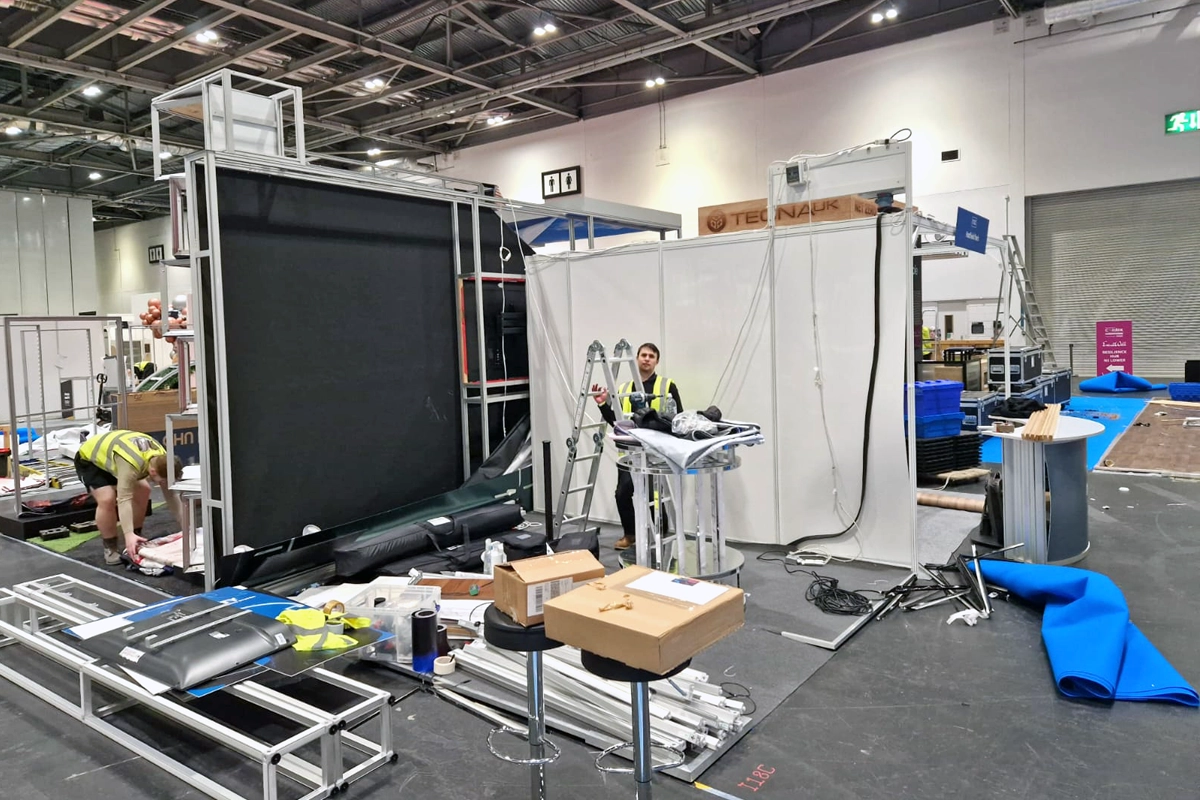


I once spent the better part of a day in an American hall beside a booth I could not take down, waiting for my own empty crate to come back to me. It was two hundred metres away at the outside. The entire aisle was waiting on the same forklifts. There was nothing whatsoever I could do about it.
That afternoon is the reason I now design flight cases that can be hidden inside the booth, which I mentioned last month and which is not a styling decision. Keep one under your counter and you are on the road while the aisle is still queuing.
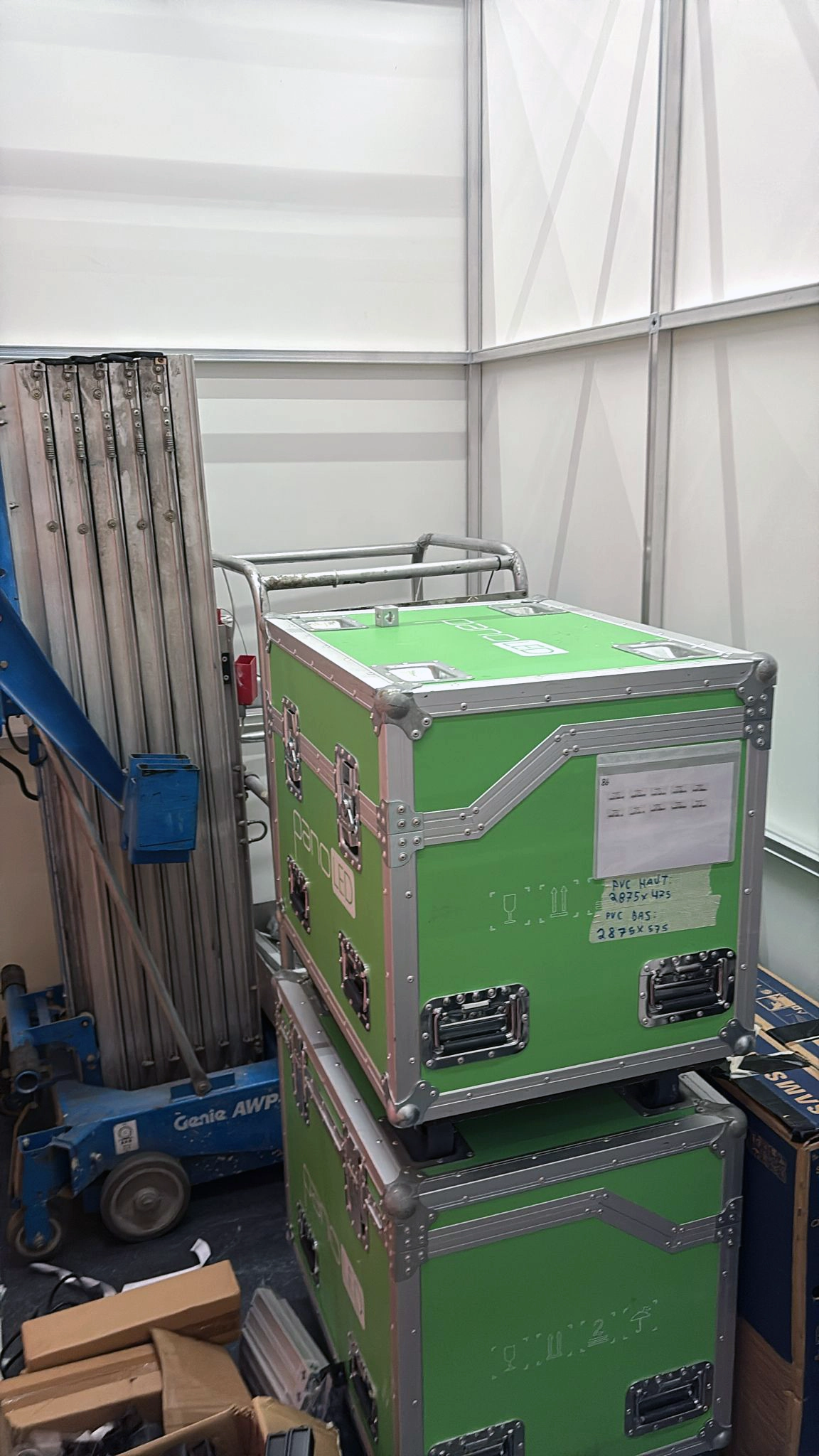
I also mentioned, in passing, that drayage barely exists in Europe, and that in most halls your own crew can build your own stand with your own tools. It was a throwaway line, and it deserves a column, because underneath it sits the biggest structural difference between the two show floors. Not the stands, the halls or the hours. Who is allowed to touch things.
An American show floor is, at heart, a system of jurisdictions: defined roles, defined rights, defined boundaries about who does what. A European one largely is not. Once you see that, the cost, the timeline and most of the arguments make sense.
The missing line item
There is no European equivalent of drayage. Not a cheaper version. No version. Your vehicle arrives at the hall, you unload it, and you carry your material into your space. If you need a forklift you order one from the venue by the hour. That is the whole system. It fits on a postcard.
I am not being smug about this. A show of American scale could not function without managed material handling, and anyone who has watched a two-thousand-exhibitor move-in from the dock knows why. It is a real service solving a real problem. It is simply not a line on a European budget, which is why Europeans heading the other way tend to need the whole thing explained from scratch.
What Europe charges you instead is time
Before any American reader concludes we have abolished the problem, let me describe a German move-in. You book a delivery slot, usually by midday the day before, and miss that deadline and the slot is gone without replacement. You then buy your way onto the site with a cash deposit. At Messe Dusseldorf it is a hundred euros, in notes, and it comes with a clock: sixty minutes for a car, ninety for a van, longer for a truck depending on weight.
Leave inside your window and you get your hundred euros back. Overrun and you do not. There is no appeal, no pro rata, and no interest whatsoever in why. We have donated that hundred euros to the German exhibition industry more than once, and on each occasion I was told, with real courtesy, that the rules had been explained to me in advance. They had.
I will confess the thought has crossed my mind that a hundred euros is a fair price for unloading at a civilised pace. Do not follow me down that road. Overstay and the deposit is not merely forfeited: at several German venues the vehicle is then treated as unlawfully parked, and the halls reserve the right to remove it without notice, at your cost and risk, accepting no responsibility for it in the meantime. The hundred euros is the cheap part.
None of which should paint the Germans as unhelpful, because the opposite is true, and I have the evidence. We once managed to lock our keys inside a vehicle at a German venue during build-up. Not only did the hall have a team for this, they had equipment for it: small inflatable cushions that ease a door frame open just far enough to reach inside. They were entirely unbothered. We were into the tailgate and unloading within minutes, and the keys, it turned out, had already been handed in to lost property.
That is the German bargain in a single morning. The rules are not negotiable and the clock is not negotiable, but if you keep to them, everything else has been arranged so that your day goes well. Nobody is trying to catch you out. They are simply not going to rescue you from a deadline you chose to ignore.
So you unload at a sprint, drive off the site, park in a field somewhere, and ride a bus back to the hall clutching your own toolbox like a commuter with an unusual hobby. Dusseldorf runs a dedicated service for this and calls it the In and Out Shuttle. When a thing has its own bus, it is not an edge case.
One concession, because it undercuts the tidy version of my argument. At the largest German venues, forklift and crane work is reserved to the fair’s own appointed forwarders, with a provision fee charged whether or not the machine is ever used. That is not drayage. But it is unmistakably an exclusive, and any European who tells you the continent has no gatekeeping has not tried to lift something heavy in Bavaria.
The difference is one of scope rather than principle. In America the exclusivity covers the work. In Europe it covers the machine. And that provision fee is a fair example of the sort of line that never appears in the quote you were sent, of which I keep a running list.
No unions on the floor. That is not the same as no rules.
Across most of Europe there is no union jurisdiction over exhibitor labour in the way there is across much of the United States. You may build your own stand. Your marketing manager may hold the other end of a panel, and nobody will faint. Italy is the exception worth checking, though not for the reason you would guess. There is no union jurisdiction there either. But Italian law treats stand building as construction work, and since October 2024 contractors and self-employed builders have needed a licence from the National Labour Inspectorate to set foot on the site.
But “no unions” gets heard as “no rules,” and that is wrong in a way that costs money. European rules are technical rather than jurisdictional: not who holds which card, but what is safe, what is compliant and what has been approved. They are enforced by the organiser’s technical office, usually on site with the show opening tomorrow.
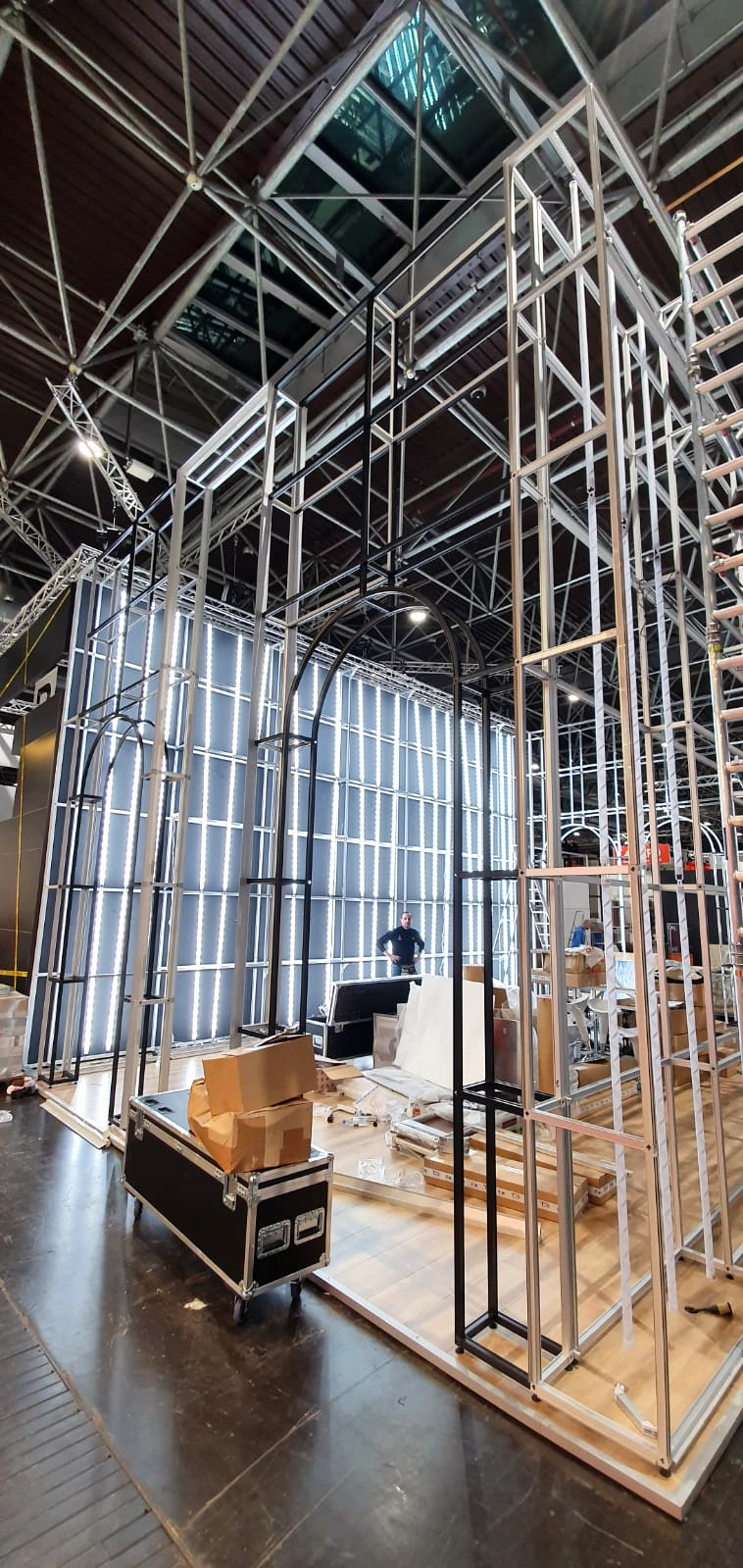
Three areas, consistently. The final electrical connection to the mains belongs to the venue’s contractor, whatever you have wired inside your own stand. Anything overhead belongs to the venue riggers, ordered well in advance, because a hanging banner is not a decision you make on the Tuesday. And stand plans are frequently subject to approval: in Germany the standard permitted height is 2.5 metres, with structural certification required above four metres, for closed ceilings, and for platforms higher than twenty centimetres, which is to say a doorstep. Plans go in six weeks ahead and nothing is built until a stamped copy comes back. The stamp is not a formality. The stamp is the permission.
What it comes down to
Nobody will stop you carrying your own box, and nobody will send a crew to do it for you at a four-hour minimum.
But it is freedom with the supervision removed, not freedom with the rules removed. The plan approval. The rigging order. The power supply. The delivery slot with a hundred euros riding on it. Every one falls weeks before you get on the plane, and not one can be fixed on the Tuesday.
So read the technical manual. Not the floor plan, and not the summary somebody has condensed into a slide. The document itself. It is long, it is dull, it has never been described as a good read, and it is the entire difference between an easy build and an expensive one.
None of this is a reason to be nervous about exhibiting in Europe. It is a reason to ask the right questions early and to budget honestly, and if it helps, I keep a plain-English guide to what a European stand actually costs.
Then, when you land, go ahead and pick up your own box.
Next month, in fairness, I will tell you what happens to Europeans who assume they can do the same thing in Chicago.
Related stories
Across the Aisle: What American Exhibitors Don’t See Coming in Europe