



How labor market dynamics shape compensation, benefits, and staffing consistency in exhibit and live-event work
In the tradeshow business, labor is usually judged by one basic question: can the work get done on time? For contractors, venues, and show organizers, that question reaches beyond headcount. It includes compensation, benefits, training, and whether a reliable workforce is in place when the hall opens and the clock is already running.
For the International Union of Painters and Allied Trades (IUPAT), market share is not just an internal organizing term. It helps explain how wages, benefits, and workforce consistency take shape in the field. When a larger share of a market is covered by a stable labor structure, standards tend to hold. When that share is smaller, labor becomes more fragmented, and so do the conditions around it.
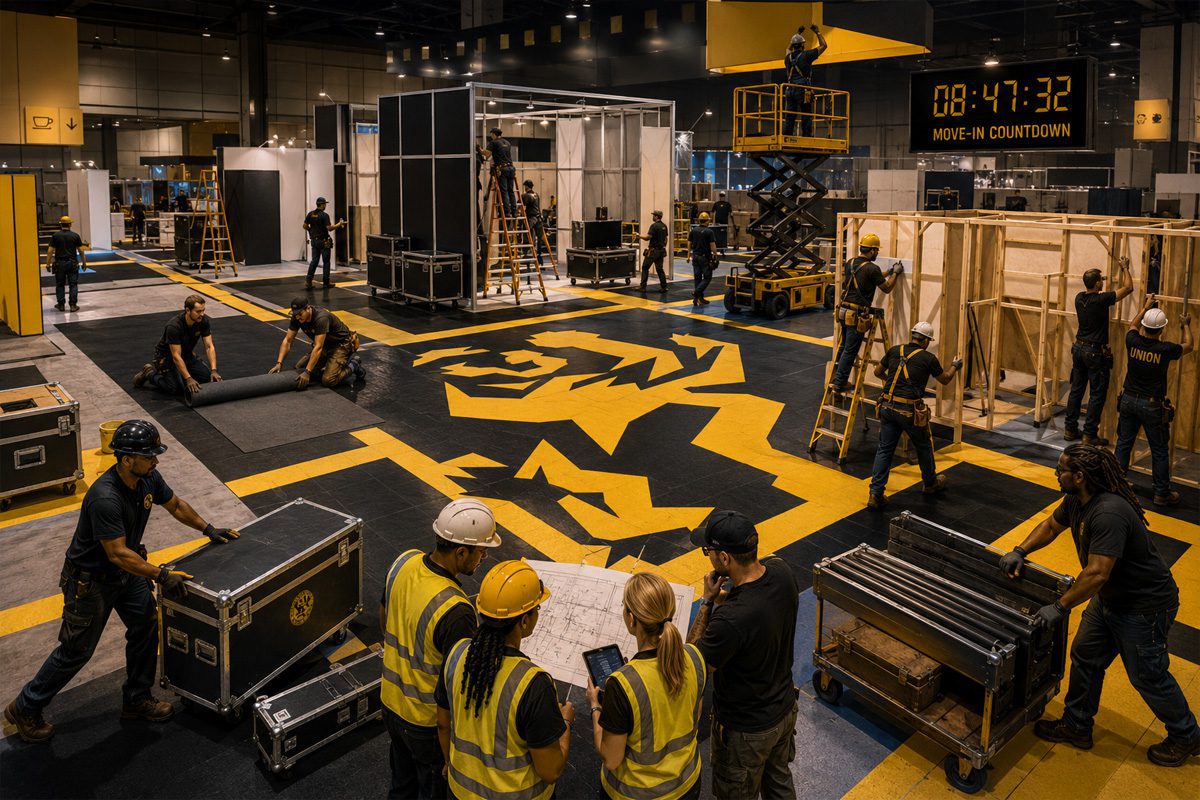
In event and exhibit work, that distinction can affect everything from retention to readiness. IUPAT’s footprint in the industry includes tradeshow workers, sign and display labor, floor covering, finishing, glazing, and related crafts that help convert empty convention space into working event environments. The work is physical, time-sensitive, and highly coordinated. It also depends on experienced crews who know how to move quickly without losing quality or safety.
“People in this business talk about labor shortages, but the bigger issue is labor consistency,” says JC Garcia, emeritus business representative, International Union of Painters and Allied Trades Local Union 1175 (IUPAT). “If you want jobs done right, on schedule, and with less confusion on the floor, you need a workforce that stays connected to the industry.”
That connection often comes down to compensation and benefits. Data from the U.S. Bureau of Labor Statistics (BLS) has consistently shown that union-represented workers, on average, earn more than nonunion workers and are more likely to have access to employer-supported healthcare and retirement benefits. In practical terms, that affects whether workers stay in the trade, build experience, and return for the next show cycle.
“Hourly pay matters, but that is not the whole decision for workers,” Garcia says. “Benefits matter. Training matters. Whether someone can see a future in the trade matters. That is what helps keep skilled people in the trade.”
That point lands squarely in the human resources conversation now shaping much of the live-event business. Staffing is not only about recruitment. It is also about retention, continuity, and the systems that support workers over time. In tradeshow labor, where deadlines are tight and experienced crews are valuable, workforce continuity has direct business value.
That is one reason IUPAT’s role extends beyond dispatching labor. The union’s structure also supports training, leadership development, and ongoing workforce coordination. Organizers and representatives work to identify labor gaps, stay connected to workers and contractors, and help maintain a labor pool that can respond when demand rises.
“A lot of what we do is making sure the workforce is there before the pressure hits,” Garcia says. “You cannot wait until move-in starts to figure out where your experience level is, where your leaders are, or whether people are ready. That work starts well before the show floor gets busy.”
Previous ECN reporting has shown how that preparation plays out in practice. In Miami Beach, IUPAT Local 1175 has worked with contractors and venue leadership to help rebuild workforce depth after the pandemic, with training and coordination aimed at improving show-floor readiness and long-term labor stability.
The bigger issue is how labor market share influences the full workforce picture, including compensation, benefits access, and the consistency contractors and organizers depend on.
For IUPAT, market share is not just about leverage at the bargaining table. In tradeshow work, it is also a measure of workforce depth, labor continuity, and the ability to support consistent standards over time.
Founded in 1887, the International Union of Painters and Allied Trades represents workers across painting, glazing, floor covering, finishing, and related trades in the United States and Canada. For more info, visit www.iupat.org.
This story originally appeared in the Q3 2026 issue of Exhibit City News, with the original magazine layout available here.
Related stories
SkillBuild Boosts Miami Beach Convention Center (MBCC) Workforce