




The news came out quietly, the way these things usually do. McKinsey is cutting 3,000 to 4,000 positions in 2026 — roughly 10 percent of its global workforce, the largest reduction since 2008. Bain, BCG, and Deloitte are doing variations of the same thing. Slower hiring. Headcount reductions. A pulling back that the firms themselves describe, carefully, as a response to AI productivity gains.
Read that again. The world’s most prestigious advisory firms are cutting people because AI is doing the work those people used to do.
That is not a technology story. That is an operating model story. And if you lead an exhibit house, event management firm, or tradeshow services company, it is your story too — whether you see it yet or not.
The Work That Got Cut
McKinsey didn’t eliminate partners. They eliminated the analytical layer underneath them — the associates and analysts who spent weeks synthesizing research, building models, producing deliverables that clients paid for at premium rates. That work turned out to be compressible. Not because the people weren’t capable. Because the work itself — pattern recognition, document synthesis, comparative analysis, structured reporting — is exactly what AI does well and fast.
Now look at your own organization.
Who builds the first-pass budget proposal for a new client? Who tracks all the open items across fifteen vendors four weeks before move-in? Who pulls together the show recap report — the one with attendance numbers, lead counts, and production notes? Who writes the post-show deck that the client’s VP of Marketing uses to justify next year’s budget? Who coordinates labor calls across four cities when the schedule shifts?
That work is not the same as McKinsey analyst work. But the underlying structure is identical. Information processing. Pattern recognition. Synthesis and reporting. Work that requires training and intelligence — and that AI is now compressing on a timeline most exhibit and event leaders haven’t fully absorbed.
This is not a prediction. It is already happening. Exhibit houses using AI-assisted design tools are producing concept renderings in hours that used to take two days. Vendor coordination that required a coordinator’s full morning is being managed by automated workflows. Project status reports that sat in someone’s inbox at 10pm are being generated in real time, without the 10pm.
The compression is real. The question is whether your operating model is designed for what comes after — or still built for what worked before.
What the Compression Exposes
Here is where most firms get stuck. They see the compression coming, buy a project management platform or an AI tool, run it on one show, and call it a strategy. The tools do what they were built to do. And then not much changes — because the tools were layered on top of an operating model that was never redesigned to use them.
The technology is not the problem. The sequence is.
An AI strategy matters. You need one. But an AI strategy built on top of a fragmented operating model does not create leverage. It accelerates the existing dysfunction.
Faster status reporting on a show where nobody is clear who has authority to approve a scope change is still a show where scope changes blow timelines. Better data flowing to a project manager who can’t make the call without running it up to ownership first is still a bottleneck — just a better-documented one. A more beautiful post-show report does not fix the fact that the debrief never happened and the same mistakes are already loading into the next program.
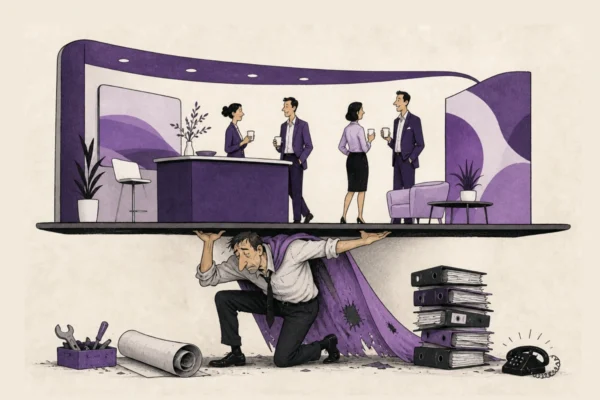
McKinsey learned this at scale. They built a business model on billable analytical hours, and then the thing that made those hours billable got automated. What survived was senior judgment — the partners who could walk into a boardroom and tell a CEO something they didn’t already know. The analytical scaffolding underneath that judgment turned out to be the exposure, not the asset.
Your firm has the same anatomy. The question is whether you know where your exposure sits.
AI Needs People. Specifically, It Needs Judgment.
There is a version of this conversation that treats AI as a headcount reduction strategy. That framing will cost you.
AI does not manage the client relationship when the exhibit director calls at 7 a.m. from the show floor and the booth isn’t where the floor plan said it would be. It does not make the call when a key I&D subcontractor is short four people and you have three hours until the show opens. It does not read the room when the client is three weeks from the show and clearly anxious about something they haven’t said out loud yet. It does not carry the institutional knowledge of having shipped 200 programs and knowing what a tight timeline actually looks like before it becomes a crisis.
What AI does is give the people who carry that judgment more room to use it.
That distinction — between work AI compresses and judgment AI amplifies — is also the most important lens you can apply to your next hire. The coordinator who tracks action items and updates the schedule manually is being replaced by technology faster than most firms have planned for. The person worth hiring in 2026 thinks clearly on incomplete information, makes good decisions under pressure, reads the client accurately, and works alongside AI tools without needing someone to manage the process around them. Firms still writing 2019 job descriptions are going to find themselves with a 2019 workforce in a market that has already moved.
The question is not whether to automate. The question is which work you automate — and what your best people do with the capacity that creates.
The Order Matters — And So Does the Design
The AI conversation in the exhibit and event industry is happening almost entirely at the tool level. Which platform. Which design software. Which project management system showed the best demo at EXHIBITORLIVE. That conversation is not irrelevant. But it is starting in the middle.
Consider what the day actually looks like at most exhibit houses right now. An account executive is managing six active programs. The client on Program A wants a budget update. Getting the answer requires tracking down the project manager, the graphics vendor, and the I&D labor estimate that was revised twice and lives in someone’s email. By the time the information is assembled, two hours are gone and the number is already out of date. Meanwhile, a critical decision on Program C — whether to go to a second-tier labor contractor because the primary is short-staffed — has been sitting for two days because the account executive wasn’t sure who had the authority to approve the extra cost, and the owner is traveling.
That is not a technology problem. That is a decision architecture problem. Who owns the budget update? What is the escalation trigger when a vendor is short? Where does approval authority actually sit versus where the org chart says it sits? Until those questions have clear answers, AI produces better-formatted versions of the same confusion.
Now redesign that scenario with the operating model fixed first. Decision rights are clear. Escalation triggers are defined. The account executive knows exactly which decisions are hers and which ones require a principal. Information flows to the right person automatically because the system was designed to move it there. In that environment, AI does something genuinely powerful — it compresses the time between information and decision. The budget update that took two hours now takes fifteen minutes. The vendor gap surfaces before it becomes a crisis call at 6am on move-in day. The scope change that used to surface in week eight shows up in week three, when there is still time to manage it without burning the margin.
That is what AI-enabled decision architecture looks like in practice. Not faster chaos. Faster clarity. But clarity has to be designed first.
AI accelerates whatever operating model you have. Build the right one, and the acceleration compounds. Leave the fragmented one in place, and you get more data on a problem you still cannot resolve quickly enough to matter.
Three Questions That Will Tell You More Than Any Platform Demo
The exhibit and event business runs on thin margins. Labor is your biggest cost and your least predictable one. A program that goes sideways in the final two weeks does not just create stress — it destroys the margin you built the whole project on. Most firms absorb that loss, close out the program, and move on. The root cause never gets addressed because nobody had time to address it, and the next show is already loading.
That is the operating model problem AI will either solve or make worse, depending on what you do next.
You do not need another software evaluation before you answer these three questions.
Where is labor cost slipping through decisions that happen too late? Not the overrun you caught — the one that was already baked in by week three because nobody had clear authority to call the constraint early. AI can surface that signal in week one. But only if the decision rights exist to act on it.
Where are your best account executives and project managers spending time on work that AI could compress in the next 18 months — and what client-facing work are they not doing because of it? Every hour a senior AE spends chasing down a vendor invoice or rebuilding a budget that already exists somewhere in three email chains is an hour not spent protecting the relationship that renews next year. That is not a productivity problem. That is a margin problem.
And where is the owner or principal still the default decision-maker on problems that should have been resolved two levels below — and what does that cost in speed, in margin, and in the capacity of the business to run without you?
Those answers will tell you more about your AI readiness than any technology audit. They will also tell you exactly where the operating model work has to happen before the AI investment pays off.
The firms that will look back at this period as a structural advantage asked a different question than their competitors. Not which tool to buy. But how work is actually designed inside the business — and what has to change so that AI makes programs run better and more profitably, not just more documented.
McKinsey didn’t see the exposure in their own model until the cuts were already decided. You have the advantage of watching it happen first — and enough time to design around it rather than react to it.
That window is not staying open indefinitely.
Jane Gentry is the founder of Jane Gentry & Company, a strategic operating model advisory firm working with mid-market CEOs and senior leadership teams in the exhibit, event, manufacturing, construction, and professional services industries. She helps leadership teams clarify how work gets designed, how decisions get made, and how AI creates leverage instead of accelerating drag. If these questions are live inside your business, a 60-minute diagnostic conversation is a good place to start. Reach Jane directly at jane@janegentry.com.