



Listen to this.
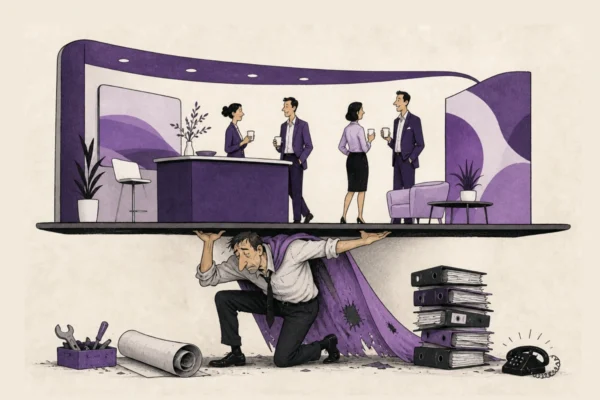
Growth changes who picks up the phone when a client calls. For years it may have been you. Now it’s often someone you hired to deliver, and the way they answer is the way your company answers.
It took me years to see that in how I answered people myself, and it came down to two sentences.
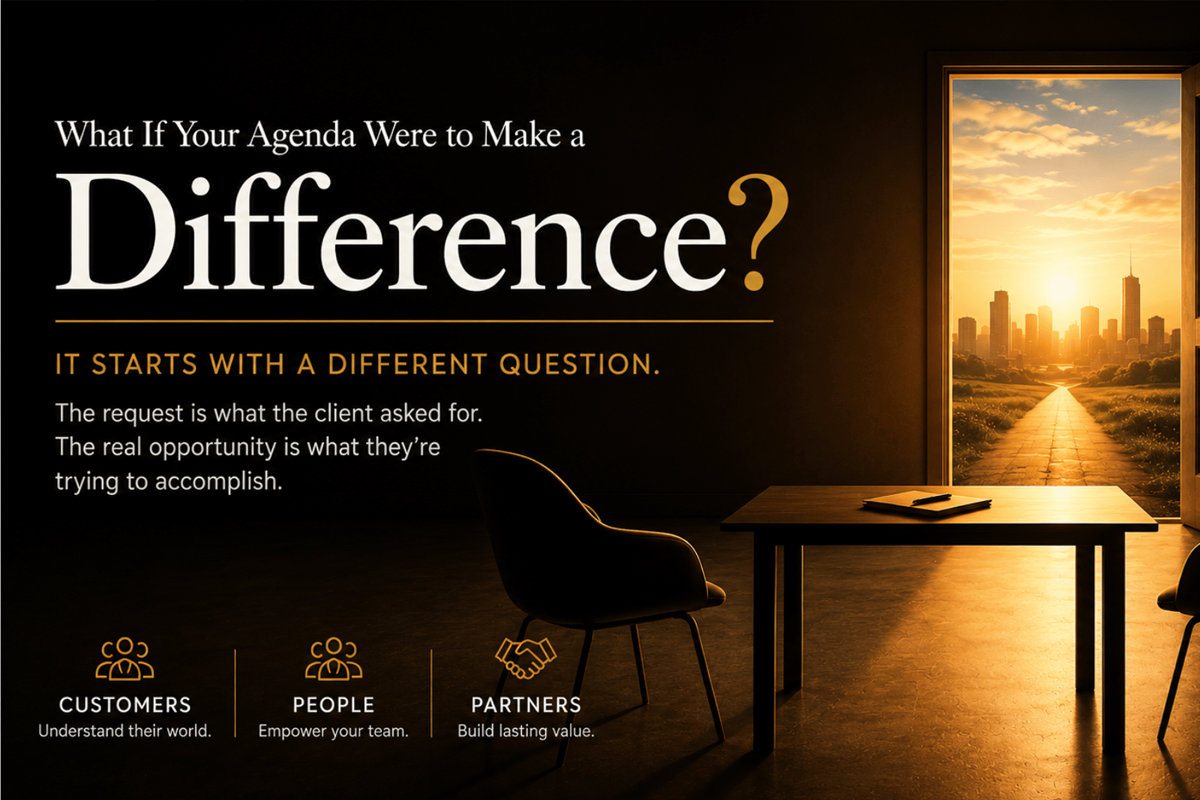
I don’t want to convince people they need me. I want to understand what they’re trying to accomplish and find out whether I can make a difference.
Those two sentences sound alike. In practice they lead to very different conversations. That distinction reaches well past my work with founders and CEOs. It changes how you sell to customers, how you lead your people and how you work with partners.
The problem with having the answer too early
Imagine you bring someone in to help you with a growth problem. The advisor listens for a few minutes and begins describing the solution.
- Maybe it’s technology.
- Possibly it’s a new sales process.
- Or it’s organizational restructuring.
- It could be a leadership program.
- Maybe it’s a new marketing strategy.
The solution might even be exactly right, but there’s a problem when we arrive at the answer before we fully understand the question. We start seeing the client’s situation through the lens of what we happen to know, what we happen to sell or what we’ve become accustomed to solving.
The more capable we are at solving a particular problem, the easier it becomes to assume that problem is the one that needs solving.
And that’s when something subtle happens. The client’s strategy becomes the vehicle for someone else’s business model. That’s backwards. The starting point has to be the client’s strategy.
- What are they trying to accomplish?
- What’s getting in the way?
- What assumptions are they making?
- What has changed?
- What does the next level require that the current level doesn’t?
- And what would actually make a difference?
Only then can we tell what role, if any, our expertise should play.
I do have an agenda
I’ve often said that I have no agenda other than supporting someone’s strategy where I can have an impact. I’ve reconsidered that. I do have an agenda. My agenda is impact.
Having an agenda isn’t the problem. The question is whether our agenda serves the other person’s objective, or whether their objective has been bent to serve ours.
- If I can help a customer see something they weren’t seeing, that’s impact.
- If I can challenge an assumption that needs challenging, that’s impact.
- If I can help the customer’s team get aligned, that’s impact.
- If I can help a company build the foundation it needs to support the growth it’s experiencing today and the growth it’s pursuing tomorrow, that’s impact.
Where this shows up inside your own company
Now turn it around. Think about your customers. Are you trying to sell them what you have, or are you trying to understand what they’re trying to accomplish? Your customer may ask for one thing when what they really need is something else.
A client calls and asks for a bigger booth. More footprint, more height, more to look at, quality labor and management onsite. What they’re after is forty qualified conversations over three show days, and their last booth produced twelve.
A bigger booth might get them there. So might a smaller booth with a better meeting plan. You only know which if you ask what they’re trying to accomplish before you price what they asked for.
The best companies don’t simply fill the order. They find out what the customer is trying to get from the show and build toward that.
That’s particularly relevant in an industry like ours, where businesses are constantly creating solutions around exhibits, experiences, events, technology, services and strategy. Our capabilities can be extraordinary. But the customer isn’t buying our capabilities for the sake of our capabilities. They’re trying to accomplish something. The better we understand that something, the more useful we become.
Now picture who took that bigger-booth call.
If your company has grown, it probably isn’t you anymore. It’s an account manager juggling five other shows, doing exactly what the company taught them to do. Hear the request, price it, get it on the schedule.
The question about what they’re trying to accomplish never comes up, so the quote goes out for the bigger booth. Nobody on that call did anything wrong. The company grew, and the way it takes a request didn’t grow with it.
A practical place to start is the next request that comes in.
Before anyone prices it, somebody asks the client one question. What are you trying to get out of this show?
Write the answer at the top of every document that travels with the job, from the first request to the install instructions. That way everyone who touches it sees it, from sales and design to the project manager on the show floor and the labor company installing the exhibit. If the answer and the request don’t match, that’s the conversation to have before a price goes out.
Now think about your people. How often do leaders walk into a conversation already believing they know the answer?
We ask questions, but we’re really looking for confirmation, and we filter every idea we hear through the solution we’ve already chosen.
What would happen if the objective weren’t to prove that our answer is right? What if the objective were to help the other person, and the company, accomplish what matters to them?
And think about your partners.
Many partnerships start with “What do I get?” What if they started with “What are we trying to accomplish together, and what can each of us contribute to making it happen?” The principle is the same.
Intent isn’t enough
There’s another distinction I’ve learned to appreciate. We can have the best intentions in the world and still fail to help.
A salesperson can sincerely believe their product is the right answer. An advisor can sincerely believe their approach is exactly what a client needs. A leader can sincerely believe they’re helping an employee.
Good intentions don’t guarantee good impact. Impact has to be measured from the other person’s perspective.
- Did the customer accomplish what they were trying to accomplish?
- Did the employee become more capable, confident or effective?
- Did the partner relationship create something neither could have created alone?
- Did the strategy actually move the business forward?
That’s a harder standard than simply asking whether we meant well. It’s also a much more useful one.
Maybe this is what experience teaches us
Earlier in my career, I probably thought more about what I could accomplish through a relationship. Today, I think more about what I can contribute to it.
After decades of building businesses, making mistakes, solving problems and watching strategies succeed and fail, I find the most satisfying outcome isn’t winning the work. It’s seeing something move forward.
- A founder makes a better decision.
- A leadership team sees the business differently.
- A company becomes more capable of handling its growth.
- A customer achieves something they couldn’t achieve alone.
- A person on the team discovers a better way forward.
That’s impact.
Maybe that’s a useful way to think about business relationships in general. Before asking what you can get from a relationship, or what you can sell through it, ask what they’re trying to accomplish and what you can contribute.
If we approached more of our relationships that way, we might discover something interesting. The less we make the relationship about what we have to sell, the more useful we become.
And if that creates business along the way? Great. That’s the byproduct. The agenda is to make a difference in what they’re trying to accomplish.
Take the next request that comes into your company from a client, someone on your team or a partner, and ask which agenda it got answered with.
Pat Alacqua has built his own companies. He helps founders, CEOs, and leadership teams fix what growth breaks. He can be reached at Pat@PatAlacqua.com.
Related stories
That Voice in Your Head Will Either Save You or Sabotage You