



Every year, The Exhibitor Advocate publishes the Annual Survey of Exhibition Rates. Every year, someone in the industry pushes back on the data: the sample size isn’t big enough, the methodology isn’t perfect, the findings don’t apply to their shows. And every year, exhibitors tell us the same thing: “this is exactly what we’re experiencing.”
That gap between what exhibitors feel and what the industry acknowledges is exactly why this research exists. Not to point fingers. Not to assign blame. But to create a shared, audited, independent set of facts that everyone at the table can build on.
The 2025 Annual Survey of Exhibition Rates, produced in partnership with Tradeshow Logic and independently audited by EVOLIO Marketing, is the most comprehensive look at exhibitor costs we’ve ever published. Four years of data across 23 major U.S. cities, and a picture of cost escalation that is, at this point, impossible to dismiss.
What the Data Is Actually Saying
The headline numbers get attention, and they should:
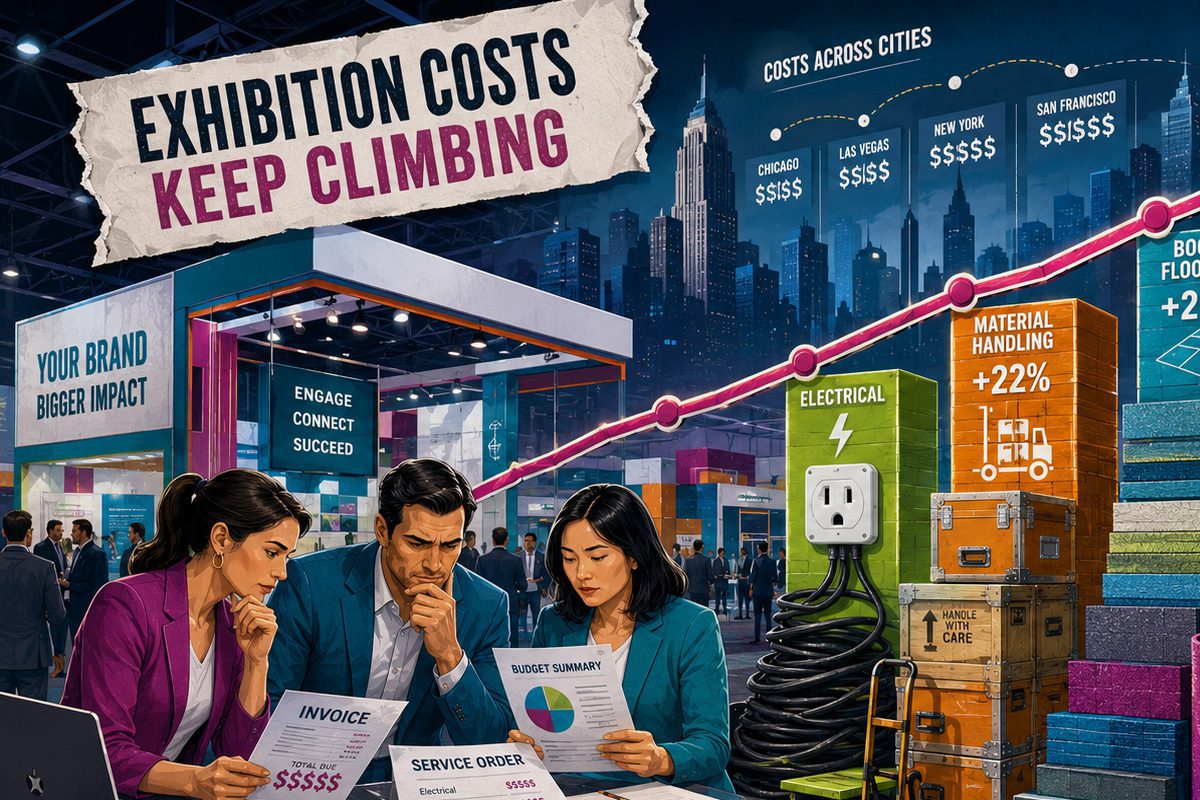
- Electrical outlet rates surged 18.4 percent in a single year. This is one of the largest single-category increases in the survey’s four-year history.
- Material handling base rates rose 9.5 percent to $2.28 per pound, more than three times the national inflation rate of 2.7 percent.
- Booth flooring accelerated sharply: carpet up 12.7 percent, rebond padding up 21.0 percent, and visqueen covering up 22.1 percent.
- Exhibiting in New York now costs approximately 75 percent more than in Atlanta, the widest geographic spread the survey has recorded.
One bright spot: hanging sign and lift rates dropped 15.3 percent on average, the largest single-category decline in the survey’s history.
But the headline numbers aren’t the whole story. What matters more is the compound effect. Material handling base rates have climbed 21.3 percent since 2022. Electrical overtime is up 41.2 percent over the same period. Booth flooring components have risen as much as 33.3 percent. These aren’t one-time anomalies. They’re a pattern.
For someone managing a portfolio of 10, 20, or 30 shows a year, these aren’t line items. They’re ongoing budget strain.
The Behavioral Shift That Should Get Everyone’s Attention
What’s most striking in this year’s data isn’t just what things cost. It’s what exhibitors are doing about it.
According to The Exhibitor Advocate’s companion research, The Evolving Landscape of Event Marketing, 80 percent of exhibitors now cite cost management as their top challenge. Not lead generation, not staffing, not logistics. Cost. And 55 percent say increased costs outweigh the value of the investment at some events.
That’s not a dissatisfied fringe. That’s the mainstream exhibitor community making hard decisions. And they are making decisions:
- 64 percent are scaling back their overall presence at events
- 55 percent are limiting onsite staff attendance
- 52 percent are re-evaluating event and exhibit budgets
- 43 percent say holding offsite activities is now preferred over exhibiting at some events
- 66 percent consider scheduled in-person meetings more effective than tradeshows for some objectives, up from 44 percent just one year prior
Here’s what that last stat should signal to the entire industry: exhibitors aren’t giving up on face-to-face. They’re giving up on formats where they can’t justify the cost or prove the value. That distinction matters.
A Note on the Data Itself
We know that no dataset is perfect. The 2025 survey is based on publicly available exhibitor manuals and rate forms, across shows of different sizes and sectors. It’s an audited snapshot, not a census. Every show is different. Every city has nuances. We say so clearly in the report.
But here’s what we also know: the exhibitors filling out their show service orders aren’t working with perfect information either. They’re working with whatever is in the exhibitor manual. Which sometimes can be difficult to navigate and understand. This survey puts that information in context for the first time, at scale, over four consecutive years. That context, city to city, year to year, category by category, is what makes it useful.
We’re not suggesting these numbers apply uniformly to every show in every market. We are suggesting that show organizers, general contractors, and suppliers who haven’t looked at where their pricing lands relative to these benchmarks, may be missing important conversations with exhibitors.
What This Means for the Industry
The exhibition industry is genuinely good at what it does. Live events create connections that no other channel replicates.
What is questionable is whether the financial model is sustainable for the people funding it, the exhibitors. When more than half say costs outweigh value at some events, and nearly two-thirds are scaling back their presence, that’s not a marketing problem.
It’s a structural one.
The path forward isn’t complicated, even if it isn’t easy. It starts with honest conversation and shared data. Show organizers who use this research to negotiate more aggressively on their exhibitors’ behalf with venues, with GCs, with service providers, etc. are the ones who will hold onto their exhibitor base. Those conversations and negotiations will become increasingly important to long-term exhibitor retention.
Suppliers and contractors who can demonstrate transparency and fair pricing relative to market benchmarks will be the ones exhibitors choose to do business with long-term. Trust, once lost, is expensive to rebuild.
And exhibitors: this data is yours. Use it. Compare your invoices to the national averages for your city. Walk into your next budget conversation with your leadership armed with independent, audited numbers. Know what the market actually looks like before you sign anything.
How to Get the Report
The 2025 Annual Survey of Exhibition Rates is available now at www.exhibitoradvocacy.com for $250. Education Subscribers receive complimentary access as part of their $299/year subscription.
The exhibitors and organizers making decisions without this data are negotiating in the dark. Don’t be one of them.
Jessica Sibila is the Executive Director of The Exhibitor Advocate, the only nonprofit association wholly dedicated to tradeshow exhibitor success.
This story originally appeared in the Q3 2026 issue of Exhibit City News, with the original magazine layout available here.