



Reimagining Workplace Culture in Experiential Marketing Agencies
by Deborah Cox, Marketing Consultant and Bree Patterson, Marketing Content Manager, at Exhibitus
When fresh talent enters the experiential marketing world, they bring energy and expectations. Today’s entrants arrive informed, confident, and ready to contribute. They’ve researched the industry, can sell their transferable skills, and see the steadiness of live events as a compelling alternative to trendier adjacent fields. Many come from theatrical design, creative technology, and engineering. All drawn by the chance to build experiences. For leaders, the takeaway is clear: a wellness-supportive culture that empowers growth and creative contribution isn’t a perk; it’s a competitive advantage.
Developing a “WellnessFirst” workforce in experiential marketing requires rethinking how people are supported and sustained across the full arc of their careers. Wellness is not limited to physical benefits or momentary perks. It includes manageable workloads, physical safety, mental wellbeing, resource allocation, and leadership practices that acknowledge the intensity of event and exhibition cycles and the importance of recovery between them. For teams operating under high pressure and tight deadlines, how work is paced, credited, and communicated matters as much as the work itself.
A “WellnessFirst” approach also broadens how talent is defined. By welcoming professionals from hospitality, retail, theater, architecture, and film production, experiential organizations strengthen performance through diverse perspectives and transferable skills. This cross-industry integration expands the talent pipeline while elevating the quality of both creative and operational outcomes.
Sustaining this workforce requires clear growth pathways, mentorship, transparent communication, and flexible leadership that adapts to project phases and individual needs. Establishing thoughtful AI guardrails further protects creative integrity, aligning speed with accountability. Together, these practices signal a commitment to longterm relationships, ensuring teams feel valued not just for showday execution, but for their ongoing contribution to the success of their agency.
The current cohort of young workers is direct about what they want: feedback, faster paths to impact, and permission to challenge the status quo. Historically, younger professionals “earned the mic” over time. Now they expect a seat at the table from day one and when they see no path up, they disengage. Wellness here is more than just healthcare and 401ks; it’s about growth, visibility, and momentum. When organizations channel ambition into structured pathways, they protect engagement by reducing burnout that comes from spinning wheels without progress. Wellness-minded teams respond by clarifying priorities, pacing work, and normalizing cross-functional learning without glorifying overextension.
For creative roles, collaboration is critical and requires a variety of skills. Today’s design packages span craft and code, aesthetics and engineering. In addition, today’s designers are expected to sell, speak marketing, and integrate technical considerations.
AI is another inflection point. Digital natives often default to “I’ll put it in AI,” while seasoned pros weigh originality and longterm implications. The healthiest cultures don’t position this as a generational rift. Instead, they set standards: when to ideate with AI, when craftsmanship is nonnegotiable, and how to protect client integrity. Guardrails reduce stress, align expectations, and keep the focus on quality outcomes instead of tool debates.
Traditional Management Skills Still Count
The evolution of workplace culture in no way suggests that traditional management skills are obsolete—they are foundational to successful business execution. The following skills are among those that leaders must maintain for a successful work environment but at times tweak delivery to ensure they are effective across generations.
Definitive goals and objectives – It is leadership’s primary responsibility to translate the vision of the company’s success into actionable goals and aligning a team’s daily work assignments with strategic objectives. Without direction, competing priorities cannot be managed effectively no matter the work experience.
Clear communication and direction — Young employees value transparency but still need guidance, direction and to be reminded of how their work contributes to the company’s overall goals and success.
Accountability — Holding employees accountable for results has always been a primary duty of managers. If discussions of accountability are objective, promptly addressed and tied to the company’s growth, a manager will foster an environment where high standards are consistently understood and met.
Feedback — Providing regular one-on-one feedback and constructive performance discussions is a classic management responsibility, even more valuable today with younger employees that demand more feedback than prior generations.
Conflict management — Avoidance is not leadership. Addressing and mediating disagreements professionally will help maintain respectful team dynamics. This skill is essential, especially in diverse, multi-generational, and often remote teams.
Decision-making — While a collaborative environment is valued, leadership still must lead. This means understanding which decisions belong to upper manager and making timely decisions about how to move forward and ultimately taking responsibility for the outcome. This is especially critical during periods of uncertainty. The entire workforce, no matter the generation or tenure of employees, must trust that the company leaders will not avoid authority when it is needed.
Cross-Industry Talent, Elevated Outcomes
Experiential marketing has always been multidisciplinary, but the talent pipeline is widening. Hospitality and retail pros bring a customer-first mindset and detail orientation. Theater, architecture, film production, and product design infuse lighting, spatial storytelling, and systems thinking that raise the bar for attendee experience. The result is a fresh perspective on sustainability and digital integration that can lead to more efficient workflows. Teams thrive when diverse experience is valued and leveraged, allowing people to feel seen as valuable resources with depth.
Some skills remain nonnegotiable, regardless of generation or role: crisp communication, strong administration, deadline discipline, and a default to team over silo. In creative work, 3D skills matter and AI fluency helps but only when balanced with human judgment around safety, engineering, and architectural constraints. Clear expectations reduce anxiety and prevent last-mile scrambles that erode morale.
Digital Fluency Without Digital Exhaustion
Market expectations are moving as fast as the workforce. Customers want answers sooner and execution quicker, the by product of the always-on digital lifestyle. Internal communications mirror this evolution. Instant messaging keeps pace with a deadlinedriven world, but it can blur boundaries. “WellnessFirst” teams define responsiveness windows and protect deep-work time. The healthiest companies hire rising talent while supporting veterans through tech adoption, being sure to honor craft while making change navigable.
Digital natives champion new platforms and experiment freely. Inclusion and flexible policies are table stakes for relevance and retention. Diversity across roles is the expectation including women in craft roles, such as carpentry, once considered uncommon. Measurement culture is rising alongside creative risk-taking, with impact reporting extending beyond ROI to Environmental, Social, and Governance (ESG)—how companies treat people and planet.
Leadership, Growth, and Retention by Design
Transparent leadership builds trust, especially for early-career professionals who want to understand the “why” behind decisions. Implementing town halls, executive roundtables, flexibility, and intuitive performance reviews signals respect for employees and their varied work styles and life stages. Formal career pathways, internal mentorship, and succession planning turn ambition into a roadmap.
Moving professional development online underscores a tech-forward culture. As personal branding rises, titles and prestige are factors in recruiting. Making social-shareable growth moments matter to incoming talent. We are seeing more strategy-oriented leadership roles and expanded middle management develop in the industry. To stay attractive across sectors, organizations need a culture employees rave about publicly and experience positively day to day.
Wellness includes positive culture, leadership attitudes and most importantly how workloads are planned. Being proactive about how work is paced and rewarded, including fair compensation for weekend or overtime work, safeguards employees from burnout and aids morale. The next generation already knows flexibility, digital presence, and high visibility drive both brand relevance and growth. This thinking extends to career sustainability. When performance reviews ask “Do you have what you need?” they are more than paperwork. They become a workplace wellness practice that elevates organizations and celebrates wins. Creating an environment that fosters collaboration is flexible when possible, and nontoxic by design builds a workplace that retains talent year over year.
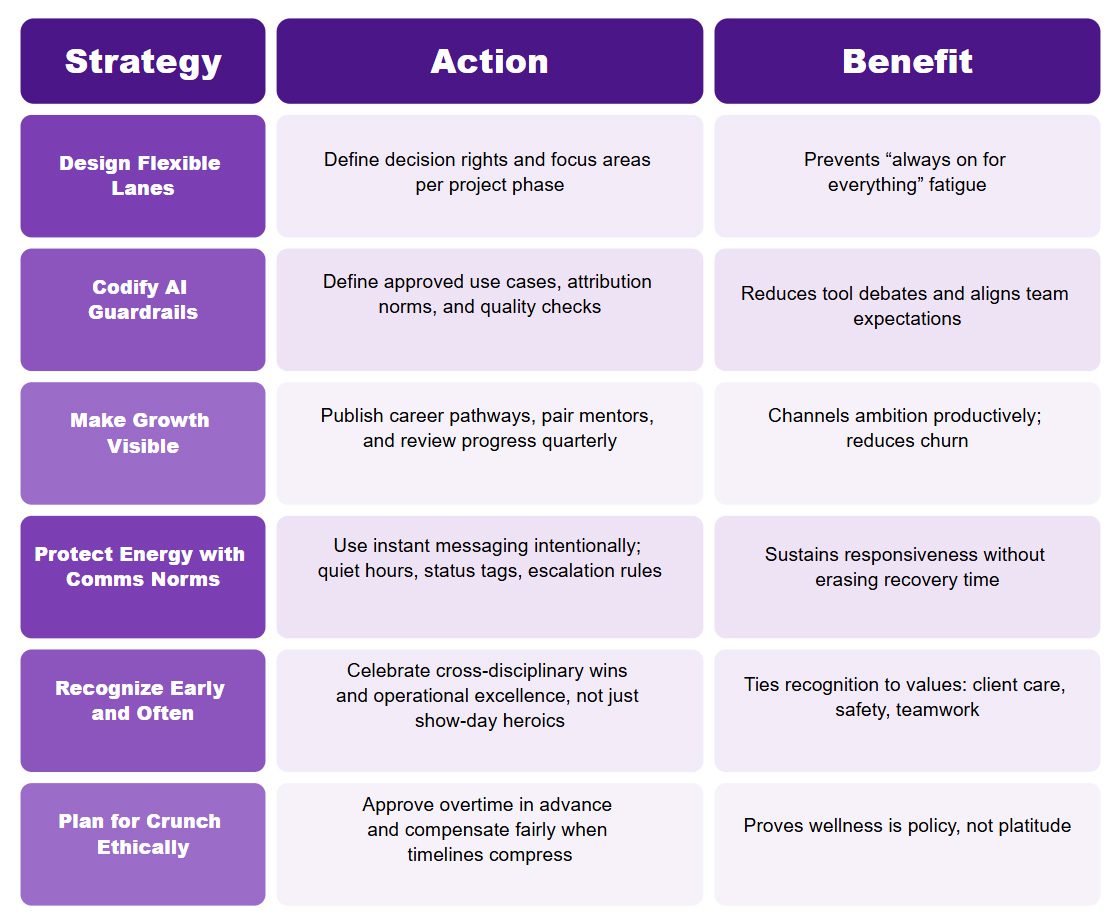
A Practical Wellness Playbook for Experiential Marketing Teams
Design flexible lanes. Encourage cross-functional contribution while specifying decision rights and focus areas per phase. This preserves creative momentum without creating “always responsible for everything” fatigue.
Codify AI guardrails. Define approved use cases, attribution norms, and quality checks so teams can move fast and honor originality and client integrity.
Make growth visible. Publish career pathways, pair mentors, and review progress quarterly. Ambition without a map turns into churn.
Protect energy with comms norms. Use instant messaging intentionally (quiet hours, status tags, escalation rules) to sustain responsiveness without erasing recovery time.
Recognize early and often. Celebrate cross-disciplinary wins and operational excellence, not just showday heroics. Tie recognition to values like client care, safety, and teamwork.
Plan for crunch ethically. When timelines compress, align resources, approve overtime in advance, and compensate fairly. Wellness is policy, not platitude.
Frequently Asked Questions
What is workforce wellness in the experiential marketing industry?
Workforce wellness in the experiential marketing industry goes beyond physical health benefits. It encompasses psychological safety, career visibility, fair workload distribution, and a culture that values people across all career stages. For experiential marketing teams, who often operate under intense deadlines and on-site pressures, wellness is also about how work is paced and recognized between shows, not just during them.How does cross-industry talent improve experiential marketing team performance?
Professionals from hospitality, retail, theater, architecture, and film production bring transferable skills that elevate the attendee experience and introduce fresh operational efficiencies. Skills like customer-first thinking, spatial storytelling, and systems design are cross functional reaches that aid incoming talent. When experiential marketing organizations actively recruit and integrate cross-industry talent, they widen the talent pipeline and raise the performance ceiling for the whole team.
What are AI guardrails and why do experiential marketing creative teams need them?
AI guardrails are organizational standards that define when and how AI tools can be used in creative workflows including approved use cases, attribution norms, and quality checkpoints. For experiential marketing creative teams this equals balancing speed with originality and client integrity. Guardrails reduce internal debate, align generational expectations, and support AI adoption rather than undermining craft and accountability.
How can experiential marketing companies improve employee retention?
Experiential marketing companies improve retention by making growth visible, recognizing contributions beyond showday heroics, and modeling flexible leadership that respects life outside of work. Succession planning, transparent communication, published career paths, mentorship programs, regular check-ins, and fair overtime policies signal that the organization values long-term workforce stability.
What does flexible leadership look like for experiential marketing teams?
Flexible leadership for experiential marketing teams means adapting management style to the project phase and the individual’s needs. It includes defining clear decision rights during crunch periods, protecting recovery time between shows, supporting hybrid or remote work where feasible, and hosting transparent forums where team members understand the business direction and feel safe asking questions.
This story originally appeared in the Q3 2026 issue of Exhibit City News, with the original magazine layout available here.