




I talk to mid-market CEOs every week who’ve done everything right on paper. They bought the tools. Hired the people. Launched the pilots. Gave the all-hands speech about transformation.
Six months later, the meeting notes look better. The emails are more polished. And the organization is still slow, still noisy, still stuck in the same decision loops it was stuck in before they spent the money.
That’s not an AI problem. That’s a leadership problem. And it’s not because these leaders are stupid or behind — it’s because every vendor, every conference, and every AI advisor they’ve talked to sold them on tools and adoption, not on what actually has to change inside the organization. The playbook they were handed was wrong. The patterns that result are predictable.
I want to be clear about something: I am not an AI skeptic. I’ve seen what happens when a mid-market company gets this right. A PE-backed logistics firm I worked with cut decision cycles by 75%. A manufacturing client improved gross margins by 8 points. Senior leaders who were about to leave decided to stay because the job finally made sense again. AI deployed on top of a well-designed operating model is a compounding advantage that’s very hard for competitors to reverse-engineer. That’s exactly why it’s so frustrating to watch companies waste it.
The CIO Is Carrying the Ball Alone
Somewhere in the last 18 months, your leadership team heard “AI” and looked at one person. The CIO accepted it because nobody else wanted it. And now every other leader in the room treats AI as somebody else’s responsibility.
I watched this play out with a $200M manufacturing company last year. They had a six-figure AI investment, a dedicated internal team, and exactly zero functional leaders who could explain how AI changed anything about how their part of the business operated. Sales forecasted the same way. Operations scheduled the same way. Finance surfaced data the same way. The only thing that changed was the tech stack underneath — and nobody above the CIO cared how it worked, as long as it didn’t break.
The technology changed. The way the company operated didn’t.
AI changes how decisions move, how information gets to the people who need it, how work gets structured across functions. The CIO can own the architecture. But the CIO can’t own a transformation that, by definition, lives inside every other leader’s domain. Every functional leader should be able to answer one question: what operating outcome is AI producing in my area? Not adoption metrics. Not training completion rates. A business result. If they can’t answer that, they don’t have an AI strategy. They have a subscription.
The Trust Problem Nobody’s Calibrating
Your leaders fall into two camps, and both are getting it wrong.
Camp one won’t move without perfect data. They worry about hallucinations and bias until the approval layers get so thick that nothing ships. Camp two takes AI output at face value — if the tool generated it, it must be right.
Here’s what I’ve seen happen in practice: the over Trusters are more dangerous than the under Trusters. The leader who’s skeptical slows you down. The leader who sends an AI-generated customer analysis to the board without checking the numbers can cost you a deal, a relationship, or your credibility in a room you can’t get back into. I’ve watched a VP present margin projections that an AI tool had generated using assumptions nobody validated. The numbers looked clean. They weren’t. That’s not an AI failure — it’s a leadership failure dressed up in a better-looking spreadsheet.
The fix isn’t complicated, but it takes reps. Get your leaders working with AI outputs in low-stakes situations before the stakes are real. Have them run AI-generated analyses against their own judgment. Let them catch where it misses. You’re not building trust or distrust — you’re building the same calibrated judgment you’d expect from any leader evaluating data from any source. AI doesn’t get a pass on that standard just because it’s new.
They’re Losing People by Dodging the Real Question
This one costs more than most CEOs realize.
Your people see the AI rollout. They hear the efficiency language. They watch the LinkedIn posts about headcount reduction. And when they ask — directly, in a meeting, to their manager — “What does this mean for my job?” they get filler. “We’re on a journey.” “This is about augmentation.” “Everyone will need to adapt.”
I’ve carried a P&L. I’ve sat across from people who needed real answers. Those phrases don’t land as reassurance. They land as confirmation that leadership either doesn’t know or won’t say.
The damage is quiet. Engagement drops. Experimentation stops. Your best people — the ones you cannot afford to lose — start hedging. They pull back on risk. Some update their resumes. You won’t see it in a dashboard. You’ll see it six months from now when your A-players are gone and the people left aren’t the ones who’ll carry you through a transformation.
AI transformation requires people to lean in. Try new workflows. Flag what’s broken. Nobody does that when they think they’re building the case for their own elimination.
The fix isn’t a communications plan. It’s a leadership capability. Your managers need to be able to sit across from someone and say: here’s what’s changing about your role, here’s what matters more now than it did a year ago, and here’s what growth looks like if you build this capability. That’s a conversation, not a town hall. And if your leaders can’t have it without retreating into talking points, you’ve got a gap that no amount of AI tooling will cover.
The Uncomfortable Math
Here’s what connects all three of these: your leaders aren’t treating AI as a reason to change how the company operates. They’re treating it as a layer on top of the operating model they already have.
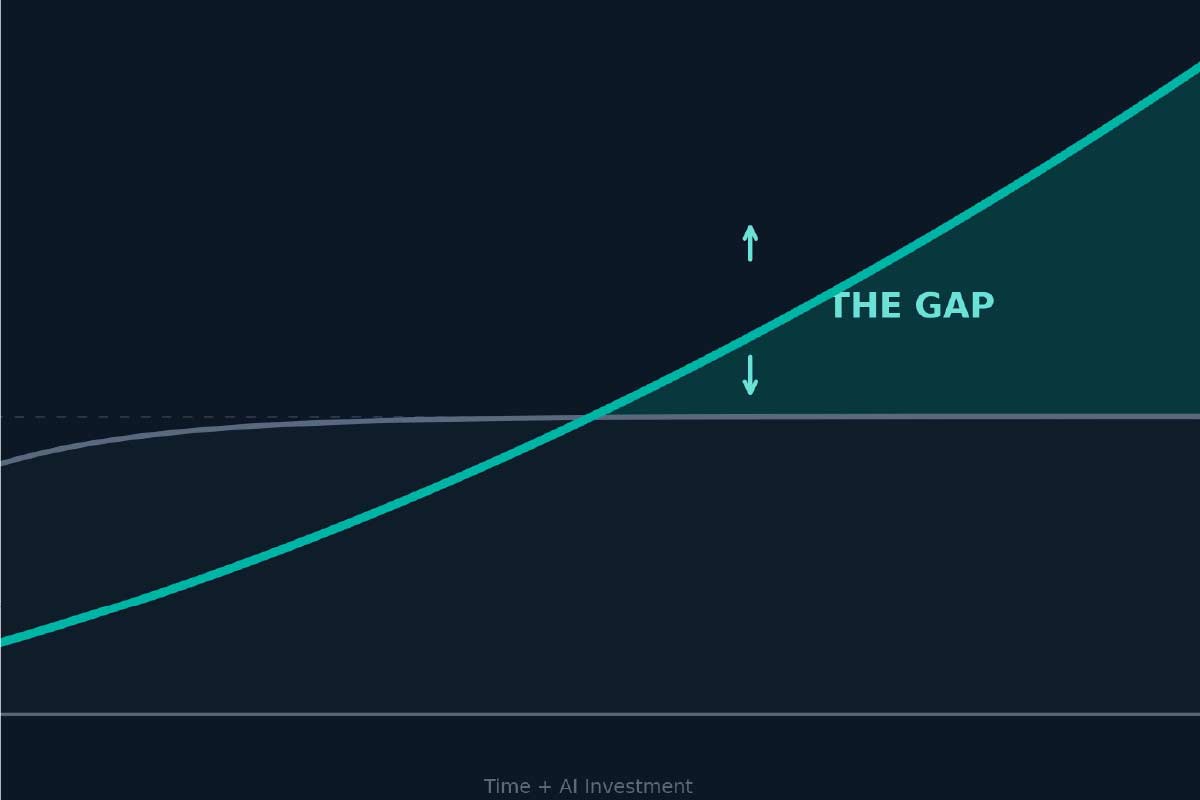
That’s a losing bet, and here’s why. AI doesn’t just expose inefficiency — it multiplies whatever system it sits on top of. If your decisions are slow, AI gives you faster inputs into the same slow process. If information breaks down between sales and operations, AI generates better reports that still land in the wrong hands at the wrong time. If work exists only because the system is broken, AI automates the workaround instead of eliminating the need for it.
Most companies are on what I call the capped curve. They get some efficiency gains, maybe some time savings, and then they hit a ceiling — because the underlying system hasn’t changed. The companies getting real leverage are on a different curve entirely. They redesigned how decisions get made, then applied AI to the new architecture. The returns compound because the system itself is different.
Your AI investment isn’t a technology decision. It’s a leadership decision about whether your operating model is ready to absorb what AI can actually do. If it’s not, fix that first. Otherwise, you’re bolting a jet engine onto a machine that can’t steer.
Where to Start
The first step isn’t buying another tool or launching another pilot. It’s asking whether your operating model — how decisions get made, how information moves, how work is structured — is ready to absorb what AI can actually do. If every functional leader can’t connect their AI investment to a specific operating outcome, you don’t have a readiness problem. You have a design problem. And that’s worth 90 minutes of honest diagnosis before you spend another dollar.
Need help. Shoot me an email titled AI HELP.
Jane Gentry is the founder of JaneGentry & Company, a strategic advisory firm serving mid-market CEOs across manufacturing, construction, logistics, and professional services. She can be reached at janegentry.com.