



LAS VEGAS — Commercial UAV Expo 2026 brought the commercial drone community to Caesars Forum Sept. 1-3 for three days of education, product launches, demonstrations and face-to-face business development. Produced by Diversified Communications and presented by Commercial UAV News, the event reflected an industry entering a more demanding stage of growth: proving that unmanned aircraft systems can operate safely, securely and profitably at scale.
The technology on the exhibit floor remained a major draw, but the larger story was integration. Conversations stretched well beyond the aircraft themselves to include batteries, lidar, artificial intelligence, GPS-independent navigation, anti-jamming technology, Remote ID detection, domestic manufacturing, cybersecurity, workforce training and regulatory compliance. For exhibitors and attendees, the question was no longer simply whether drones can perform commercial work — it was how organizations can build reliable programs around them.
FROM A NEW SHOW TO AN ESTABLISHED INDUSTRY MARKETPLACE
The scale of Commercial UAV Expo helps explain how quickly the market has matured. The inaugural 2015 event at Caesars Palace sold out its original exhibit floor nearly two months before opening; organizers added another hall, ultimately promoting more than 130 booths and more than 100 exhibiting companies from over a dozen countries. That first edition was built around helping asset owners compare a still-emerging category of aircraft, sensors, software and services.
By 2022, the event had moved to Caesars Forum and sold out again. The eighth edition recorded 232 exhibitors and 3,405 verified professionals from 60 countries and 48 states. In 2025, the 11th annual show reported 230 exhibitors and 3,393 verified professionals representing all 50 states and 60 countries, supported by more than 140 industry experts in the conference program. The 2026 event was promoted ahead of opening with expectations of more than 3,500 attendees, 225-plus exhibitors and 150-plus speakers. Organizers had not yet published a final 2026 attendance or net-square-foot figure when this article was prepared, so the advance numbers should not be treated as final.
The inaugural show focused largely on systems selection, enterprise workflows, data integration and the legal questions surrounding early commercial adoption. Today’s floor functions more like a complete industry marketplace: aircraft and sensor manufacturers now share space with battery developers, navigation and communications specialists, software providers, public-safety organizations, universities, training companies, government agencies and firms addressing cybersecurity, compliance and domestic sourcing.
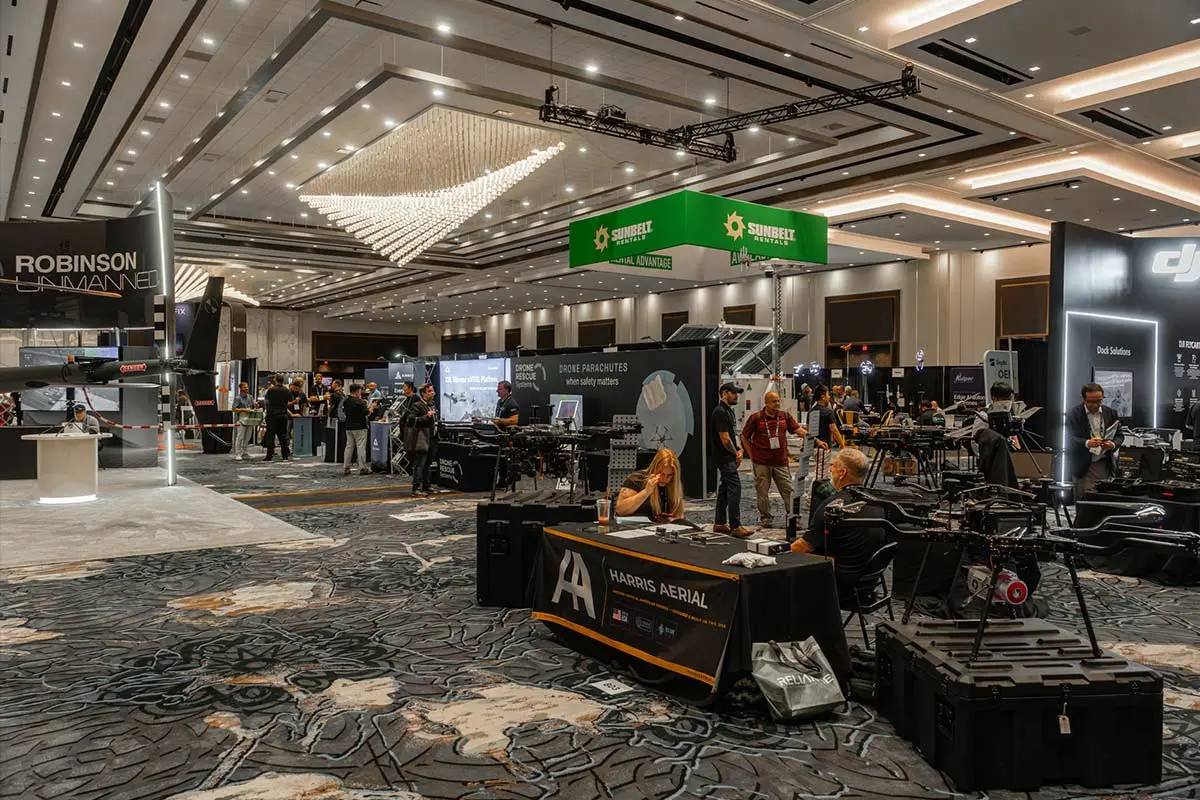
Programming has moved onto the floor as well. The 2026 layout incorporated the Forum Theater, Pilot Hub, Level-Up Lounge and a 40-by-50-foot indoor airspace enclosed by 15-foot-high netting for live demonstrations. Roundtables, career development, marketing consultations and hands-on flight content extended the value of the hall beyond a traditional row of booths — the footprint is better understood not simply as exhibit space, but as a series of content and community environments designed to keep attendees engaged throughout the day.
POLICY MOVES TO THE CENTER OF THE FLOOR
Regulation and procurement policy became two of the show’s defining conversations. The FCC’s addition of foreign-made drones and components to its Covered List in December 2025, followed by a newer proposal this summer targeting so-called “military-grade” drones and sensors, created immediate concern for operators, manufacturers, educators and public agencies. Thermal imaging systems, lidar-equipped aircraft, docking stations and spray drones may serve everyday commercial or public-safety missions, yet broad definitions can pull those systems into national-security policy debates.
Pilot Institute later reported that its review of nearly 4,000 readable public comments found 98.6 percent opposed the FCC’s “military-grade” drone proposal.
That uncertainty is also changing education and certification. Universities and training providers are increasingly responsible for helping students and working pilots understand not only flight skills, but also equipment eligibility, procurement requirements, cybersecurity and the regulations attached to specific missions. Professionalization is becoming as important as technical capability.
FAA AND EASA LOOK TOWARD SCALABLE BVLOS
The closing-day keynote brought the Federal Aviation Administration and the European Union Aviation Safety Agency together to discuss regulatory convergence and beyond-visual-line-of-sight (BVLOS) operations. Both authorities share the goal of safely integrating crewed and uncrewed aircraft, even as the United States and Europe pursue that goal through different regulatory frameworks.
For commercial operators, scalable BVLOS is essential to expanding inspection, delivery, public-safety, mapping and infrastructure programs beyond limited pilot projects. The keynote made clear that the next phase of growth depends on normalizing those operations rather than treating each flight as an exception, and it underscored the value of international coordination for companies that want to operate across borders.
A SHOW FLOOR BUILT AROUND REAL PROBLEMS
Product news reinforced the same shift toward practical deployment. Pitch the Press selected Harris Aerial, Skyline Nav AI and UtopiaCompression Corporation as its 2026 winners from 14 presenting exhibitors. Harris Aerial highlighted a compact, payload-agnostic platform built to National Defense Authorization Act (NDAA) compliance standards; Skyline Nav AI presented GPS-independent navigation hardware for missions where satellite signals may be degraded or unavailable; and UtopiaCompression focused on aircraft detection as drone traffic increases.
Elsewhere, exhibitors introduced technology aimed at the operational barriers keeping programs from scaling. Infinite Electronics presented anti-jamming, multi-constellation GNSS (Global Navigation Satellite System) antennas. A2Z Drone Delivery launched a dual-battery aircraft designed to add redundancy for delivery and patrol missions. UAS Sentry introduced modular and portable Remote ID detection products. Amprius Technologies showcased a silicon-anode battery cell reaching 500 Wh/kg for long-endurance unmanned aviation. GeoCue expanded its NDAA-compliant lidar portfolio, while EagleNXT introduced a multispectral, panchromatic and radiometric thermal sensor for agriculture, environmental monitoring, solar inspection and industrial temperature mapping.
Taken together, those announcements told a cohesive story: resilience, compliance, endurance and usable data are now core selling points, and buyers are evaluating complete systems and long-term operating risk rather than airframes or specifications alone.
NETWORKING BECAME PART OF THE EXPERIENCE
Commercial UAV Expo also demonstrated how thoughtful show-floor activations can support serious business goals. Drone soccer, live-flight demonstrations, receptions and other game-based activations gave attendees natural reasons to stop, participate and begin conversations. The activities added energy without distracting from the technical nature of the event, and they helped turn aisle traffic into networking opportunities.
For the exhibit and event industry, that balance is worth noting. Highly specialized audiences do not necessarily need louder attractions; they need relevant experiences that lower the barrier to conversation. A short competition, hands-on demonstration or shared challenge can create the opening that leads to a product discussion, partnership or follow-up meeting.
WHAT THE SHOW’S EVOLUTION MEANS FOR THE EVENTS INDUSTRY
For exhibit houses, production companies and event strategists, Commercial UAV Expo illustrates how a technical conference can grow without losing its specialized identity. The opportunity extends well beyond building more 10-by-10 booths: as exhibitors mature, they need environments that can demonstrate systems, explain complex buying criteria, support private conversations and produce content that continues working after the hall closes. That creates demand for stronger demonstration design, reliable network infrastructure, broadcast-quality content capture and safe rigging around live-flight areas. Exhibitors selling lidar, thermal imaging, navigation or data platforms must make invisible technical processes visible to buyers — through large-format visualization, real-time dashboards, recorded mission footage and controlled hands-on experiences that translate specifications into business outcomes.
The expanded mix of theaters, lounges, roundtables and activations also changes the production model. Education and exhibits are no longer separate experiences: show management must coordinate stage programming, traffic flow, power, connectivity, sponsor visibility and food-and-beverage schedules so content drives attendees back into the hall instead of pulling them away from exhibitors. Sponsors, meanwhile, gain more useful options than logo placement alone — hosted education, charging and meeting lounges, flight demonstrations, competitions and branded professional-development experiences can all create measurable engagement.
The growing public-safety, university and government presence introduces additional requirements. Vendors may need secure meeting space, accessible educational environments, clear safety protocols, controlled demonstration zones and production partners familiar with regulatory or sensitive subject matter. For Las Vegas suppliers, the show also represents a concentrated opportunity to support international exhibitors that need local labor, rental equipment, AV, scenic fabrication, freight coordination and turnkey show services.
COMMERCIAL AND DEFENSE INTERESTS SHARE AN ECOSYSTEM
The show also revealed how closely commercial and defense priorities now overlap. Secure communications, resilient navigation, domestic manufacturing and cyber protection matter to both sectors, even when the end use is entirely nondefense. Federal security participation and cybersecurity discussions reinforced the reality that a connected aircraft is also a connected endpoint that must be protected.
At the same time, commercial operators are working to ensure that security policy does not unintentionally restrict tools used for infrastructure inspection, emergency response, mapping, agriculture, entertainment and other civilian applications. International collaboration will be important here, as industry groups, regulators and nondefense businesses increasingly organize across borders to advocate for workable standards and a commercial voice in aviation policy.
THE INDUSTRY’S NEXT TEST
Commercial UAV Expo 2026 showed a sector with no shortage of innovation. Its more important message, however, was that innovation alone is no longer enough. The companies positioned to grow will be those that can combine aircraft, sensors, software and data with compliant procurement, trained people, secure systems and repeatable operating procedures.
That evolution was visible in the conference rooms, on the exhibit floor and in the conversations continuing after the show. Commercial drones are moving deeper into mainstream business and public-sector operations. The next test is whether policy, infrastructure and workforce development can move at the same speed.