



We had signed everything. The documents were in order, the stand was a modular system recognized across the world, and the wall in question was a design we have built countless times. Then, at a recent show in the UK, I was standing on site when somebody asked us to strengthen the top section of it.

The wall in question, once finished. Photo courtesy of T3 Systems.
Extra bracing, on the top section of a wall that had never needed any. We knew the structure was sound, and the check behind the request was hardly a proper stress test. A hi-vis jacket and a clipboard confer powers that no engineering degree can match. I have learned not to argue, partly because I would not win, and partly because I suspect somebody has a quota. We added a couple of braces and that was that.
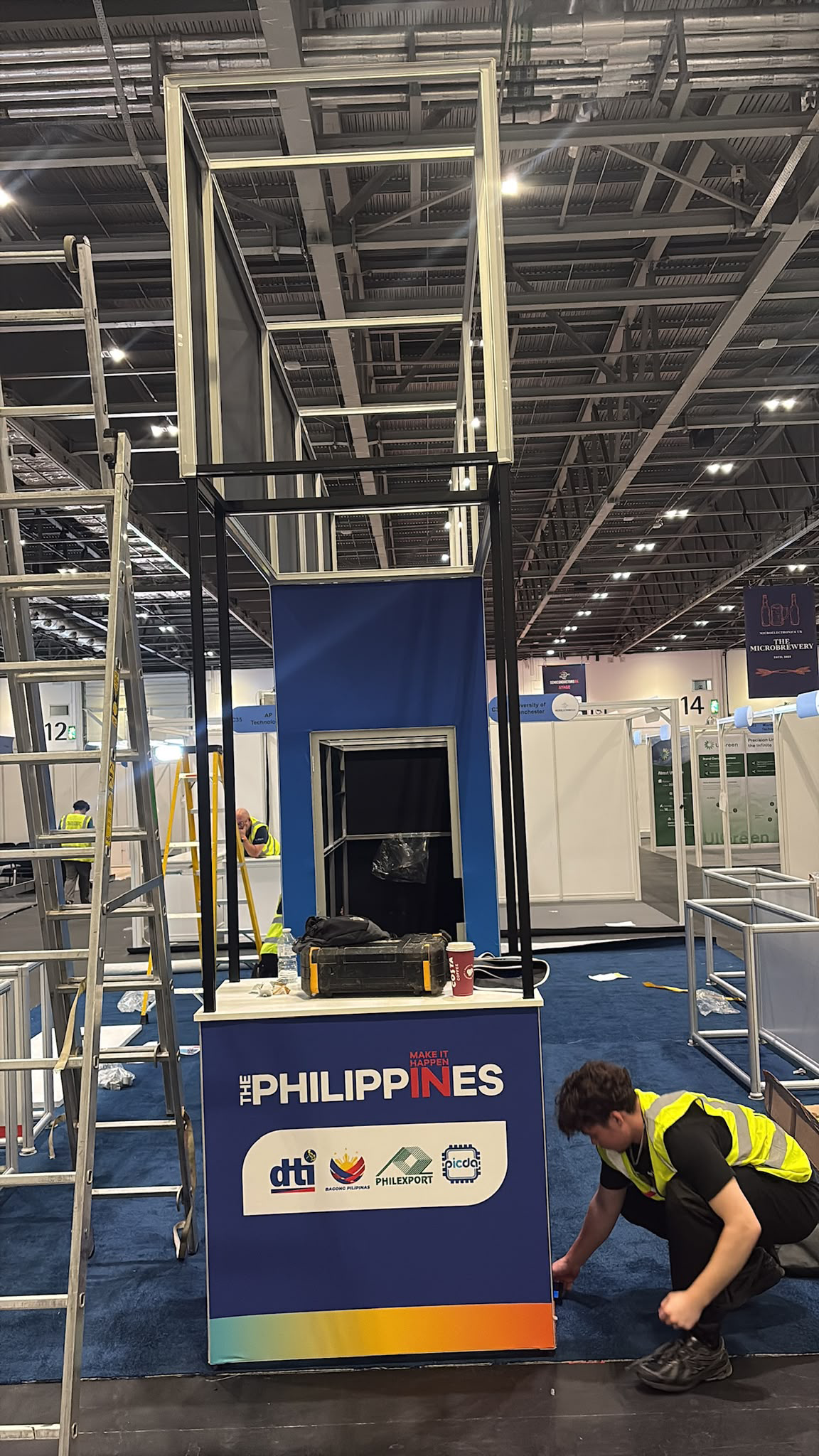
The same wall seen side-on during installation. The extra bracing went into the top section. Photo courtesy of T3 Systems.
It was a small price. What stayed with me was how little the signed paperwork had to do with it. That is the thing about exhibiting abroad: you sign first and read later, and what you signed is rarely the last word.
You sign first, you read later
There is a line on almost every European registration form that gets less attention than the stand number. It says that by signing, you accept the technical guidelines. Not the guidelines you have read, but the ones that arrive later as a PDF.
ISPO’s German participation terms say it outright: the technical guidelines are legally binding as soon as an application has been submitted. Other German organizers word it differently, but the pattern is the same.
Nine venues, one template, and an asterisk
Messe Düsseldorf’s guidelines state that they were written to match those of eight other German venue companies: Hannover, Leipzig, Berlin, Frankfurt, Munich, Cologne, Nuremberg and Stuttgart. Learn the structure once and you can find your way around any of them.
The asterisk comes in the next sentence. Building law in Germany belongs to the individual state, so, in the guidelines’ own words, the regulations will differ from site to site. You have learned the outline. You have not learned the answers.
My favourite detail is that “stand construction” does not mean a structure under the German Building Code. Legally, a trade fair stand is furnishings inside a place of assembly. Your stand is furniture. It is a temporary fitting in a hall full of people, and the rules read accordingly.
The English is a courtesy
Almost every set of German guidelines carries the same small line near the front: the German text is binding. Düsseldorf says it. Cologne says it. Frankfurt says it. The Swiss venue Olma Messen St. Gallen adds that the original German is the definitive, legally binding version. The English you are reading is a service to you. It is not the contract.
In practice this rarely matters, until the one day it does. If a clause governs something expensive to get wrong, such as a plan approval or a height limit, ask the venue to confirm in writing what the German says. It is a two-line email, and far cheaper than a conversation on build-up day.
In America, it is your wallet
The American equivalent is the exhibitor service manual, and it works differently. Nobody is bound to the manual as such. You simply pay for ignoring it.
A recent US exhibitor manual promises savings of as much as 35 percent on show services for forms returned before the deadline. One US exhibit house puts the penalty for missing the first cutoff at between 30 and 50 percent.
The right to bring your own people is in there too, with a date attached. At PACK EXPO International, the deadline for registering an exhibitor-appointed contractor was the same as the services discount deadline. I keep a running list of the other items that catch people out.
So on one side of the Atlantic the manual is a price list with a clock on it. On the other it is a rulebook with a signature already on it.
And it is never the whole document
Messe München states that it may impose requirements beyond those in its guidelines. Messe Frankfurt reserves the right to issue further safety regulations at any time. Düsseldorf says the circulars sent after stand allocation form part of the conditions of participation. Which is the bracing story, in writing. The PDF you filed in January is not necessarily the last word by June.
Check the version date on the front. Düsseldorf’s current guidelines are marked as valid from 1 January 2026 and dated September 2025. Then check your inbox for anything that arrived since.
Hand it to whoever builds
The organisers of the IAA transport show expect the exhibitor to forward the stand confirmation, the technical guidelines, the exhibition conditions and the service offers to every partner planning and building the stand. It sounds obvious, and it is the step most often skipped, because the person who signed the form and the person who builds the stand are rarely the same person.
It matters more if you build modular, because the same stand will meet different guidelines at every venue. A system designed to be rebuilt in different halls is only as portable as your reading of each hall’s rules.
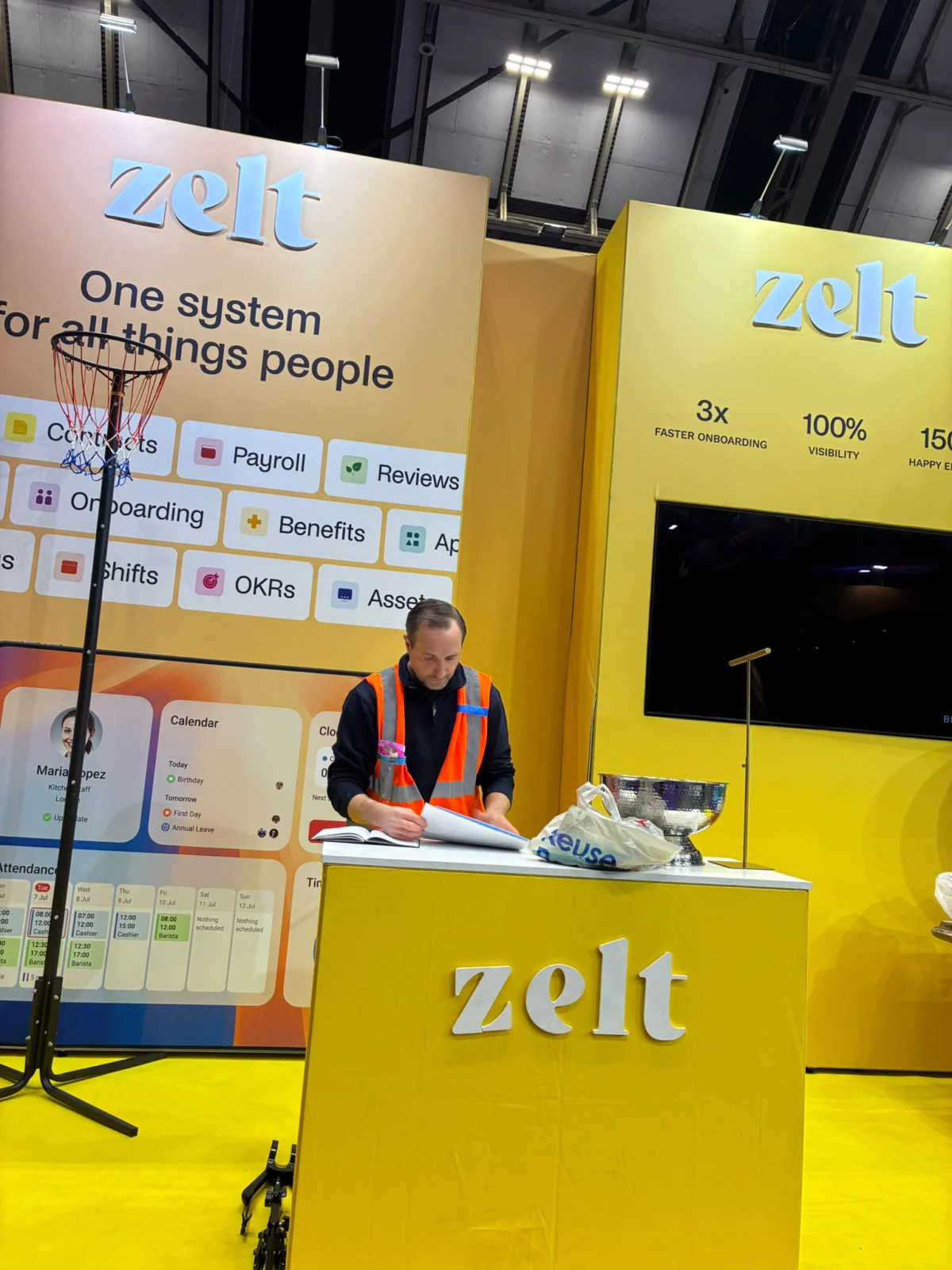
Checking the drawings on site. Whoever builds the stand needs the manual, not just whoever signed the form. Photo courtesy of T3 Systems.
What it comes down to
In America, ignoring the manual costs you money. In Europe, you have already signed it. Either way, read the document itself, not the summary on a slide.
And when somebody with a clipboard asks for one more brace, be ready to say yes.
Next month, in fairness, a look at the different words each side of the Atlantic uses for the same exhibition terms, including a few graphics mismatches that are very much worth knowing before your artwork goes to print.
Philippe van Ameyde is Managing Director of T3 Systems, a British-French manufacturer of modular, reusable exhibition stands founded in 1981, with two Queen’s Awards for Enterprise and more than 25,000 stands delivered in over 40 countries. He has 15 years of experience designing, building and contracting stands in Europe and North America.
Read more at t3systems.com/exhibition-stands-europe.
Related stories