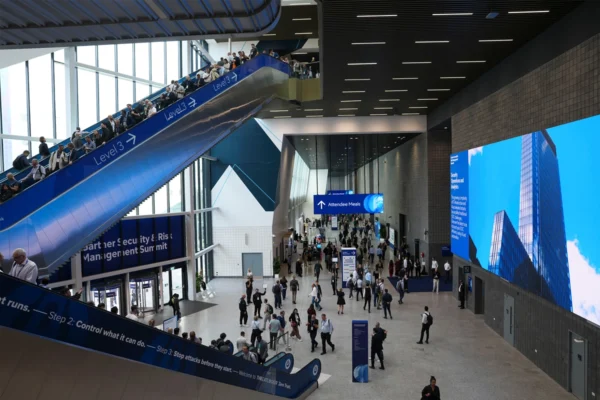




A European exhibitor walks onto an American show floor on move-in morning, picks up a case to carry it to his booth, and a man he has never met, very politely, asks him to put it down.
He is not being difficult. The case is, for the moment, his job. On an American show floor, in the union cities especially, who is allowed to touch what is not a suggestion. It is the structure the whole day is built on.
I have written these last two months about what catches Americans out in Europe. In fairness, I owe the other side of the ledger, most of which I have either done myself or watched a client do at close range.
Drayage is real
I said last month that drayage does not exist in Europe. What I did not say is how genuinely shocked Europeans are when they meet it.
Your freight does not arrive at your booth. It arrives at the venue or a marshalling yard, and from there it is moved, stored and returned by the official contractor, charged by weight with a minimum. It does not matter that your stand is twelve feet away. You will not be carrying it, and that is the point.
Europeans assume this is a racket. It is not. An American show can run to two thousand exhibitors moving in through a finite number of dock doors, and without a single system deciding what moves when, the whole thing seizes. Budget for it as a real and significant line, in advance. It is not a fee they forgot to mention. It is the fee. For anyone pricing a first show, I keep a plain-English guide to what a stand actually costs for a European stand.

Who touches what
This is the big one, and it is where European instincts do the most damage.
In much of the United States, especially the union cities, there are defined boundaries around who does what on the floor: one group for the build, another for electrical, another for anything hung from the ceiling. The lines vary by city, by hall and sometimes by year. You do not need to recite them. You need to know they exist and ask what they are before you touch anything.
Let me tell you what happens when you do not. A European exhibitor on a small booth connected his own spotlights, the sort of thing you would do without a second thought in Cologne. It fell inside the electrical union’s jurisdiction, and the response was not a warning. The stand was blacked out, powerless in front of the aisle, on a floor about to open. The lights had to come down and be reinstalled by the people whose work it was. It cost thousands, and it cost them the morning.
The maddening part is that the line is hard to read from the outside. On another occasion I have seen a single union member assigned to a stand, entirely content to let our team crack on around him, his presence alone being what the rule required. Same country, same broad system, a completely different day. One booth blacked out over a spotlight, another where a handshake and a bit of respect was the whole of the requirement.
That is the real difficulty. It is not that the rules are harsh. It is that you cannot always tell in advance which version of the day you will get, and the cost of guessing wrong is your stand. So ask first, in writing, before anyone picks up a drill. It feels absurdly cautious. It is far cheaper than the alternative.
No shell to build onto
One practical point that catches Europeans on smaller stands. In Europe, book a modest booth around twelve feet and you can assume a rigid shell is waiting: an Octanorm or Sodem structure, aluminium walls solid enough to attach to. You design to clamp onto walls that are already there.
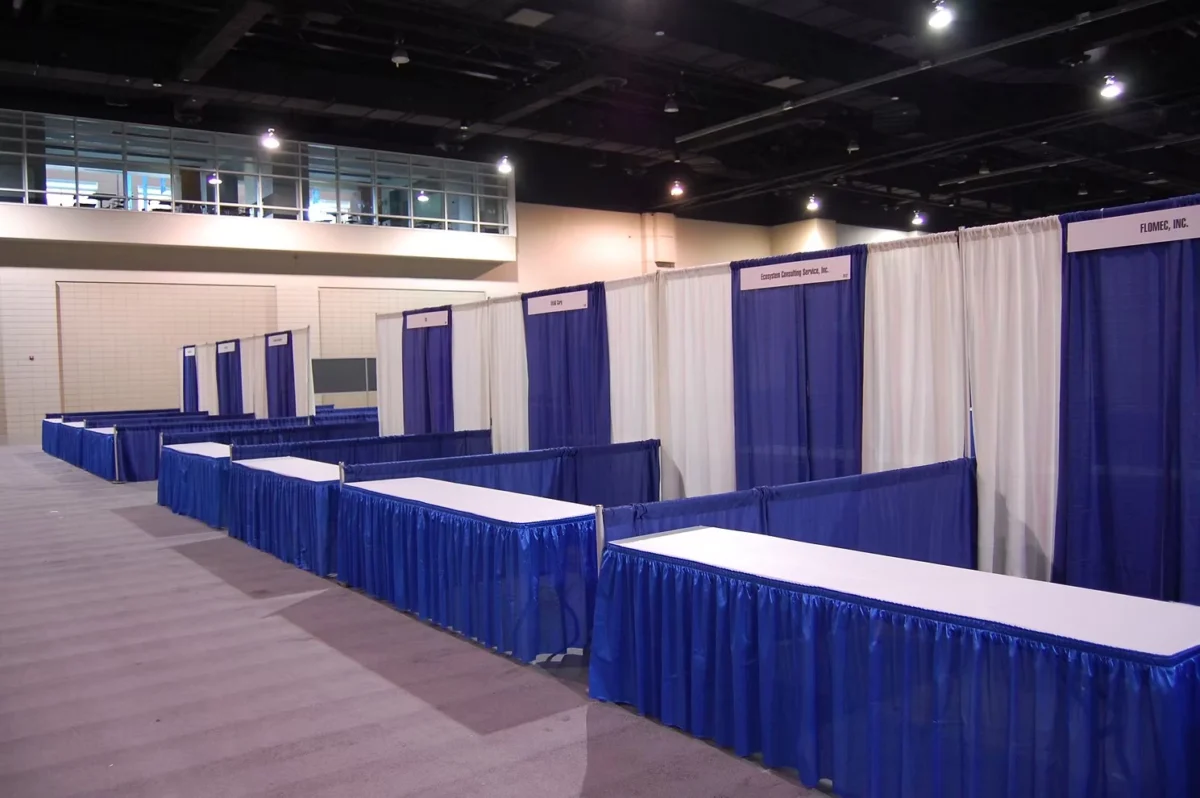
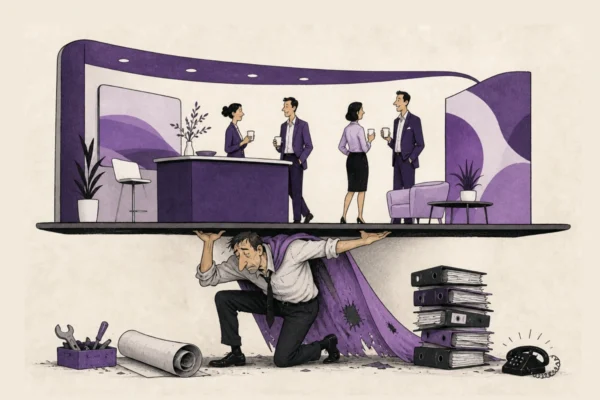
In the United States those walls are usually not there. A smaller booth is far more likely to be pipe and drape: fabric on poles, with low draped walling between stalls. It is not rigid, it will not take weight, and there is nothing to fix your graphics to. A European stand designed to hang off a shell arrives to find nothing to hang off, and everything must suddenly be freestanding. Solve that at the drawing stage. Before you design a small American booth, ask the question you would never ask at home: is there a wall, or is it a curtain?
The upside
Europeans arrive braced for cost and bureaucracy and forget to expect competence. American shows are superbly organised. The general service contractor model Europeans grumble about the price of also means one clear point of responsibility: when something goes wrong at eleven at night, there is a desk to go to and a person whose job it is to fix it. I have had smoother move-ins in American halls than in some European ones, because everyone knows their lane.
Plan for the scale, too. Stands are bigger and lighting bolder, and a design that reads as confident in Cologne can read as timid in Las Vegas. Turn yours up.
What it comes down to
The mistake runs both ways. Europeans think America is Europe with worse costs. Americans think Europe is America with fewer rules. Both find out on the morning of the build, which is the most expensive morning to find anything out.
So if you are European and America-bound: budget for drayage as a certainty, check whether your small booth has real walls or just curtains, and ask who is permitted to do what before you touch a thing.
And when a very polite man asks you to put the box down, put the box down. It is his job, not yours. Enjoy the rare luxury of watching someone else carry it.
Philippe van Ameyde is managing director of T3 Systems, a British-French maker of modular, reusable exhibition stands. He has spent 15 years designing, building, and contracting stands across Europe and North America. For more info, visit t3systems.com.