



How does one measure the success of an event?
New Orleans held two world’s fairs, 100 years apart. Each lost money. In the first one, the fair director resigned prior to the close of the show and was later indicted for embezzling over a million dollars. The second fair declared bankruptcy during the run of the show, having the distinction of being the only fair in history to do so. Both New Orleans’ Fairs were dismissed as failures but financials alone do not tell the entire story.
The World’s Industrial Cotton Centennial Exposition New Orleans, 1884
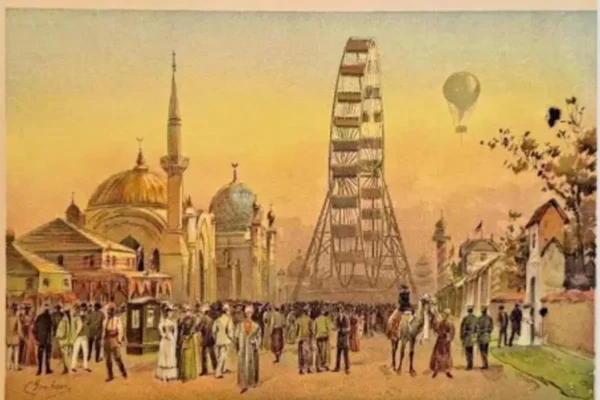
New Orleans’ business leaders wanted to commemorate the 100th anniversary of the first cotton shipment from the U.S. with a celebration. The National Cotton Planners Association proposed the idea in 1882, and it would be the third southern city to host a world’s fair. Like their predecessors, New Orleans hoped to show northern investors that the south was ripe for investment. They believed that by bringing cotton farmers and manufacturers together, the local economy would benefit.
The Exposition opened December 16, 1884. Four miles from the downtown area, and stretching from the mighty Mississippi to Saint Charles Avenue, the fair covered 247 acres of plantation land. Rain delayed construction, requiring additional crews and overtime work. The fair opened two weeks late. President Chester Arthur, in residence at the White House, launched the event via telegraph, signaling a Corlis steam engine to power the machines at the fair.

The main building, with 1,656,000 square feet of interior exhibit space, covered 33 acres of land. It was larger than many current convention centers, and three times the size of the Louisiana Superdome. Electricity was a focus of this fair and the main hall was lit with 10 times the amount of light in all of New Orleans. In addition to electric lights, there were locomotives, steam engines, and the original Liberty Bell. The Music Hall housed a giant organ and could seat 11,000 people. The observation hall offered electric elevators, and experimental electric street cars shuttled visitors around the fairgrounds. The smaller Horticultural Hall was modeled after London’s Crystal Palace, and remained on the grounds until it was destroyed by a hurricane in 1950.
Other main buildings included: a Government and States Building, the Women’s Department, and the Mexican Mining Pavilion. Fair organizers projected attendance at five million people, but only 1.16 million paid to visit. The fair lost $470,000.
One of the more interesting characters from this fair was “the Major,” a former Confederate officer who allegedly absconded with $1.7 million of Louisiana’s money. Edward A Burke, the owner and editor of the New Orleans Times Democrat, was the state treasurer, and fair director. Burke expanded the fair from the planned national event into an international one. He successfully politicked Congress and solicited a loan of $1 million dollars. He recruited Central American countries to exhibit. Burke resigned as director in May of 1885, and the fair closed prematurely on June 1. Burke lost his reelection bid for state treasurer in 1888 and available funds in the treasury were later found to be missing. Burke was out of the country in London at the time of his indictment. He denied any wrongdoing and never returned to New Orleans, living the remainder of his life in Honduras.
After the fair, cotton exports to Mexico and Central America increased significantly, and the city’s port gained renewed prominence. The fairgrounds transformed into the Olmstead-designed Audubon Park, and Victorian homes and people began populating St Charles Avenue. Despite these benefits, the next world’s fair in the state would not occur for another one hundred years.
The Louisiana World Exposition New Orleans, 1984
Before the Fair
Between 1970 and 1985, the U.S. economy endured four separate recessions. Price for a gallon of gas rose from a national average of $0.33 in 1970 to $0.57 in 1975 and increased to $1.19 per gallon by the summer of 1980 (equivalent to about $4.77 today). The oil crisis of the mid-seventies resulted in long lines at gas pumps and devastated New Orleans’ oil and gas-based economy. Politicians and business leaders sought new ways to improve the local economy and agreed to focus on tourism.
Mardi Gras attracted crowds, but that was only for one to two months out of the year. The Jazz Festival was beginning to attract two hundred thousand fans, but that was only for one week in April. Conventions brought some people and business to the city, but numbers paled in relation to Chicago and Las Vegas. The Rivergate Convention Center opened in 1968 with 130,000 square feet of exhibit space and the Superdome opened in 1975 adding a potential 165,000 square feet of exhibit space; however, both venues combined were smaller than Atlanta’s GWCC which opened in 1976.
The city leaders noticed what other cities had done to entice money-spending visitors. They had watched Seattle, San Antonio, and Spokane attract a combined 20 million people with world’s fairs. They knew Spokane had made a profit of $47 million from the 1974 fair. They decided to host a similar event. They would showcase New Orleans as an international city and entertain millions from around the world. The theme would be: “The World of Rivers: Fresh Water as a Source of Life.”
New Orleans knew how to throw a party. There would be bands, balloons, floats, fireworks, parades, booze and people. There would be flags, fountains, fun, excitement, music, and memories. There would be food: oysters, gumbo, crawfish, jambalaya, mango freezes, Frito pies, Belgian waffles, and of course, a variety of fresh seafood. There would be a German beer garden and specialty alcohol-infused, fair-inspired drinks like “the hand grenade” and “tropical isle.” A riverside building would house displays from 90 nations. There would be plenty to see and to do: the Space Shuttle, an Aquarium, a working oil rig, a water ride, a monorail, a Ferris wheel, a gondola, an aquacade, a kids’ amphitheater, a giant pumping heart. There was a “Great Hall” with 580,000 square feet of exhibit space and “The Wonderwall.”
It sounded great. Unfortunately, the timing was bad. Two years earlier, Knoxville (only 600 miles away) hosted a fair that drew eleven million people. Disney opened EPCOT, a sort of permanent world’s fair, in October 1982. Los Angeles hosted the Summer Olympics the same year as the ‘84 fair. Money was tight and discretionary spending was limited. The fair Committee anticipated attendance of 12 million people. Only 7.3 million walked through the turnstiles—and that number included season ticket holders who returned multiple times.
After the Fair
“Failed Fair Gives New Orleans a Panful Hangover” proclaimed a New York Times headline 12 days after the fair ended. The bottom line: the 1984 New Orleans World’s Fair lost $121 million.
The fair did lose money, but that did not tell the whole story. The fair created an estimated eight to 10 thousand new jobs. 10 new hotels, and at least 6,000 hotel rooms were added to the downtown area. $7.1 million was spent on sidewalk and road improvements in the French Quarter (this amount does not include infrastructure repairs around the fairgrounds). Visitors to the fair spent money. If every visitor spent $20.00 (and out of towners spent considerably more) the total would be greater than the loss of $120 million. The fair transformed the warehouse district from a dilapidated industrial district to a thriving commercial and residential area. The first French Quarter Festival (a direct result of the fair planning) opened one month before the fair and today generates about $300 million in economic impact.
The fair transformed the New Orleans riverfront experience in 1984 and continues to do so today. It was an investment in the future that reaped amazing results including condos and businesses in the warehouse district, a cruise ship terminal, and the Fulton Street pedestrian mall. However, the two biggest impacts were the Riverwalk New Orleans (Riverwalk) and the New Orleans Ernest N. Morial Convention Center (NOENMCC).
The original Riverwalk opened in 1986 with 130 retail spaces, generating an estimated $60 million in annual sales. It transformed the riverfront into a tourist attraction, and stimulated investments in the area. In 2014, the (new) outlet collection at Riverwalk supported over 1,000 local jobs and contributed $1.5 billion in retail sales.
Two months after the close of the fair, the “Great Hall” opened as the New Orleans Convention Center. The first show was Heli-Expo 1985, and it would be followed by another 27 events that year. In 1992, the building was named after Ernest “Dutch” Morial, the mayor of New Orleans from 1978—1986, and an early and vocal proponent for the center. The convention business is a dynamic economic engine in New Orleans. It supports 24,000 jobs annually, and contributes over $138 million in tax revenue.
Did the world’s fair make a difference? Consider the total effect of the convention center during the past 40 years, from 1984 to 2024:
- Nearly 2,000 major events
- 12.8 million attendees
- Direct spending of $532.6 million
- Over $90 billion in total economic impact
History is the ultimate judge of whether a person, or an event, ultimately succeeds or fails. The 1984 world’s fair was intended to revitalize the New Orleans economy by creating a convention center that would continue to bring business to the city.
This story originally appeared in the Q3 2026 issue of Exhibit City News, with the original magazine layout available here.