



I asked 15 people in one company to tell me how work flows through their business. Two of them even attempted an answer.
I was there to confirm the owner was ready to sell. He wasn’t.
Not because the company was failing. It was doing well—good revenue, good clients, a team that clearly cared. But when I went looking for how the place actually ran, there was nothing to find. The process lived differently inside each person’s head. “Truth” was spread across the project software, three separate document vaults, a library of recorded calls, and a hundred habits nobody had ever written down. Nothing is codified. Nothing is systematized. The company ran, and ran well, entirely on people who each held their own private version of how things get done.
The owner saw a team of committed experts. That’s what it feels like from the inside.
A buyer sees risk. And buyers price risk. It shows up as a lower multiple, a bigger earnout, and a longer leash tying the owner to the business for years after the deal closes. The payout he spent two decades earning starts to look less like a check and more like a new job with a countdown clock.
Here’s why this matters even if you never plan to sell. A buyer’s diligence is only asking, early and out loud, the question your own growth will eventually force anyway: can this business run without the heroes?
The heroes
You know the ones. Every company in this business has them. They are the person who, the Thursday before move-in, reroutes the freight that hit the wrong dock, fixes the labor call that fell through in a second city, and somehow opens the show clean on Monday. They are the one who holds the context in her head, knows which vendor will actually answer at 6 a.m., and catches the mistake before the client does.
Monday night you tell her she saved the show. You mean it. And after a season like that, most owners say the same thing: “I need more people like her.”
You don’t and that’s not the real problem.
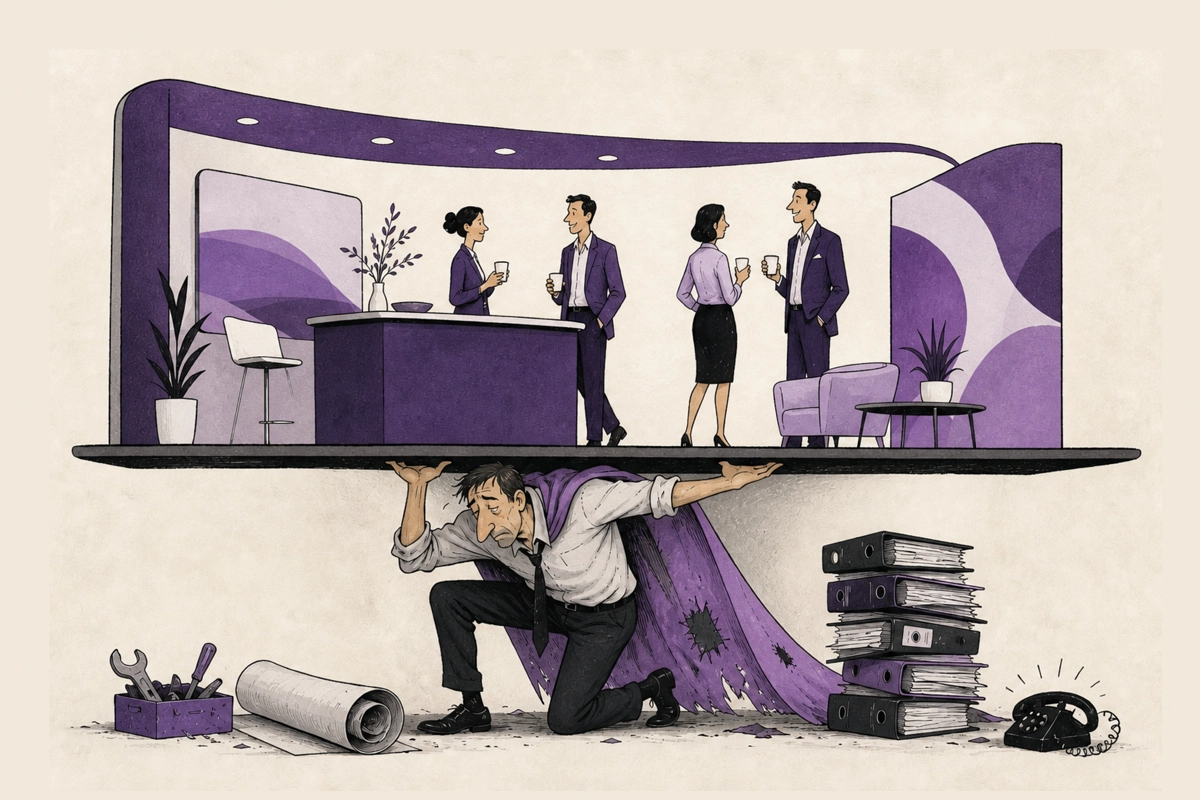
The real problem is that your entire busy season depends on a handful of people being exceptional at the exact moment everything goes wrong. That feels like strength. In my experience, it’s a design gap wearing a cape.
Call it what it is: heroics. Heroics are what a company runs on when it doesn’t have a system yet.
At $8M or $10M, that’s fine. It’s more than fine—it’s how you win. One or two people can hold the whole operation because it’s small enough to fit inside their heads. Fast decisions. No handoffs. No documentation, because the person who needs to know already knows.
Then you grow—more shows, more markets, more crews, more service lines —and you keep running the bigger company the way you ran the small one. On heroics. In time it’s more of them, from more tired people, across more moving parts. Nobody decides to do this. You just feel the season getting heavier every year, and you assume you need better people. What actually happened is that the way work gets done stopped scaling a while ago, and you’ve been covering the gap with adrenaline.
The vise is getting tighter, too. Demand has come all the way back—B2B exhibitions run above pre-pandemic levels and still take the largest share of most companies’ marketing budgets. The labor to deliver it hasn’t kept up. In the Event Industry Council’s 2025 staffing outlook, 89 percent of event professionals said staffing shortages hurt their ability to deliver events. The turnover rate for hourly employees in this business runs near 63 percent a year. The work is there. The people to do it aren’t. And the ones you have keep leaving.
What it costs before anyone tries to buy you
Heroics don’t show up as a line item. That’s what makes them dangerous.
They hide the real cost of the work. When your best person absorbs a broken labor call by working the problem for two hours, that time never gets priced, never gets tracked, never shows up in the job margin. The show looks profitable. It wasn’t. You paid for the fix out of a person instead of out of the profit and loss (P&L). Multiply that across a season and margin leaks in a place your accounting will never find, because the cost was paid in effort, not dollars.
And they burn out exactly the people you can’t replace. The reward for saving the show is that you get handed the next crisis. Your best people do the math on another year of being the reason it didn’t fall apart, and they leave—often to a competitor, sometimes to a client. They leave with the context. All of it. The vendor relationships, the workarounds, the thousand small judgments that lived in one person’s head and now walk out the door.
That’s the same thing the buyer saw. The company’s value was sitting inside people who could quit. The only difference is that the buyer put a number on it and you haven’t.
Well, you might be right that your best people are exceptional and you’re lucky to have them. But when the whole build depends on one person being exceptional, you don’t have a talent advantage. You have a single point of failure you’re actively exhausting.
Why this industry keeps doing it
The tradeshow and event world rewards heroics more than almost any business I know. The deadlines are immovable. Everyone sees the booth, and nobody sees the process behind it. The culture runs on war stories. We celebrate the save. We promote the firefighter. This means the behavior quietly capping your company is also the behavior you keep rewarding. The person who builds a calm, boring, repeatable process gets less applause than the one who pulls off a miracle. Guess which one your ambitious people learn to become.
The fix is one thing, not ten
The company has to exist somewhere other than inside your people.
That’s the whole fix. Not a new platform. Not another vault. The operation—how work flows, who owns what, what happens when the freight goes sideways—has to live in something the company owns, so it survives any one person leaving, getting sick, or burning out.
With the company I opened with, we didn’t start with software. We started with four questions.
What roles do we actually have? What is each one for, and how will we measure whether it’s working? How does work really flow through the business, and how should it? And what decisions can each person make on their own to do their job and keep the work moving?
That’s the foundation. Answer those honestly and you have a company that exists outside the people running it. Skip them and buy another tool, and all you’ve done is build a fifth place the truth gets stored.
None of this requires a six-month project. It requires deciding that the way your best people do the work is company property, not personal knowledge—and then writing it down while they’re still here to tell you. The install sequence when the schedule compresses. The client who has to be called before a change, not after. The vendor who bails you out every time. Get it into the open before the season, or the market, takes those people somewhere else.
You built something real. The season proves it every year. But there’s a difference between a company that performs under pressure and one that only exists under pressure—and you usually can’t tell which you have until the two people holding it together aren’t in the room.
So before the next season, or the next buyer, asks it for you: if your two best people didn’t show up, would you have a capacity problem—or would you have no company?
If you want to find the answer before the season finds it for you, that’s the work I do with owners: getting the business out of people’s heads and into something you actually own.
This story originally appeared in the Q4 2025 issue of Exhibit City News, p. 20. For original layout, see Print Version
Related stories
That Voice in Your Head Will Either Save You or Sabotage You
What McKinsey’s Cuts Should Tell Every Exhibit and Event Leader