



Artificial intelligence, rising costs, new rules, labor needs, and the demand for real human connection are changing the tradeshow industry.
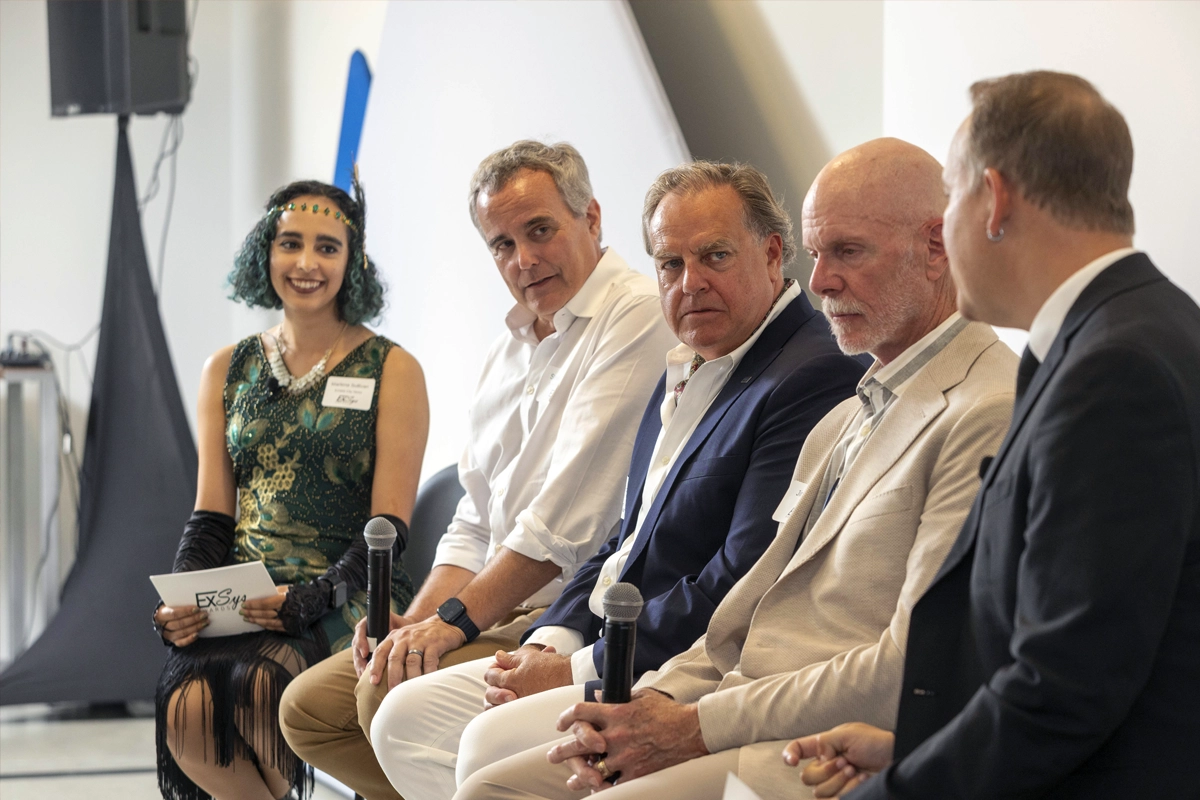
Those forces framed “Forecasting the Future,” a July 28 panel presented during the 2026 ExSys Awards at Moss Inc. headquarters in Franklin Park, Illinois. Exhibit City News (ECN) Editor Marlena Sullivan and The Experiential Design Authority (TEDA) Executive Director Travis Stanton moderated the discussion.
The panel brought together Exhibitor Appointed Contractor Association (EACA) Executive Director Jim Wurm, Steve Riches of the International Federation of Exhibition and Event Services (IFES) and Laguna Displays, and Steve Deckel, chief executive officer of Deckel & Moneypenny.
Wendi Jacobs of Acer Exhibits & Events was scheduled to take part but could not attend because of weather and flight problems. She had submitted written answers before the event, and those comments remain part of the reporting. Deckel stepped in for Jacobs during the live panel and submitted written answers after the event.
Together, the panelists described an industry facing new technology, higher costs, rule changes, workforce pressure, and changing client needs.
AI Is Already Here
Jacobs says artificial intelligence (AI) is already changing marketing and communications. She expects the technology to keep growing, and she believes new laws and consumer protections may follow.
She predicts more false advertising class-action lawsuits tied to AI campaigns. In her view, those cases could lead to stronger rules for marketers. Her larger concern, however, is trust.
The amount of low-quality AI content has made Jacobs question what she sees online. Consumers may feel the same way. As a result, marketers may have to work harder to prove that their messages are true.
Tradeshows may benefit from that doubt. At a face-to-face event, buyers can meet company staff, see products, ask questions, and judge claims in person. That direct contact can offer a level of trust that online campaigns may not provide.
AI Can Find the Right Moment
AI can also help marketers find sales leads and improve timing.
Jacobs described a company that uses an AI tool to review show floor plans. The tool spots booth size changes and new exhibitors from one year to the next. It then contacts those exhibitors with an AI-generated booth image and an offer for fabrication services.
“The timing on that messaging is brilliant,” Jacobs says in her written response.
Deckel is less certain that AI rules will come quickly in the United States. In his post-event answers, he says political and financial pressure against regulation may make new rules hard to pass without a major public push.
He is more concerned about creative quality. Deckel says the experiential industry should create original and meaningful spaces, while AI often uses past ideas and patterns to predict what should come next.
Some clients may accept that work. Others will still want original thinking and skilled creative teams.
Great Image, Bad Booth
AI-generated booth concepts can create problems for designers and builders. Clients can make polished booth images without knowing structural limits, show rules, or venue needs. A concept may look impressive on a screen but be impossible to build.
Jacobs says AI works better with two-dimensional images than with real three-dimensional exhibit design. Generated concepts may include ceilings, walls, lighting, or other features that are not allowed in a booth.
Clients may also leave International Association of Exhibitions and Events (IAEE) guidelines and show rules out of the prompt. Designers must then explain why the booth cannot be built as shown.
Deckel raises a similar concern. A single event may have rules from the state, city, convention center, general contractor, and show organizer.
He compares the problem to asking when someone can buy alcohol on a Sunday. The answer depends on the place and the local rules. Deckel says an effective AI prompt would need to account for every layer of rules tied to the event.
Even then, the result may still be unoriginal or fail to meet one or more requirements. Jacobs says AI can spark ideas and help teams explore new concepts, but skilled professionals must turn those ideas into safe and legal spaces that work on the show floor.
Budgets Blink First
Cost pressure appears across the panelists’ answers.
Riches says international exhibiting costs are rising faster than many client budgets. Foreign exhibitors entering the United States often face higher costs than they see in other markets. Those expenses may lead companies to reduce booth size, bring fewer staff members, or skip a show.
Tariffs have also made it harder for some international companies to sell products in the United States, Riches says. Some foreign exhibitors have pulled out of U.S. shows as a result.
Jacobs sees similar pressure among U.S. exhibitors. Companies are shrinking booth footprints, cutting exhibit features, and finding new ways to manage expenses. She shared one example of a client who moved exhibit freight costs from the marketing budget to the logistics budget.
Wurm says the rising cost of show participation is pushing more companies to consider private events. Businesses are looking for more value from their event spending.
Many industries still use events to attract prospects, collect leads, and build relationships. However, the cost of joining a large show may make that choice less appealing for some companies.
Big Attendance, Small Answers
Exhibitors are also asking for better data.
Jacobs says total attendance does not show whether an event brought the right audience. Exhibitors need to know how many attendees fit their target group and how many of those people reached the booth.
A show may attract 50,000 attendees, but that number offers little value without details about job roles, buying power, interests, and behavior. Large events can make those questions harder to answer.
When thousands of exhibitors are spread across many product groups, a company may not know how many qualified buyers had a real chance to visit its booth.
Jacobs wonders whether the industry will see more small and focused tradeshows. She also expects user conferences and brand events to keep growing.
These formats may serve a more defined audience and make it easier for exhibitors to judge results. Organizers still need to improve how they collect and share data.
Without better information, exhibitors may struggle to make a clear return on investment (ROI) decision. The issue is not only how many people attended. The more useful question is whether the right people attended and took action.
Less URL, More IRL
Deckel also sees an opening for in-person events.
He says trust in mass media, digital media, and social platforms is falling as people see more fake images, audio, and video. Some influencers are also reporting lower income.
That shift may help trade publications, corporate events, sports events, and tradeshows because they can still bring clear audiences together. Deckel describes the current climate for face-to-face experiences as one of the strongest he has seen.
“Less URL, more IRL,” Deckel says, using the abbreviation for “in real life.”
Think Global, Build Local
International projects bring another set of problems.
Riches says IFES members should plan early for delays tied to travel rules, visas, and transportation. The group also encourages members outside the United States to work with local partners for fabrication and installation and dismantle (I&D) services.
A trusted local partner can help prevent delays and may also help keep a project on schedule and within budget.
Riches says IFES works with the Exhibitions and Conferences Alliance (ECA) in the United States. The group also partners with the European Exhibition Industry Alliance (EEIA) in Europe.
These ties help IFES track policy issues in different markets and support companies working across several legal and political systems.
More Data on Materials
Riches says European rules may affect the information exhibit builders are asked to provide.
Under the European Union’s (EU) Corporate Sustainability Reporting Directive, some larger companies must report environmental and social effects more clearly. As a result, clients may ask exhibit builders for better data on materials, reuse, waste, carbon, transportation, and supplier practices.
The EU Packaging and Packaging Waste Regulation entered into force in 2025 and applies beginning Aug. 12, 2026. The rule aims to reduce packaging waste and improve how packaging is made, recycled, reused, and managed.
For the exhibition industry, it may affect how materials are packed, moved, protected, reused, and thrown away.
The EU Deforestation Regulation applies to large and medium-sized operators beginning Dec. 30, 2026. Most micro and small operators follow on June 30, 2027.
The rule covers certain goods, including timber and some wood-based products. Riches says records for plywood, medium-density fiberboard, timber, flooring, furniture, and other wood-based parts will become more important.
Europe is also moving toward closer review of environmental claims. Companies may face more questions when using terms such as “sustainable,” “eco-friendly,” or “climate neutral” without proof.
Riches says standard rules do not mean every country, organizer, venue, or service provider must work in the same way. Instead, shared rules create a common language that helps markets work together.
A Federal Plan with Local Effects
Wurm is watching a proposed federal rule released by the U.S. Office of Management and Budget (OMB) on May 29.
The proposal would change federal financial assistance rules, including how conference attendance and related costs are handled. Under the proposal, conference attendance costs would be allowed only when the federal agency clearly approves them and includes them in the award terms.
The proposal would also stop recipients and subrecipients from using federal awards to pay venues for certain services. Those services include security, crowd control, facility access, logistics, and safety support.
ECA President and CEO Tommy Goodwin has warned that the proposal could create problems for venues and conference attendees.
“The OMB wants to make wholesale changes to the regulations governing grants made by federal agencies for medical research, transportation, cybersecurity, public health and more,” Goodwin says.
Limits on grant-funded attendance could stop researchers from sharing findings and meeting partners, he says. The rules could also affect workforce development groups and state and local governments that use events to find training, workers, and new tools.
Those concerns reflect ECA’s reading of the proposed rule. The proposal had not been finalized when the panelists submitted their written answers.
Fees on Repeat
Wurm is also watching exhibitor-appointed contractor (EAC) fees.
Some organizers and general service contractors charge EAC fees that go beyond the cost of registering and approving a contractor, he says. EACA accepts that organizers face costs when reviewing insurance forms, checking qualifications, and enforcing show rules.
However, the group questions why the same contractor may be charged several fees during one event.
Sales tax remains another concern. Labor contractors must watch states that charge sales tax on products and services delivered at show sites, Wurm says.
EACA reviews those rules so members can avoid penalties.
Crews Need More Than Tools
The labor market is changing.
Wurm says workers will still need to read blueprints, plan work, lead crews, and serve clients. They may also need to use those skills at private events and move between several venues in the same city.
EAC companies may carry much of the burden for leadership and team training, he says. Union programs may cover blueprints and tools, but they do not always teach management skills.
Builders and designers also need a clearer view of show floor access rules. Shop supervisors may arrive onsite believing they do not need EAC credentials because they are only supervising, Wurm says.
A person entering the show floor during move-in may still need to provide insurance papers and follow EAC rules. Organizers want anyone entering an active construction area to be covered for injury, property damage, and damage to the building.
The issue is both legal and practical. A worker or supervisor who enters the floor becomes part of the move-in process and must follow the same safety rules as others in that space.
Connecting Students and Employers
The panel also addressed hiring and working with students.
In response to an audience question, Deckel recommended connecting with universities through the Experiential Designers and Producers Association (EDPA). He says EDPA can help companies find the right contacts and schools.
Deckel serves as an EDPA vice president and holds a Certified Trade Show Marketer (CTSM) designation.
His advice points to a wider need in the industry. Companies looking for new talent may need to build stronger ties with colleges, teachers, and student programs before they begin hiring.
One System, Many Footprints
Sustainability and modular design will continue shaping exhibits, Jacobs says.
System-based exhibits can allow one set of parts to support several booth sizes. That flexibility may help exhibitors cut waste, control costs, and change their programs without building a new exhibit for every event.
Jacobs also sees continued interest in greenery, built-in lighting, digital features, creative hanging signs, and inflatables.
At the same time, some exhibitors are moving away from rigged hanging signs to control costs. Towers and floor-level digital features can provide visibility without the same rigging expense.
The Human Advantage
Despite the focus on AI, rules, and costs, the written answers keep returning to relationships.
Jacobs says personal service remains central to the exhibit business. She recalled a client who could not reach the coat hooks inside an exhibit closet.
At the next show, Jacobs arranged for extensions that placed the hooks at a useful height. The change was small, but the client kept telling others about it.
That story shows the value of attention and follow-through. It also explains why referrals and third-party recommendations still matter.
Riches stresses the value of trusted international partners. Wurm focuses on onsite communication, training, and responsibility. Deckel argues that original work and strong execution will continue to separate skilled teams from automated options.
Technology can help companies find prospects, develop ideas, and process information. People still have to turn those ideas into safe, useful, and memorable experiences.
The industry may not be able to predict every change. Still, the panelists’ answers suggest that companies can prepare by building stronger relationships, improving data, managing costs, learning the rules, developing talent, and using new technology with care.